Articles Posted in DHS

11116320723_8d37fed841_z

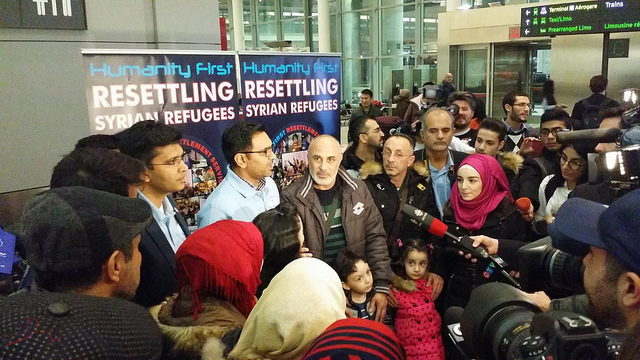
Last week, in a 289-137 vote the House of Representatives overwhelmingly voted in favor of a bill that would require a comprehensive background check to be conducted for every Syrian and Iraqi seeking refugee admission to the United States. Among its provisions, the bill, better known as the American Security Against Foreign Enemies Act of 2015 (American SAFE Act of 2015) will require supplemental certifications and background investigations to be conducted before a Syrian or Iraqi refugee can be admitted to the United States. These additional security protocols will require multiple federal government agencies to work together in order to determine whether 1) such an alien poses a threat to the national security of the United States and 2) whether it is in the public interest of the United States to admit the alien based on the findings of the security checks conducted. The bill received overwhelming support from Democrats and Republicans alike amid the recent terrorist attacks claimed by ISIS leaving 129 dead and 353 wounded in the city of Paris. Though the bill will need to pass through the Senate before it can become law, the House’s overwhelming support for the bill has blocked the President from using his veto power.

Specifically, the bill will apply only to Syrian and Iraqi nationals referred to in the bill as ‘covered aliens.’ A covered alien means any alien applying for admission to the United States who is either a) a national or resident of Iraq or Syria b) has no nationality but whose country of last habitual residence is Iraq or Syria c) has been present in Iraq or Syria at anytime on or after March 1, 2011.

Continue reading

9319698471_083278482d_zThis week USCIS and the Department of Homeland Security (DHS) announced the addition of sixteen new countries that will be eligible to participate in the H-2A and H-2B visa programs next year. Nationals from the following countries: Andorra, Belgium, Brunei, Colombia, Finland, France, Germany, Greece, Lichtenstein, Luxembourg, Malta, Monaco, San Marino, Singapore, Taiwan, and Timor-Leste will join sixty-eight other countries already participating in the H-2A and H-2B programs. Foreign nationals from these countries can apply for the H-2A and H-2B programs beginning January 18, 2016. If a country fails to meet the requirements for continued designation of these benefits, DHS reserves the right to remove any country from the list of eligibility, as it did recently with the country of Moldova and the H-2B program. Moldova may still continue to participate in the H-2A program since it has proven compliant with the necessary standards regulating the H-2A program. USCIS may consider other foreign nationals for the H-2A and H-2B programs even if their countries do not participate in these programs on a case by case basis.

Continue reading

logo-2

By Yingfei Zhou, Esq. 

Last week, attorneys Yingfei Zhou, Esq. and Marie Puertollano, Esq. from our office attended the 28th AILA California Chapter Conference on Immigration Law held in San Diego, California. Together, they brought our audiences the latest updates on various issues discussed at the government open forums.

  1. USCIS I-797C Receipt Notices or I-797B Approval Notices without I-94 attached are not accepted by DMV as Proof of Legal Residence

3285309862_e84a0f6bae_z

The December visa bulletin was recently released by the DOS on November 9, 2015. For the month of December CIS has announced that family based applicants must use the ‘date of filing’ chart to determine when their adjustment of status applications may be filed. This means that for family based preference categories, there are presently immigrant visas available and demand has not yet been met for the fiscal year. Employment based applicants must refer to the ‘final action date’ chart as a basis for applying for adjustment of status. This means that presently there is more demand than immigrant visas available for employment based categories. For the month of December, filing dates have remained unchanged. The impact of the dual chart system will not be felt until CIS requests visa numbers from the DOS in April 2016 for adjustment of status filings based on the October Visa Bulletin. In this post we will discuss new announcements that have appeared on the December visa bulletin and projections for EB-2 India, EB-2 and EB-3 China, F-2A, and F-2B. These projections are based on guidance provided by the Chief of the Visa Control and Reporting Division, Charles Oppenheim. While they do not guarantee actual immigrant visa availability, these projections are helpful reference points.

Replacement of Foreign Affairs Manual (FAM) and New Visa Waiting List

The December visa bulletin has announced that the Foreign Affairs Manual (FAM) used internally by the Department of States will be replaced with 9 FAM-e beginning November 18, 2015. Public release of the new FAM has not yet been announced.

Additionally, a ‘Visa Waiting List’ will be released beginning with the January Visa Bulletin which will provide applicants information on the National Visa Center waiting list starting November 1, 2015.

Continue reading

3209934849_5f5faed197_b
It is our pleasure to bring you the latest in immigration news including recent USCIS announcements, workload updates, tips, and important reminders to avoid delays in application processing or rejections. For more information please contact our office.

Comment Period for Proposed USCIS Form Revisions:

The Department of Homeland Security (DHS) and United States Citizenship and Immigration Services (USCIS) have proposed changes to the following USCIS forms. DHS and USCIS invite the general public, organizations, and federal agencies to submit comments on the proposed revisions by the deadlines outlined below:

Senate

On October 20, 2015 Democrats in the Senate successfully blocked the Republican backed bill S. 2146: Stop Sanctuary Policies and Protect Americans Act from moving forward with a vote of 54-45. At its core, the bill aimed to hold sanctuary jurisdictions accountable for noncompliance of federal orders including detainment of undocumented immigrants, increasing penalties for individuals caught re-entering the United States after their removal, and providing protection to state and local law enforcement officials cooperating with federal law enforcement officials. The bill was introduced by Republicans after an act of violence took the life of a San Franciscan woman at the hands of an alleged undocumented immigrant with a felony record, who had also been the subject of multiple removals. Public outcry ensued after the city sheriff released the perpetrator despite a federal immigration detainment order. According to Republicans, San Francisco is one of hundreds of sanctuary cities that refuse to comply with federal immigration orders to facilitate the detainment and removal of undocumented immigrants.

Among its provisions, the bill aimed to crackdown on so called ‘sanctuary cities’ notorious for their noncompliance by limiting government funding. By cutting necessary funding, Republicans hoped that this would force cooperation between local law enforcement officials and federal law enforcement officials including ICE officers. Republican Senator Vitter who introduced the bill, argued that the violent crime that occurred in San Francisco was just one example highlighting the magnitude of compliance concerns. According to Vitter, ‘sanctuary cities’ like San Francisco have repeatedly refused to comply with orders of detainment issued by the Department of Homeland Security. Prior to the vote, the White House had warned Senate Republicans that if the bill did pass with the 60 necessary votes, they could expect the President to veto the bill. Although the bill was criticized by Democrats for stereotyping undocumented immigrants and making sweeping allegations against the undocumented immigrant community, the bill raises serious competence and compliance concerns.

Continue reading

ellis

Photograph taken at Ellis Island

Further changes have been made to the November Visa Bulletin published earlier this month by the Department of State. The dual chart system remains in place including the ‘final action date’ chart and ‘date of filing’ chart. So what has changed? USCIS has become more involved in the application process for family-sponsored and employment-based immigrant applications since the introduction of the date of filing chart. A disclaimer has now been added to the November Visa Bulletin above the date of filing chart which instructs applicants to visit the USCIS website for more instructions on how and when the chart is to be used. USCIS has created this new web page to notify applicants whether they can proceed with applications for permanent residence based on the date of filing chart published monthly on the Visa Bulletin. The website will be updated within about a week of the publication of the Visa Bulletin every month. The webpage is intended to provide applicants information in regards to visa availability for family-sponsored and employment-based immigrant visas for each fiscal year, letting applicants know whether the filing date chart is enforceable. So far, USCIS has indicated that the filing date chart for October and November 2015 is enforceable.

Continue reading

317775677_53964625b8_z

International students seeking a STEM Optional Practical Training (OPT) extension must be aware that the Department of Homeland Security (DHS) has not yet published a replacement rule authorizing further STEM OPT extensions, this following a court decision prohibiting DHS from allowing 17 month extensions to be issued. The OPT program allows foreign students the right to seek temporary employment during or following their studies in the United States. On August 12th of this year a court decision invalidated the processing of a DHS rule allowing a 17 month STEM OPT extension program to take place, due to procedural errors. The court’s ruling will be officially enforced on February 12, 2016 in an effort to delay hardships STEM students are likely to experience, and the disruption of employment among technology companies and relevant sectors. The delay also allows DHS to present a new rule before February 12, 2016.

With time running out (4 workdays to be exact) no such rule has since been released by DHS. While DHS has not communicated any changes to international student offices, we expect that any new rulings will have no impact on the initial 12-month OPT program. Until further clarification is provided by DHS, universities are authorized to continue to produce I-20 forms for STEM extensions. In fact, most universities are continuing to accept applications for STEM extensions, regardless of DHS’ failure to publish a new rule within the given time. Students should heed with caution if they wish to file an application for extension, as they may risk forfeiting money spent on such applications. EAD cards already issued under the existing STEM program are considered valid until further notice. DHS mandated employment reports and regular attendance should continue as normal. Students should make sure to abide by the strict unemployment limits of OPT, regardless of these developments.

Continue reading

1

Last week, we reported to our readers that on September 25th the Department of State and USCIS re-issued the October Visa Bulletin and changed the date of filing chart drastically, rolling back the ‘Dates of Filing’ for heavily used visa categories, including employment based and family-sponsored petitions. The American Immigration Lawyers Association, along with policymakers, and immigration advocates, are urging Congress, the White House, USCIS, and Department of State to restore the initial dates of filing that were authorized and released on September 9th 2015 with the October Visa Bulletin.

If you would like to pressure the government to honor the initial dates of filing, released on September 9th, we invite you to sign the White House petition by clicking here. We must hold the government accountable for their actions by advocating for the restoration of the initial dates of filing. With the release of the October Visa Bulletin, the DOS introduced a dual chart system for the first time in history which included a new ‘date of filing’ chart. The new date of filing chart would have allowed thousands of foreign nationals to file their adjustment of status and employment authorization applications, before a visa became available to them. This action was made by the DOS in an effort to modernize and streamline our immigration system as part of President Obama’s Executive Actions on Immigration announced on November 20th of last year. Due to the recent drastic changes that have been made to the date of filing chart, we encourage you to become involved by signing the petition or writing to your local Congressman/Congresswoman. Thousands of foreign workers and family members of foreign nationals have been impacted by the recent changes, given that the majority of applicants who would have been eligible to file for their green card applications and employment authorization cards, will no longer be able to do so. They must continue to wait until their priority date becomes current on the date of filing chart.

Continue reading

flag

On September 9th the Department of State and USCIS jointly announced new procedures that will allow family-based and employment-based applicants stuck in immigrant visa backlogs to apply for an immigrant visa (adjustment of status) before their priority date becomes current and an immigrant visa becomes immediately available to them. These new procedures will be implemented beginning October 1, 2015 as part of President Barack Obama’s executive actions on immigration with the purpose of modernizing and streamlining our legal immigration system for the 21st century. These new changes were introduced in the October Visa Bulletin. 

What is the Visa Bulletin?

The Department of State publishes a monthly report of visa availability known as the ‘Visa Bulletin.’ The Visa Bulletin is essentially a guide to be used by applicants and consular officials denoting visa availability for the issuance of visas at consulates and embassies worldwide. USCIS utilizes the Visa Bulletin to determine whether Form I-485, Application to Register Permanent Residence or Adjust Status, can be accepted for filing and processing. In order to file Form I-485 a prospective immigrant must determine whether a visa is available to them at the time the Form I-485 is filed and at the time Form I-485 is approved. The Department of State and Department of Homeland Security work together to revise the Visa Bulletin on a monthly basis estimating immigrant visa availability for prospective adjustment of status applicants. The DOS allocates available visas by providing visa numbers according to the prospective immigrant’s preference category, country of birth and priority date. This allows distribution of visas for all preference categories. A prospective immigrant’s priority date can be found on Form I-797 Notice of Action or ‘Receipt Notice’ for the petition filed on the applicant’s behalf.

What is a Priority Date?

A priority date is generally defined as the “date when your relative or employer properly filed the immigrant visa petition on your behalf with USCIS.”  For employment-based petitions, “if a labor certification is required to be filed with your immigrant visa petition, the priority date is the date the labor certification application was accepted for processing by the Department of Labor.”

Continue reading