Articles Posted in Embassies

sharon-mccutcheon-jU40gA2UDmA-unsplash-scaled

The House of Representatives has introduced a new bill called the HEROES Act, (Health and Economic Recovery Omnibus Emergency Solutions Act), that provides short term financial relief during this health crisis. In this post, we discuss who would be covered under the HEROES Act and what type of relief would be provided by the Act.

To become law, the HEROES Act will need to be approved by the Senate and signed by the President. The President has openly voiced his opposition for the bill because the bill authorizes federal funds for undocumented immigrants. The bill will likely receive push back in the Republican controlled Senate or at the very least be subject to significant changes. Nonetheless if the bill fails, it will at least provide a foundation upon which Congress can reach a compromise.


What is it?


The HEROES Act is a $3 trillion bill that would provide stimulus checks to individuals who did not previously qualify for stimulus checks under the CARES Act (Coronavirus Aid, Relief, and Economic Security), such as undocumented immigrants.


Relief for Undocumented Individuals


The HEROES Act would provide temporary relief from deportation for undocumented immigrants working in essential fields such as health care workers and allow them to apply for employment authorization throughout the period of the pandemic. In addition, unlike the CARES Act, undocumented immigrants and their families would be eligible to receive stimulus checks. The HEROES Act would allow direct payments to be issued in the amount of – $1,200 for an individual, $2,400 for joint filers, and $1,200 for up to three dependents. The HEROES Act would also authorize undocumented immigrants to be eligible for the first round of stimulus checks sent out in April. The Act also proposes additional health care benefits for immigrants who are eligible for Medicaid and would require immigration authorities to release people from immigration detention where possible.


Low-Risk Detainees


The HEROES Act would require Immigration and Customs Enforcement (ICE) to evaluate the files of detained immigrants and release those who are not subject to mandatory detention, and those who do not pose a risk to national security. In the alternative the HEROES Act would encourage ICE to pursue low-cost alternatives to detention for low-risk immigrants such as requiring detainees to wear ankle bracelet monitors.

The bill would also require detention facilities to provide detainees with free and unlimited soap, as well as phone and video call accessibility to communicate with family and legal representatives.


Expedited Processing for Foreign Medical Workers


The HEROES Act would require expedited visa and green card processing for foreign medical workers seeking to practice medicine, conduct medical research, or pursue education or training to combat COVID-19. Consulates and Embassies worldwide would also be required to prioritize visa interviews for these workers, granting emergency appointments in person or teleconference appointments. Foreign doctors who have completed residency programs in the United States would be eligible to receive permanent residence on an expedited basis. Medical professionals in H-1B status would be eligible to transfer between hospital systems without having to apply for a new visa. In addition, medical students would be eligible to transfer rotations within their host institution and would be compensated for their work throughout the pandemic. In addition, such students could work outside of their approved program so long as their work relates to fighting COVID-19.

Continue reading

jennifer-lo-mxrpqMFgIjw-unsplash-scaled
Great news has come down from the U.S. Court of Appeals for the Ninth Circuit this afternoon.

Dealing a blow to the Trump administration, the court issued a majority decision denying the federal government’s motion to lift a lower court injunction that prevented the government from implementing Presidential Proclamation No. 9945, signed by the President on October 4, 2019.

The Proclamation attempted to bar certain individuals from entering the United States pursuant to an immigrant visa, unless they could demonstrate (1) that they would be covered by certain approved health insurance within 30 days of entry or (2) that they had the sufficient financial resources to cover foreseeable healthcare costs.

jc-gellidon-UIp163xCV6w-unsplash-1-scaled

We are pleased to report the introduction of a brand-new Senate bill called the Healthcare Workforce Resilience Act, sponsored by Senators David Perdue, Todd Young, Dick Durbin, and Chris Coons. The purpose of the bill is to increase the number of health care workers available to meet the demand of the COVID 19 pandemic.

If passed, the Healthcare Workforce Resilience Act, would allow nurses and physicians with approved immigrant visas the ability to adjust their status, so that they can help our nation fight the coronavirus and have a durable immigration status.

As you know, there are currently thousands of nurses and doctors stuck overseas waiting in line for green cards to become available, despite a grave need for their services during this public health crisis. What’s worse is that many of these workers already have approved immigrant petitions but are prevented from serving our communities due to the long visa backlogs.

The bill would authorize the U.S. Citizenship and Immigration Services (USCIS) to “recapture” up to 25,000 immigrant visas for nurses and 15,000 immigrant visas for physicians. USCIS would also recapture immigrant visas for the families of these medical professionals.

These recaptured visas would be drawn from the pool of unused employment-based visas that Congress has previously authorized. These visas would be issued in order of priority date and would not be subject to the country caps. To facilitate timely action, premium processing would be applied to qualifying petitions and applications. Furthermore, the bill would direct the Department of Homeland Security and Department of State to prioritize visa appointments for fully qualified nurses and physicians to enter the United States as fast as possible.

Continue reading

bulletin-board-2768204_1920

The Department of State has released the visa bulletin for May 2020 outlining the availability of immigrant visa numbers for the upcoming month.


Please note:

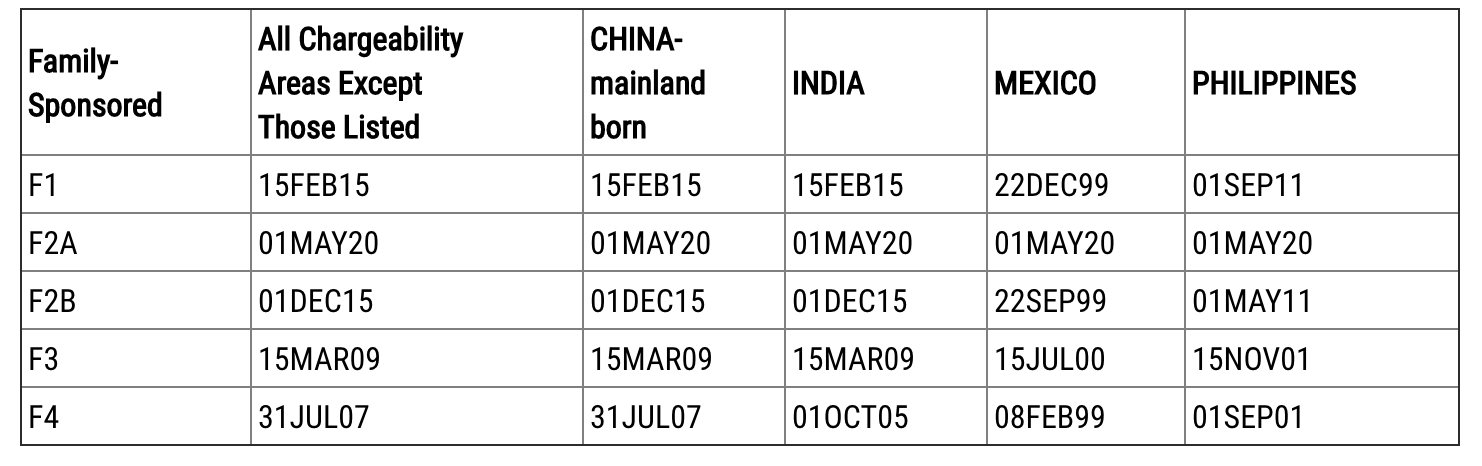
Unless otherwise indicated on the U.S. Citizenship and Immigration Services (USCIS) website at www.uscis.gov/visabulletininfo, individuals seeking to file applications for adjustment of status with USCIS in the Department of Homeland Security must use the “Final Action Dates” charts below for determining when they can file such applications. When USCIS determines that there are more immigrant visas available for the fiscal year than there are known applicants for such visas, USCIS will state on its website that applicants may instead use the “Dates for Filing Visa Applications” charts in this Bulletin. 


May Visa Bulletin Cutoff Dates


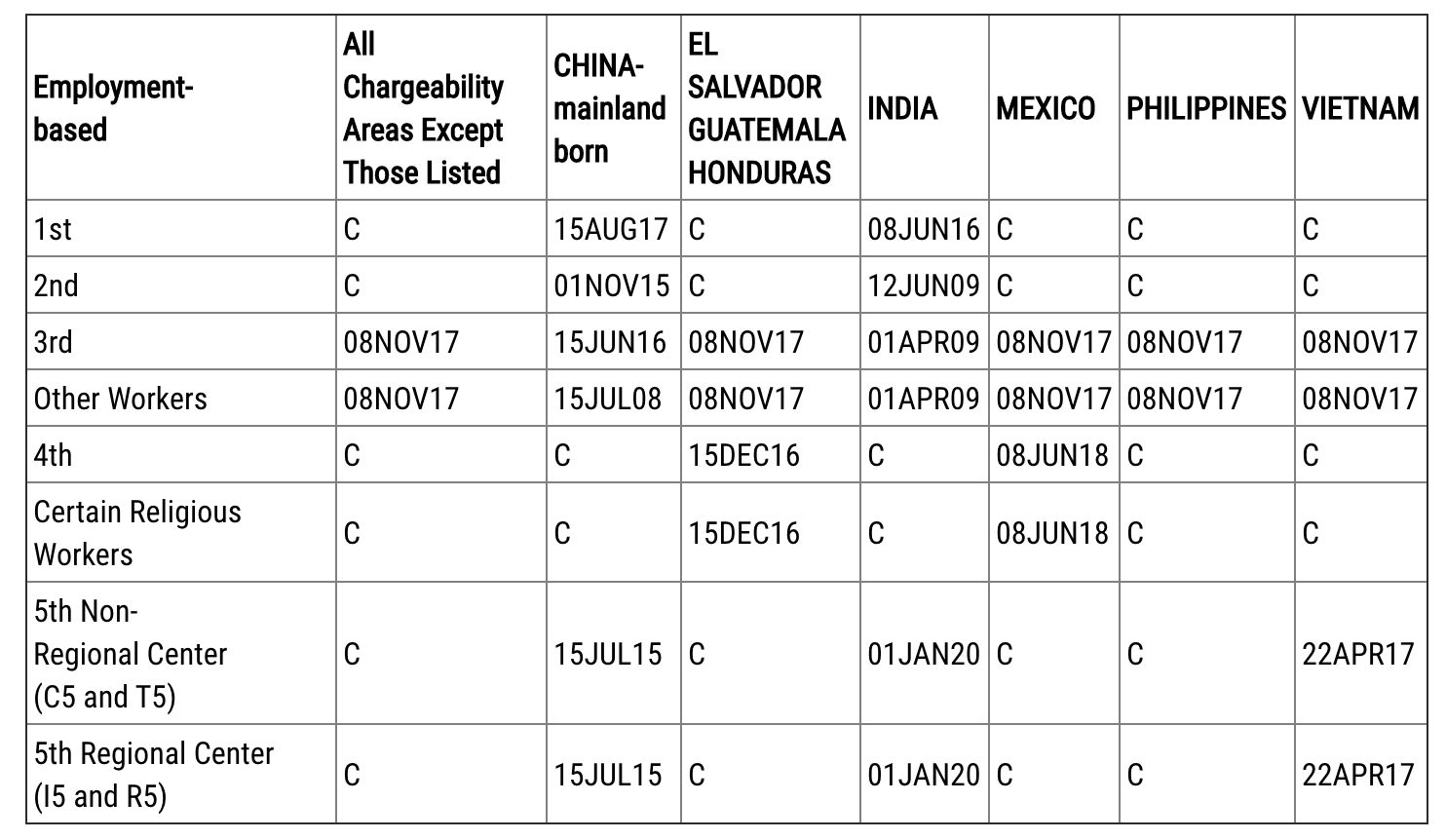
According to the Department of State’s May Visa Bulletin, the following cutoff dates will apply for the issuance of an immigrant visa:

  • EB-1: All countries except for China and India will become current on May 1. China will advance by five weeks to July 15, 2017, while India will advance by three months to August 1, 2015.
  • EB-2: China will advance by one month to October 1, 2015, and India will advance by one week to June 2, 2009. All other countries will remain current.
  • EB-3 Professional and Skilled Workers: All countries except India and China will remain retrogressed at January 1, 2017. Cutoff dates for China and India will advance, with China moving ahead by one month to May 15, 2016, and India moving ahead by more than five weeks to March 1, 2009.
  • EB-5: Most countries will remain current. China will advance by more than six weeks to July 1, 2015; India will advance by nine months to October 1, 2019; and Vietnam will advance by just under two months to April 1, 2017.

Employment-Based Priority Cut-off Dates for May 2020


USCIS recently announced that it will honor Final Action dates for adjustment of status filings in May. In order to file an employment-based adjustment of status application next month, employer-sponsored foreign nationals must have a priority date that is earlier than the date listed below for their preference category and country. This is the second consecutive month that USCIS has chosen the Final Action Dates chart, after several months of honoring the Dates for Filing chart.

The May Final Action Dates chart is current for EB-1 countries worldwide, after several months of retrogression.


How will the President’s Executive Order affect immigrant visas?


The President’s executive order will temporarily suspend and limit the entry of foreign nationals seeking an immigrant visa at a U.S. Consulate abroad. Although the order will apply for the next 60 days, the order will have little practical effect on immigration, given that U.S. Consulates and Embassies worldwide have suspending the issuance of all visas until the COVID-19 pandemic subsides.

If U.S. Consulates and Embassies resume operations within the next 60 days, the executive order will prevent foreign nationals from obtaining immigrant visas at U.S. Consulates worldwide. The suspension will apply to individuals who, as of Wednesday, were outside of the United States, do not have an immigrant visa, do not have official travel documents other than visas, and have not been exempted by the executive order.

Continue reading

donald-trump-4817333_1280

The long-awaited Executive Order temporarily suspending the immigration of certain aliens into the United States has been released.


WHO IS IMPACTED BY THE EXECUTIVE ORDER?


The order entitled, “Proclamation Suspending the Entry of Immigrants Who Present Risk to the U.S. Labor Market During the Economic Recovery Following the COVID-19 Outbreak,” suspends and limits the entry of the following types of aliens (for a 60-day period) beginning 11:59 p.m. eastern daylight time on April 23, 2020.


Your entry is suspended and limited if all of the following are true:

THREE PART TEST


  • You are an alien outside of the United States on the effective date of the Proclamation (April 23rd)
  • You are an alien that does not have an immigrant visa that is valid on the effective date of the Proclamation (April 23rd) and
  • You are an alien that does not have an official travel document other than a visa on the effective date of the proclamation (April 23rd) or issued on any date thereafter that permits him or her to travel to the United States and seek entry or admission
    • Official travel documents include a transportation letter, an appropriate boarding foil, or advance parole document.

ENFORCEMENT


This Proclamation shall be enforced by U.S. Consulates worldwide at their discretion giving them the power to determine whether an immigrant has established his or her eligibility and is otherwise exempted from the Proclamation. The Department of State will implement the proclamation as it applies to immigrant visas, at the discretion of the Secretary of State in consultation with the Secretary of Homeland Security.

The Department of State governs the immigration process outside of the United States, while the Department of Homeland Security governs the immigration process within the United States and guides the United States Citizenship and Immigration Services (USCIS).


WHO IS EXEMPT FROM THE EXECUTIVE ORDER?


The order expressly exempts:

  • Lawful Permanent Residents of the U.S.
  • Aliens who are the spouses of U.S. Citizens
  • Members of the U.S. Armed Forces and any spouse and child of a member of the U.S. Armed Forces
  • Aliens under 21 years of age who are children of United States Citizens and prospective adoptees
  • Aliens seeking to enter the U.S. on an immigrant visa as a physician, nurse, or other healthcare professional
  • Aliens seeking to enter the U.S. to perform medical research or other research intended to combat the spread of COVID-19
  • Any spouse any unmarried child under 21 years of age of any such alien who is accompanying or following to join the alien
  • Any alien applying for a visa pursuant to the EB-5 Immigrant Investor Program
  • Aliens whose entry furthers important United States law enforcement objectives
  • Any alien seeking entry pursuant to a Special Immigrant Visa in the SI or SQ classification, and any spouse and child of any such individual
    • SI: Certain aliens employed by the U.S. Government in Iraq or Afghanistan as translators or interpreters
    • SQ: Certain Iraqis or Afghans employed by or on behalf of the U.S. Government
  • Any alien whose entry would be in the national interest of the United States (national interest waivers)
  • Aliens seeking entry for asylum, refugee status, withholding of removal, or protection under the Convention Against Torture and Other Cruel, Inhuman or Degrading Treatment or Punishment

Continue reading

connection-4884862_1920

In this post, we summarize all of the major and recent developments taken by USCIS, the Department of State, and the Department of Justice in response to the COVID-19 pandemic.

These developments directly impact immigration in significant ways that will be discussed in further detail below.

As this situation evolves, we will continue to update this post for your benefit. You may also read all of our COVID-19 related posts here.


USCIS Field Offices, ASCs, and Asylum Offices Temporary Closed to the Public

To combat the spread of the COVID 19 pandemic, on March 18th USCIS announced the temporary closure of field offices, application support centers, and asylum offices, to the public until at least May 3rd.

We suspect that this closure will be further extended given the current public health crisis we are experiencing nationwide.

Applicants who were scheduled to appear for an interview, biometrics, or asylum interview from March 18 to May 3rd will receive a notice in the mail regarding impacted services, as well as a notice rescheduling the appointment.

ASC appointments will be rescheduled once offices are re-opened to the public.

At this time, please continue to be patient and monitor your mail closely.


USCIS Field Office and Service Center Operations Continue

Although USCIS is closing field offices to the public, the agency has stated that office employees will continue to perform mission-essential services that do not require face-to-face contact with the public.

Furthermore, USCIS service centers and facilities continue to operate and will continue to adjudicate petitions filed nationwide.


USCIS Expands RFE/NOID/NOIR/NOIT/I-290B Deadlines

On March 30, 2020, USCIS announced that it will consider any response to an RFE, NOID, NOIR, or NOIT received within 60 calendar days after the response due date set in the request or notice before any action is taken by USCIS.

Continue reading

test-4481925_1920-1

In this post, we will discuss Form DS-5540, a mandatory public charge questionnaire that must be completed by all foreign nationals seeking an immigrant visa at a U.S. Consulate or Embassy abroad and some non-immigrant visa applicants.

What is Form DS-5540, Public Charge Questionnaire?

Shortly after the publication of the public charge rule in the Federal Register, the government published a separate rule requiring applicants seeking immigrant visas, including diversity visas, at a Consulate abroad, to complete Form DS-5540, except for certain types of immigrants exempt from the public charge ground of inadmissibility such as self-petitioners under the Violence Against Women Act (VAWA) and Afghan and Iraqi interpreters applying for special immigrant visas.

In addition, the government has given consular officers broad discretion to require nonimmigrant visa applicants to complete DS-5540, if for example the officer determines more information is needed regarding the applicant’s ability to financially support themselves following entry into the United States, without depending on the government’s assistance, or if the consular officer is not satisfied with the information provided by the applicant.

Therefore, consular officers have the power to request nonimmigrant visa applicants to complete DS-5540.

The DS-5540 solicits information that helps consular officers determine whether applicants are subject to the public charge visa ineligibility ground (section 212(a)(4) of the Immigration and Nationality Act) and will not rely on certain specific public resources upon entering the United States.

Continue reading

thinker-28741_1280

In this blog post we answer your frequently asked questions regarding the public charge rule.

Overview:

On October 10, 2018, the Department of Homeland Security first published the final rule “Inadmissibility on Public Charge Grounds” which dramatically changes the way in which an individual is determined to be a “public charge.” Although five separate courts issued injunctions to stop the government from implementing the final rule, on January 27, 2020, the Supreme Court of the United States ruled in favor of the Trump administration, allowing the government to implement the public charge rule, except in the state of Illinois where a state-wide injunction remains in place.

The new regulations will make it more difficult for certain adjustment of status and immigrant visa applicants to prove that they are not likely to become a public charge to the United States government.

The following frequently asked questions have been prepared to better inform our readers and address concerns regarding the effect of the public charge rule.

Q: When will the public charge rule take effect?

A: Shortly after the Supreme Court’s ruling, USCIS formally announced on its website that the public charge rule will affect all applications for adjustment of status (green card applications) postmarked on or after February 24, 2020 (except in the state of Illinois, where the rule remains enjoined by a federal court).

Q: Who does the public charge rule apply to?

A: In general, all applicants for admission to the United States are subject to the public charge ground of inadmissibility under INA § 212(a)(4) unless specifically exempted.

The following non-citizens are affected by the public charge rule:

  • Applicants for adjustment of status in the United States
  • Applicants for an immigrant visa abroad
  • Applicants for a nonimmigrant visa abroad
  • Applicants for admission at the U.S. border who have been granted an immigrant or nonimmigrant visa, and
  • Nonimmigrants applying for an extension or change of status within the United States (new policy under the final rule).

Applicants seeking lawful permanent resident status (applicants for adjustment of status) based on a family relationship are most affected by the public charge rule.

Continue reading

iran-4743599_1920

On January 23, 2020, the United States Citizenship and Immigration Services (USCIS) formally announced by way of a notice published in the Federal Register that nationals of Iran and their dependents are no longer eligible to change or extend their stay in E-1 or E-2 nonimmigrant status due to the termination of the 1995 Treaty of Economic Relations (also known as the Treaty of Amity) between the United States and Iran.

Under current immigration law, “the existence of a qualifying treaty or authorizing legislation is . . . a threshold requirement for issuing an E visa.” Therefore, the termination of the Treaty of Amity between the United States and Iran no longer provides a basis for Iranian nationals to qualify for the E nonimmigrant visa classification.

When did the Treaty end?

On October 3, 2018, the U.S. Department of Homeland Security notified Iran of the Termination of the Treaty of Amity. On October 23, 2019, the Department of State provided DHS with formal notice of the termination of the treaty. Currently, there are no other qualifying treaties with Iran or any legislation for granting E-1 or E-2 status to Iranian nationals.

What does this mean?

Accordingly, a national of Iran is no longer eligible for an extension of stay in E-1 or E-2 status or a change of status to E-1 or E-2 on the basis of the Treaty of Amity.

Continue reading

15146360079_21d95fc033_b

We kick off a brand-new week with breaking news handed down by the United States Supreme Court.

Today, in a 5-4 decision, the Supreme Court ruled that the Trump administration may enforce  the controversial rule entitled, “Inadmissibility on Public Charge Grounds” which expands the scope of public benefits that will render a permanent resident or immigrant visa applicant ineligible for immigration benefits. The public charge rule makes certain individuals inadmissible to receive permanent residence on public charge grounds based on their use of certain government assistance programs.

As we reported, on January 13, 2020 the Trump administration filed an emergency appeal asking the Supreme Court to lift a remaining lower court injunction preventing the government from enforcing the public charge rule. Today, the conservatives on the Supreme Court overpowered the four liberal justices on the court, in favor of the Trump administration, ruling that the government may now begin to enforce the public charge rule despite challenges to the rule pending in the lower courts.

Overview: 

Under current immigration law, an individual who, in the opinion of DHS is likely at any time to become a public charge is (1) ineligible for a visa (2) ineligible for admission to the United States and (3) ineligible for adjustment of status (permanent residence).

In determining whether an applicant is or will likely become a public charge USCIS has always considered the receipt of Temporary Assistance for Needy Families (TANF), Supplemental Security Income (SSI), and Medicaid, benefits that make an applicant ineligible for permanent residence.

The public charge rule goes further and expands the list of benefits that make a foreign national ineligible to obtain permanent residence or an immigrant visa (in addition to the benefits listed above). These additional benefits include:

Continue reading