Articles Posted in Family Visas

donald-trump-4817333_1280

The long-awaited Executive Order temporarily suspending the immigration of certain aliens into the United States has been released.


WHO IS IMPACTED BY THE EXECUTIVE ORDER?


The order entitled, “Proclamation Suspending the Entry of Immigrants Who Present Risk to the U.S. Labor Market During the Economic Recovery Following the COVID-19 Outbreak,” suspends and limits the entry of the following types of aliens (for a 60-day period) beginning 11:59 p.m. eastern daylight time on April 23, 2020.


Your entry is suspended and limited if all of the following are true:

THREE PART TEST


  • You are an alien outside of the United States on the effective date of the Proclamation (April 23rd)
  • You are an alien that does not have an immigrant visa that is valid on the effective date of the Proclamation (April 23rd) and
  • You are an alien that does not have an official travel document other than a visa on the effective date of the proclamation (April 23rd) or issued on any date thereafter that permits him or her to travel to the United States and seek entry or admission
    • Official travel documents include a transportation letter, an appropriate boarding foil, or advance parole document.

ENFORCEMENT


This Proclamation shall be enforced by U.S. Consulates worldwide at their discretion giving them the power to determine whether an immigrant has established his or her eligibility and is otherwise exempted from the Proclamation. The Department of State will implement the proclamation as it applies to immigrant visas, at the discretion of the Secretary of State in consultation with the Secretary of Homeland Security.

The Department of State governs the immigration process outside of the United States, while the Department of Homeland Security governs the immigration process within the United States and guides the United States Citizenship and Immigration Services (USCIS).


WHO IS EXEMPT FROM THE EXECUTIVE ORDER?


The order expressly exempts:

  • Lawful Permanent Residents of the U.S.
  • Aliens who are the spouses of U.S. Citizens
  • Members of the U.S. Armed Forces and any spouse and child of a member of the U.S. Armed Forces
  • Aliens under 21 years of age who are children of United States Citizens and prospective adoptees
  • Aliens seeking to enter the U.S. on an immigrant visa as a physician, nurse, or other healthcare professional
  • Aliens seeking to enter the U.S. to perform medical research or other research intended to combat the spread of COVID-19
  • Any spouse any unmarried child under 21 years of age of any such alien who is accompanying or following to join the alien
  • Any alien applying for a visa pursuant to the EB-5 Immigrant Investor Program
  • Aliens whose entry furthers important United States law enforcement objectives
  • Any alien seeking entry pursuant to a Special Immigrant Visa in the SI or SQ classification, and any spouse and child of any such individual
    • SI: Certain aliens employed by the U.S. Government in Iraq or Afghanistan as translators or interpreters
    • SQ: Certain Iraqis or Afghans employed by or on behalf of the U.S. Government
  • Any alien whose entry would be in the national interest of the United States (national interest waivers)
  • Aliens seeking entry for asylum, refugee status, withholding of removal, or protection under the Convention Against Torture and Other Cruel, Inhuman or Degrading Treatment or Punishment

Continue reading

board-1815980_1920


In this post, we bring you a late-breaking update regarding the President’s recent tweet announcing the temporary suspension of immigration into the United States by executive order.

While the President has not yet signed the executive order suspending immigration, in a press briefing held today, reporters had the opportunity to ask President Trump who will be most affected by his suspension.

library-of-congress-jPN_oglAjOU-unsplash-scaled

Yesterday evening, President Donald Trump made an unusual announcement via twitter stating, “In light of the attack from the Invisible Enemy [COVID-19], as well as the need to protect the jobs of our GREAT American Citizens, I will be signing an Executive Order to temporary suspend immigration into the United States!”

Since that tweet, no executive order has been released by the White House and no details have been provided relating to what that executive order might include, who might be affected, and how long the temporary suspension might last.

According to NPR, an official from the Department of Justice reported that the draft executive order is currently under review by the Office of Legal Counsel.

Is it worth noting that at present United States Consulates and Embassies abroad have already suspended routine visa processing and are not taking appointments for visa interviews until further notice. USCIS is still accepting and adjudicating petitions for immigration benefits as usual, however USCIS field offices, ASC offices, and asylum offices are closed to the public until May 3rd.

Responding to the President’s tweet, White House Press Secretary Kayleigh McEnany said today in a statement that the President, “is committed to protecting the health and economic well-being of American citizens as we face unprecedented time,” she continued, “As President Trump has said, ‘Decades of record immigration have produced lower wages and higher unemployment for our citizens, especially for African American and Latino workers. At a time when Americans are looking to get back to work, action is necessary.”

Continue reading

connection-4884862_1920

In this post, we summarize all of the major and recent developments taken by USCIS, the Department of State, and the Department of Justice in response to the COVID-19 pandemic.

These developments directly impact immigration in significant ways that will be discussed in further detail below.

As this situation evolves, we will continue to update this post for your benefit. You may also read all of our COVID-19 related posts here.


USCIS Field Offices, ASCs, and Asylum Offices Temporary Closed to the Public

To combat the spread of the COVID 19 pandemic, on March 18th USCIS announced the temporary closure of field offices, application support centers, and asylum offices, to the public until at least May 3rd.

We suspect that this closure will be further extended given the current public health crisis we are experiencing nationwide.

Applicants who were scheduled to appear for an interview, biometrics, or asylum interview from March 18 to May 3rd will receive a notice in the mail regarding impacted services, as well as a notice rescheduling the appointment.

ASC appointments will be rescheduled once offices are re-opened to the public.

At this time, please continue to be patient and monitor your mail closely.


USCIS Field Office and Service Center Operations Continue

Although USCIS is closing field offices to the public, the agency has stated that office employees will continue to perform mission-essential services that do not require face-to-face contact with the public.

Furthermore, USCIS service centers and facilities continue to operate and will continue to adjudicate petitions filed nationwide.


USCIS Expands RFE/NOID/NOIR/NOIT/I-290B Deadlines

On March 30, 2020, USCIS announced that it will consider any response to an RFE, NOID, NOIR, or NOIT received within 60 calendar days after the response due date set in the request or notice before any action is taken by USCIS.

Continue reading

test-4481925_1920-1

In this post, we will discuss Form DS-5540, a mandatory public charge questionnaire that must be completed by all foreign nationals seeking an immigrant visa at a U.S. Consulate or Embassy abroad and some non-immigrant visa applicants.

What is Form DS-5540, Public Charge Questionnaire?

Shortly after the publication of the public charge rule in the Federal Register, the government published a separate rule requiring applicants seeking immigrant visas, including diversity visas, at a Consulate abroad, to complete Form DS-5540, except for certain types of immigrants exempt from the public charge ground of inadmissibility such as self-petitioners under the Violence Against Women Act (VAWA) and Afghan and Iraqi interpreters applying for special immigrant visas.

In addition, the government has given consular officers broad discretion to require nonimmigrant visa applicants to complete DS-5540, if for example the officer determines more information is needed regarding the applicant’s ability to financially support themselves following entry into the United States, without depending on the government’s assistance, or if the consular officer is not satisfied with the information provided by the applicant.

Therefore, consular officers have the power to request nonimmigrant visa applicants to complete DS-5540.

The DS-5540 solicits information that helps consular officers determine whether applicants are subject to the public charge visa ineligibility ground (section 212(a)(4) of the Immigration and Nationality Act) and will not rely on certain specific public resources upon entering the United States.

Continue reading

pope-moysuh-ObweQkF5w30-unsplash
Welcome back to Visalawyerblog! In this post, we bring you the latest immigration news for the week.

USCIS Announces Workload Transfers

In an effort to manage heavy workloads, increase efficiency, and decrease processing times, the United States Citizenship and Immigration Services (USCIS) has been transferring cases between service centers.

cms-265128_1920
In this blog post, we would like to remind our readers that today is the last day to submit a public comment on the USCIS proposed rule increasing immigration fees for certain petitions. Initially USCIS had set a 30-day comment period ending on December 16, 2019, however the comment period was later extended for two more weeks, ending today December 30, 2019.

Once the comment period has closed, USCIS will review all public comments and publish a final rule in the Federal Register which will contain the rule’s effective date of implementation.

The filing fees for the following petitions would increase substantially under the proposed rule:

passport-2642170_1920-1

The U.S. Department of State recently released the December 2019 Visa Bulletin. In this post, we will discuss the current state of the visa bulletin, potential for advancement, retrogression, and predictions.

Family-based Preference Categories

The Final Action Date for F2A has been current and remains current since July 2018 across all countries through December. Low demand in this category has made it “current” and is expected to remain current for the foreseeable future.

Movement for all other family-preference categories remains as before.

F-4 visa demand is increasing which may result in slow movement in this category in the foreseeable future, but not nearly enough to cause a retrogression.

Employment-based preference categories

Overview

For the month of December 2019, EB-2 Worldwide, as well as EB-2 El Salvador, Guatemala, Honduras, Mexico, Philippines, and Vietnam remain current.

Similarly, EB-3 Worldwide, as well as EB-3 El Salvador, Guatemala, Honduras, Mexico, and Vietnam remain current.

The Visa Bulletin notes that visa availability is likely to slow down for employment-based visa categories due to the steady increase in the level of employment-based demand for adjustment of status cases filed with USCIS. If the current pace of demand continues, a final action date will be implemented for EB-2, EB-3, and EB-3 Other Worker preference categories as early as January.

Charles Oppenheim, Chief of the Visa Control and Reporting Division at the U.S. Department of State has reported that if the level of demand subsides, it is possible that these categories will remain current, however there is no evidence that demand will slow down for these categories, therefore visa applicants should be prepared for the implementation of Final Action Dates as early as January 2020.

Continue reading

paid-160126_1280

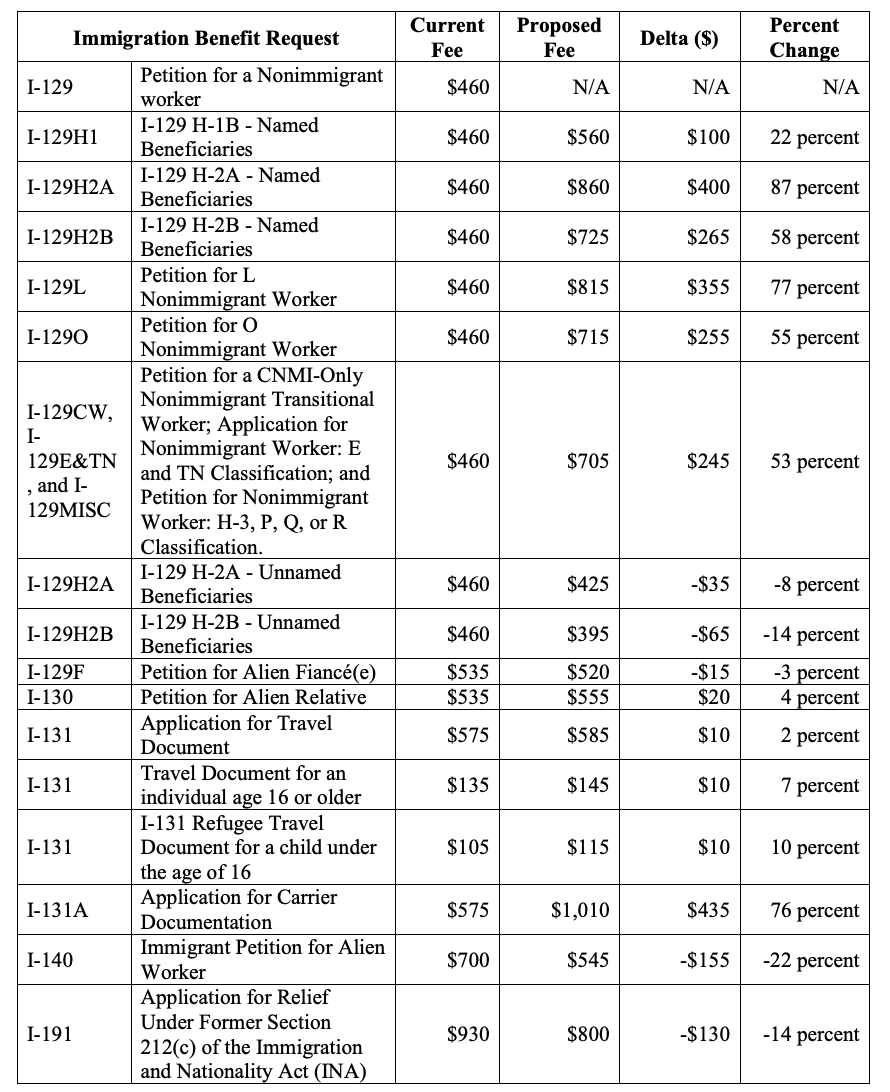
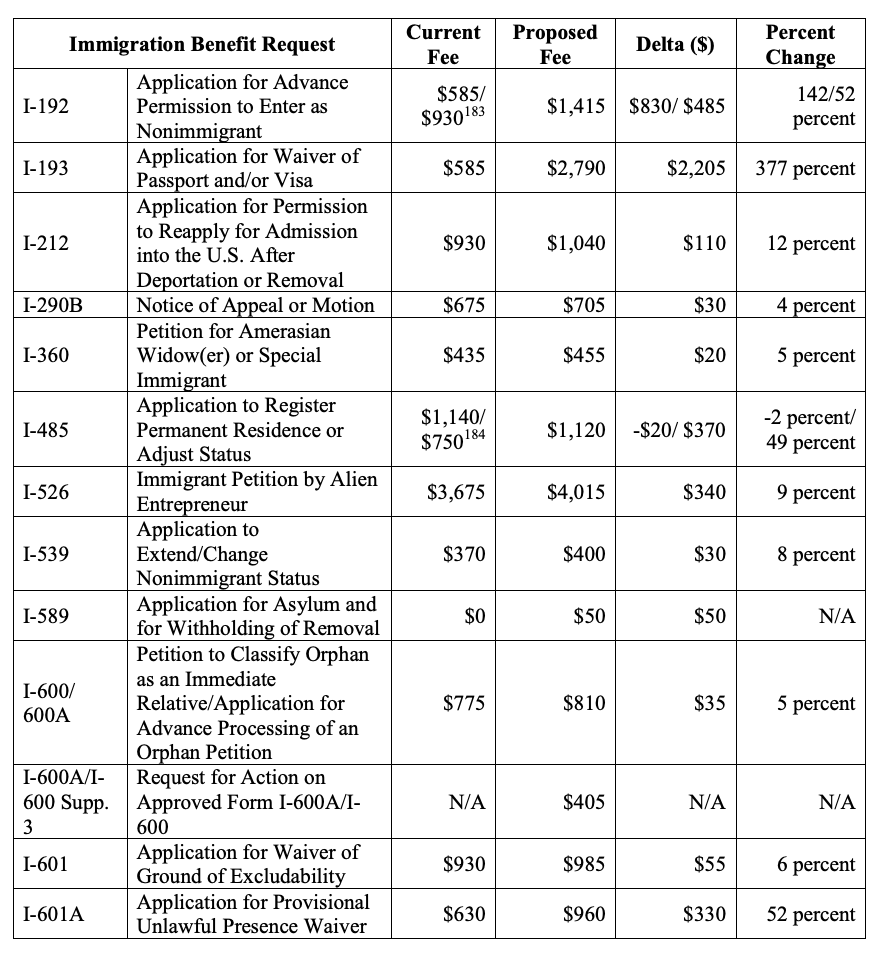
On November 14, 2019, the United States Citizenship and Immigration Services will publish a proposed rule in the Federal Register to increase immigration fees for certain petitions. After publication, the proposal will be open for a 30-day comment period. After that point the agency will review public comments and draft the final rule. At this time there is no definitive date set out in the proposed rule for enforcement of these fees. Therefore, readers should note that these fee increases will likely not take effect until well into Fiscal Year 2020.

What does the rule propose?

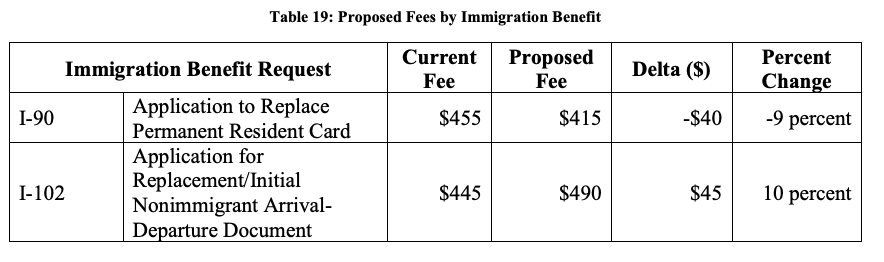
The rule proposes the following fee increases by immigration benefit:

https://www.immigrationlawyerblog.com/files/2019/11/Screen-Shot-2019-11-12-at-4.02.14-PM.png https://www.immigrationlawyerblog.com/files/2019/11/Screen-Shot-2019-11-12-at-4.02.20-PM.png https://www.immigrationlawyerblog.com/files/2019/11/Screen-Shot-2019-11-12-at-4.02.26-PM.png

Moreover, DHS proposes that fees for the following types of petitions be limited to a 5 percent increase above current fees:

  • Form I-290B, Notice of Appeal or Motion.
  • Form I-360, Petition for Amerasian, Widow(er) or Special Immigrant.
  • Form I-600, Petition to Classify Orphan as an Immediate Relative
  • Form I-600A, Application for Advance Processing of an Orphan Petition
  • Form I-600A/I-600, Supplement 3, Request for Action on Approved Form I-600A/I600.42
  • Form I-800, Petition to Classify Convention Adoptee as an Immediate Relative.
  • Form I-800A, Application for Determination of Suitability to Adopt a Child from a Convention Country.
  • Form I-800A, Supplement 3, Request for Action on Approved Form I-800A

Changes to Fee Waiver Requests

DHS further proposes to limit fee waivers grants to individuals who have an annual household income of less than 125 percent of the Federal Poverty Guideline as defined by the U.S. Department of Health and Human Services (HHS).

Continue reading

chicago-3885138_1920

In the latest blow to President Trump’s embattled Presidency, on November 2nd federal judge Michael Simon issued a preliminary injunction blocking the government from enforcing the President’s Proclamation issued on October 4, 2019, suspending the entry of any immigrant who will “financially burden the United States healthcare system.”

Judge Simon’s decision came just one day before the government’s planned implementation of the Presidential Proclamation.

The judge’s order applies nationwide and prohibits the government from implementing any part of the Proclamation requiring individuals seeking an immigrant visa to provide evidence “to a consular officer’s satisfaction” that they would either be covered by an approved health insurance within 30 days of entry to the United States, or possess the financial resources to pay for reasonably foreseeable medical costs.

Judge Simon’s decision came in response to a class action lawsuit filed in Federal District Court in the District of Oregon by seven United States Citizens and a non-profit organization against the Trump administration, challenging the legality of the Presidential Proclamation.

Plaintiff’s argued that the Proclamation should be found unlawful because it does not advance the President’s goal of reducing the burden of uncompensated care for uninsured individuals. Plaintiff’s called into question the President’s true intentions in issuing the Proclamation, stating that the Proclamation “is but the latest link in a long chain of statements and actions by this President and his Administration expressing antipathy toward all noncitizens. . .particularly immigrants of color, from Central and Latin America, Africa and the Middle East.”

Continue reading