Articles Posted in Permanent Residents

7507465248_ed7b64e022_z

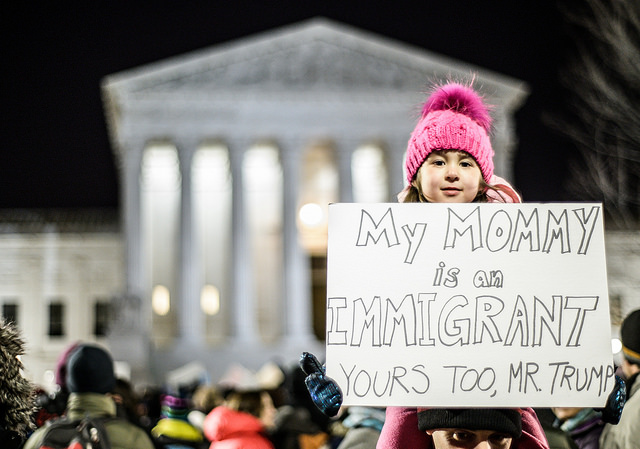
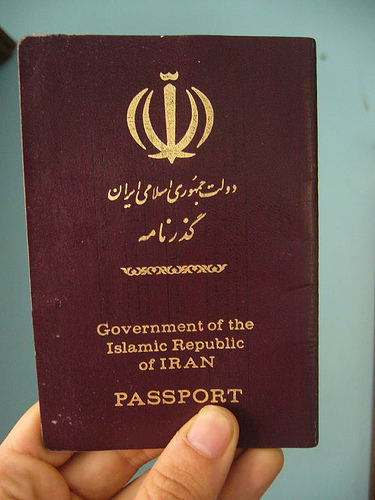
On Saturday night, a federal judge granted an emergency stay on Donald Trump’s executive orderProtecting the Nation from Terrorist Attacks by Foreign Nationals” which temporarily bans the entry of immigrant and non-immigrant foreign nationals from Syria, Iraq, Iran, Libya, Somalia, Sudan, and Yemen for a 90-day period. The stay filed by the American Civil Liberties Union, on behalf of two Iraqi men detained at New York’s John F. Kennedy airport, prevents immigration authorities from detaining foreign nationals from the 7 Muslim majority countries, who have already arrived on U.S. soil, as well as those mid-flight. The stay does not invalidate the executive order signed by Trump, but limits its enforcement on individuals who have already arrived in the United States. Individuals who have attempted to enter on valid visas, refugee status, or LPR status must be released from detention. Trump’s temporary ban on immigrants and non-immigrants from these countries sent the country into chaos, as protestors swarmed international airports across the nation calling for an end to the ban and the release of persons detained. U.S. Customs and Border Protection, and law enforcement officials are struggling with the executive order, absent clear policy and guidance from the Department of Homeland Security.

This is a developing story. More information soon. 

4597450178_deae92dd6d_b-2

The H-1B visa is one of the most coveted visas in the United States for several reasons. One of the biggest perks of the H-1B visa is that it is granted for a period of three years, and can be extended for an additional three years. Recipients of the H-1B visa can also bring their dependents to live with them in the United States on an H-4 visa. The H-1B visa is also a popular option because it gives workers the flexibility of accepting and entering new employment, made possible by the portability provision of the H-1B program (8 U.S.C. § 1184(n)). The portability provision allows an H-1B worker to change jobs without having to risk falling “out of status.” Recently, USCIS also improved its portability provision with the passage of a new law that will give H-1B workers who have been laid off a 60-day grace period to transfer to a new employer. But perhaps the greatest upside to the H-1B visa however, is that it is one of the few visas that allows a nonimmigrant to apply for permanent residency as a beneficiary of an immigrant visa petition, without the immigrant petition having any negative affect on their H-1B status. This privilege is recognized in the law and is known as “dual intent.” Foreign nationals holding a “dual intent” visa such as an H-1B visa are allowed to file a green card petition, while continuing employment under the terms of their visa, and may also travel on their visa without seeking permission from USCIS.

In this sense, the H-1B visa is one of the few visas that opens a direct path to permanent residency. Other popular employment visas such as the E-2 treaty investor visa do not create a direct path to permanent residency and are not considered “dual intent” visas.

Continue reading

new-piktochart_843_6a8b1e61f05cd05ee2ec4001cba0911607cca5e7

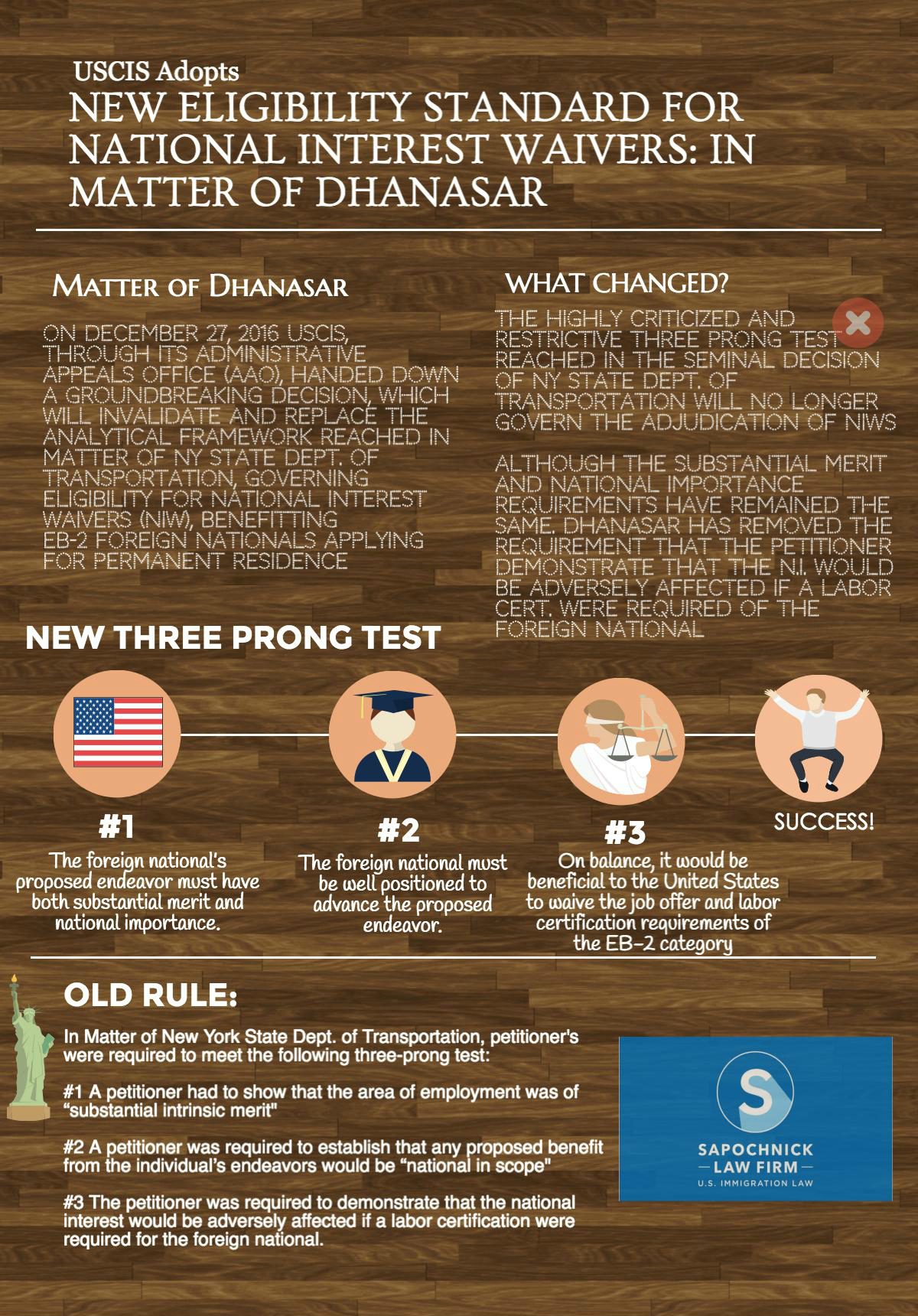
On December 27, 2016 in Matter of Dhanasar, 26 I&N Dec. 884 (AAO 2016) the USCIS Administrative Appeals Office (AAO) handed down a groundbreaking decision which has changed the analytical framework for determining eligibility of national interest waivers. This new decision will affect foreign nationals who are pursuing a green card based on employment in the EB-2 category, and who are eligible for a “national interest waiver.”

The national interest waiver is a discretionary waiver of the job offer and labor certification requirement made possible by subparagraph (A) of section 203(b)(2) of the Immigration and Nationality Act. This section of the INA states that the Secretary may, when it deems it to be in the national interest of the United States, “waive the requirements of subparagraph (A) that an alien’s services in the sciences, arts, professions, or business be sought by an employer in the United States.”  In addition to meeting a three-prong test of eligibility, to obtain a national interest waiver, the foreign national must be a member of a profession holding advanced degrees or their equivalent or prove that “because of their exceptional ability in the sciences, arts, or business they will substantially benefit prospectively the national economy, cultural or educational interests, or welfare of the United States.”

Without this discretionary waiver, EB-2 applications must be accompanied by a labor certification and their employer must go through the process of advertising the position to prove to immigration that there are no other applicants who are qualified, willing, and able to fill the position that the foreign national is expected to fill. Employers must also meet prevailing wage requirements as established by law. Establishing the national interest waiver in other words made it easier for qualifying foreign nationals in the EB-2 category to skip the job offer and labor certification requirement, streamlining their path to permanent residency.

Continue reading

For years you have 8276375308_d5f2721898_zput your trust in our office for all of your immigration needs and for that we thank you. We consider ourselves very fortunate to be able to serve you and your families. Throughout the years, we have helped thousands of immigrants from all over the world attain their American dream. Learning about their lives and their struggles has

always been an important part of our practice. Although many challenges lie ahead for immigration, we are confident that important changes will come about in the new year. Do not despair and know that our office will be with you every step of the way. We wish you and your families the happiest of holiday seasons.

1047083584_3520848b69_z

In this segment, we answer 5 of your most frequently asked questions received from our social media platforms and website. Please remember that every case is different and every immigration journey is unique. You should not compare your situation to anyone else’s. We hope that our answers will provide you with further guidance while you embark on your immigration journey. If you have any further questions, please call our office to schedule a free first time consultation. We serve international clients and domestic clients in all 50 states. We thank you for your continued trust in our law office. Do you want us to answer your question in a future segment? Please email nathalie@h1b.biz. For more information on the services we offer please click here.

Immigrating a Foreign Spouse: Incorrect Filing of the I-130

Q: I am currently at an impasse with my wife’s immigration process. We have moved on to the NVC stage of the process, and they have notified us that they will tentatively schedule her for her immigrant visa interview in her home country, although she is currently in the US on an expired visa. Thus-far, her I-130 petition has been approved and they denied the I-129 because of the approval. How can I get the interview location changed to the US without paying for and submitting the I-485?

A: Thank you for your question. More information is needed from you to fully assess your wife’s case such as a complete copy of the I-130 petition that was filed with USCIS. It appears that at the beginning of her case you elected to begin consular processing to immigrate your wife to the United States, and she later traveled to the United States while her I-130 petition was pending with USCIS. As you know, the first step of the consular process to immigrate a foreign spouse, requires you to file the I-130 petition for alien relative. This brings us to the main problem. The I-130 petition is the petition that determines where your wife will be interviewed, whether it be for adjustment of status in the United States, or to obtain an immigrant visa. In other words, the I-130 petition is intimately tied to the location where she will have her interview. On Part C. Item number 22 of the I-130 petition, USCIS specifically asks you to provide complete information regarding whether your relative is in the United States and will apply for adjustment of status, or whether your relative is not in the United States and will instead apply for a visa abroad at an American consular post or embassy abroad. If you responded that your relative was not in the United States and would apply for an immigrant visa abroad at the time of filing, it would be a very rare circumstance that USCIS would allow a change of venue for her interview.

Continue reading

12989079454_c59633f34d_z

The Department of Homeland Security is expected to publish a final rule tomorrow November 18, 2016 benefitting EB-1, EB-2, and EB-3 employment-based immigrant workers and highly-skilled nonimmigrant foreign workers. The final rule is effective January 17, 2017. The final rule will streamline the process for employment based sponsorship of nonimmigrant workers for lawsuit permanent resident status (LPRs), increasing job portability, and promoting stability, flexibility, and transparency in the way DHS applies its policies and regulatory practices to these programs. These changes were proposed in order to better equip U.S. employers to employ and retain highly skilled foreign workers who are the beneficiaries of employment-based immigrant visa petitions known as Form I-140 petitions. The new rule will allow foreign workers to have more flexibility, and affords workers the opportunity to further their careers by accepting promotions, giving them the freedom of being able to change positions with current employers, change employers, or pursue other employment.

The final rule conforms with longstanding policies and practices in accordance with the American Competitiveness and Workforce Improvement Act of 1998 (ACWIA) and the American Competitiveness in the Twenty-first Century Act of 2000 (AC21). The final rule seeks to further enforce the principles embodied in these pieces of legislation by providing nonimmigrant workers who have been sponsored for permanent residency based on the filing of an I-140 petition, greater flexibility and job portability, while expanding the competitiveness of American employers, boosting the U.S. economy, and protecting American workers. The final rule also clarifies and improves DHS policies and practices outlined in policy memoranda and precedent decisions of the Administrative Appeals Office. The final rule seeks to clarify regulatory policies in order to provide greater transparency to stakeholders. The final rule also clarifies interpretative questions related to ACWIA and AC21.

Continue reading

16216912657_b301085bef_z

In this post we bring you your daily dose of immigration updates. For more information on the immigration services we provide please visit our website. For a free first legal consultation please contact our office. It is our pleasure to accompany you on your immigration journey.

USCIS extends TPS Designation for Nepal for 18 months

The Secretary of Homeland Security recently announced that Temporary Protected Status (TPS) for eligible nationals of Nepal will be extended for an additional 18 months, beginning December 25, 2016 through June 24, 2018. Eligible TPS applicants must either be foreign nationals of Nepal or habitually resided in Nepal. DHS will be extending current TPS Nepal Employment Authorization Cards (EADs) with a December 24, 2016 expiration date for an additional 6 months, valid through June 24, 2017.

For more information regarding TPS for Nepal please click here. For information about the TPS program please click here. Employers interested in verifying or reverifying the employment eligibility of employees who are TPS beneficiaries, may click here for more information.

EADs Extended 6 Months for Guinea, Liberia and Sierra Leone TPS Beneficiaries

Current Beneficiaries of the Temporary Protected Status (TPS) program for the designations of Guinea, Liberia, and Sierra Leone have had their TPS status extended for a period of 6 months, to expire on May 21, 2017. The Department of Homeland Security authorized this temporary extension to allow beneficiaries to make an orderly transition out of the United States, before termination of their TPS status on May 21, 2017. Current beneficiaries of the TPS program from these designations will automatically retain their TPS status until this date, and the validity of their current Employment Authorization Cards (EADs) will be extended through May 20, 2017.

Click here for more information about the 6-month extension of orderly transition before termination of TPS designations for Guinea, Liberia, and Sierra Leone. For general information about the TPS program please click here.

Continue reading

14306017036_931628b92f_z

For persons who have entered the United States illegally or who have accrued unlawful presence after having overstayed their visa, the possibility of obtaining lawful permanent residence (a green card) is very limited. In the United States there are generally two ways to adjust status to permanent residence. With few exceptions, a green card may generally be obtained through employment-based sponsorship, or family sponsorship based on a qualifying family relationship, such as a U.S. Citizen or Legal Permanent Resident relative. Unlawful presence is a very serious immigration offense that is subject to punishment depending on the amount of time a person has accrued unlawful presence in the United States.

Undocumented immigrants who accrue unlawful presence in the United States, and subsequently leave the country, and attempt to re-enter the United States lawfully, may be subject to either a 3- or 10-year bar, based on the amount of time they have accrued unlawful presence in the United States. Specifically, under the Immigration and Nationality Action Section §212(a)(9)(B)(i)(I) a person who has accrued more than 180 days of unlawful presence in the United States, is subject to a 3-year bar automatically triggered once the person departs the United States. The bar would thereby prevent a person from being re-admitted into the United States, depending on the amount of time they were previously unlawfully present in the country. Similarly, under the Immigration and Nationality Act §212(a)(9)(B)(i)(II), a person who has accrued one year or more of unlawful presence in the United States, is subject to a 10-year bar preventing a person from being re-admitted to the United States, once they have departed from the United States.

Continue reading

3134127288_bf609afe71_z

Today, October 24, 2016 the Department of Homeland Security published the final rule increasing fees for certain immigration and naturalization petitions processed by U.S. Citizenship and Immigration Services (USCIS). Overall the Department of Homeland Security increased filing fees for certain petitions by an average of 21 percent. The new fees will be enforced by USCIS beginning December 23, 2016. The fee schedule has been adjusted following the agency’s decision to conduct a comprehensive review of filing fees for fiscal year 2016/2017. USCIS determined that an adjustment in the filing fees would be necessary in order for USCIS to recover costs for services expended and maintain adequate service. The proposed fee schedule was first published on May 4, 2016. The final rule clarifies that all persons applying for immigration benefits may be required to appear for biometrics services or an interview, and thus must pay the biometrics services fee accordingly.

EB-5 Investor Visa Program

The EB-5 Immigrant Investor Visa Program will be most heavily impacted by the new fee schedule. The new filing fee for Form I-924, Application for Regional Center under the Immigrant Investor Pilot Program, will increase by a rate of 186% requiring Regional Centers seeking designation under the program, to pay a filing fee of $17,795 instead of the current rate of $6,230. Regional Centers will be required to pay a $3,035 annual fee to certify their continued eligibility for the designation.

The filing fee for the I-526 Immigrant Petition by Alien Entrepreneur, an application associated with the EB-5 visa program, will increase to $3,675, a 145% increase up from the current rate of $1,500. The filing fee for an investor’s petition to remove conditions on residence remains unchanged.

Naturalization

USCIS has established a three-tiered fee schedule for naturalization applicants filing Form N-400 Application for Naturalization. First, the fee schedule includes a standard filing fee for most applicants, from a rate of $595 to $640. Second, DHS has established a reduced fee of $320 for naturalization applicants whose household income is greater than 150% but less than 200% of the Federal Poverty Guidelines. Third, there will be no filing fee for naturalization applicants who are members of the military, applicants with approved fee waivers, and others who may qualify for a fee waiver according to sections 328 or 329 of the Immigration and nationality Act (INA).

Continue reading

16302668209_fe49a9859d_b

Image Courtesy of Scotland Shop

In this informational post we discuss the I-130 Consular Process for spouses. Consular processing refers to the process by which a U.S. Citizen immigrates their foreign spouse to the United States from abroad. Depending on the foreign spouse’s country of residence, and the volume of applications processed by USCIS, the National Visa Center, and the U.S. Consulate or Embassy where the foreign spouse will have their immigrant visa interview, the process to immigrate a spouse to the United States can take anywhere from 8 to 12 months. Consular processing is a complicated process. It is recommended that applicants obtain the assistance of an experienced attorney to file this type of application.

What is the first step involved in the process?

The first step involves filing the I-130 Petition for Alien Relative. This petition establishes that a relationship exists between the U.S. Citizen and intending immigrant. This petition thus is used for family-based immigration to the United States. A separate I-130 must be filed for each eligible relative that will immigrate to the United States including minor children of the foreign spouse. The filing and approval of the I-130 is the first step to immigrate a relative to the United States. Because this petition is filed by the U.S. Citizen petitioner, the foreign spouse does not need to wait until a visa number becomes available before applying for an immigrant visa at a U.S. Consulate/Embassy abroad. By contrast, if the petitioner is not a U.S. Citizen and is instead a Lawful Permanent Resident, an immigrant visa is not immediately available to the foreign spouse. Due to this, the foreign spouse must wait until their priority date becomes current according to the visa bulletin issued by the Department of State. The I-130 is accompanied by various supporting documents mostly biographical in nature. These documents include the signed forms, the filing fees, passport photographs of the petitioner and beneficiary, the petitioner’s proof of citizenship, a copy of the beneficiary’s passport ID page, copy of their birth certificate with a certified translation, and a copy of the marriage certificate. Once these documents have been compiled, the applicant mails them to USCIS for approval. USCIS takes approximately 4 months to process and approve this application. This time frame will depend on the volume of applications being processed by USCIS at the time of filing.

The National Visa Center Stage

Once the I-130 petition has been approved, USCIS will mail the petitioner a receipt notice known as the I-797 Notice of Action. This Notice of Action serves as proof that the I-130 petition has been approved, and more importantly indicates that the petition will be forwarded to the Department of State’s National Visa Center within 30 days. The National Visa Center is a government agency that conducts pre-processing of all immigrant visa petitions that require consular action. The National Visa Center requires the applicant to send various documents, before the application can be sent to the United States Consular unit where the foreign spouse will attend their immigrant visa interview. The NVC determines which consular post will be most appropriate according to the foreign spouse’s place of residence abroad, as indicated on the I-130 petition. Once the NVC has received all documents necessary to complete pre-processing of the immigrant application, the case is mailed to the consular unit abroad. From the date the I-130 has been approved, it takes approximately 30-45 days for the National Visa Center to receive the application from USCIS and begin pre-processing.

Continue reading