Articles Posted in Work Visas

debate3_1

Yesterday, October 19th the third and final Presidential debate took place in Las Vegas, Nevada. This was the last opportunity Presidential candidates, Donald J. Trump, and Hillary R. Clinton, had to present their positions on various different issues, and make a final attempt to gain the support of undecided voters. The debate has left much to talk about, while many questions still remain unanswered. The moderator of the debate, Chris Wallace, of FOX news questioned the candidates on various different topics ranging from the Supreme Court nomination, economy, foreign policy, and more importantly the candidates’ positions on immigration reform.

On the subject of immigration, the moderator introduced his question on immigration by providing an overview of each candidate’s positions on immigration. Wallace discussed the fact that throughout his campaign, Donald Trump has staunchly advocated for mass deportations and the building of a more secure border, which he believes will successfully deter undocumented immigrants, criminals, and terrorists from entering the United States.

By contrast, Wallace highlighted the fact that Hillary Clinton has offered no specific plan on how she would secure our southern borders, where there is currently a massive influx of immigrants, specifically unaccompanied children from Central America, seeking refuge in the United States. Wallace reiterated Hillary Clinton’s commitment to offer a comprehensive immigration reform package within the first 100 days she is in office that includes a pathway to citizenship for undocumented immigrants, with proven ties to the United States.

Each candidate was asked to discuss why their immigration policy is the best, and why their opponent is wrong. Donald Trump was given the first opportunity to respond. Trump opened the conversation on immigration by taking the position that providing amnesty for undocumented immigrants would be a ‘disaster’ for various different reasons. First, he stated that it would be unfair for undocumented immigrants to be given a path to citizenship, while immigrants wishing to enter the United States legally, are forced to wait many years to obtain permanent residence. Second, he emphasized that securing our country’s borders is his number one priority. Trump bolstered his claim that strong borders are necessary, by referring to mothers he had met on the campaign trail, whose children were brutally killed by people he claims entered the country illegally. He also stated that for the first time ever he has been endorsed by 16,500 Border Patrol Agents, as well as ICE who share in his belief that our country needs strong borders. Third, Trump claims that strong borders are necessary to deter the thousands of people who are coming into the country illegally, and to prevent drugs from pouring into the United States. Lastly, he stated that the war on drugs is the biggest problem the United States is facing today, thus in his view this presents an even greater obligation to secure our borders. He blamed the Obama administration for its failure to deter illegal immigration, illicit drugs from coming into the United States, and for allowing criminals to enter the United States.

Continue reading

4885882921_388eda7215_z

In this segment, we answer 5 of your most frequently asked questions received on our social media platforms and our website. Please remember that every case is different and every immigration journey is unique. You should not compare your situation to anyone else’s. We hope that our answers will provide you with further guidance while you embark on your immigration journey. If you have any further questions, please call our office to schedule a free first time consultation. We serve international clients and domestic clients in all 50 states. We thank you for your continued trust in our law office. Do you want us to answer your question? Please submit your questions to us through our website, or our Facebook page. For more information on the services we offer please click here.

The Affidavit of Support: Using Assets to Supplement Income

Q: I will be petitioning my spouse for permanent residence soon and have a question about the affidavit of support. If I do not have the support of a joint sponsor and my income does not meet 125% of the federal poverty line, can I use my assets?

A: Yes, you may use your assets to supplement your income if your total income does not meet the income requirements of the 2016 HHS poverty guidelines according to your household size, as specified by the charts below. If your total income falls short, you may submit evidence to demonstrate the value of your assets, or the sponsored immigrant’s assets, and/or the assets of a household member with their consent. Not only can the assets of the petitioner, immigrant, or household member be used to supplement any deficient income, but the assets of these persons can be combined to meet the necessary financial requirement. In order to use assets, the total value of the assets must equal at least five times the difference between your total household income amount and the current Federal Poverty Guidelines for your household size. An exception exists for U.S. citizens sponsoring a spouse or minor child. In this case, the total value of the assets must only be equal to at least three times the difference. Not all assets may be used to supplement income. Assets that can be converted to cash within one year without hardship or financial harm may only be used to supplement income. The owner of the asset must provide a detailed description of the asset (if the asset is property, an appraisal can be included or online listing from a reputable website showing the estimated value of the asset), proof of ownership of the asset (title, deed, etc.), and the basis for the owner’s claim of its net cash value. If you are using your home as an asset, you must use the net value of your home (the appraised value minus the sum of all loans secured by a mortgage, trust deed, or other lien on the home). You may use the net value of an automobile only if you can show that you own more than one automobile, and at least one automobile is not included as an asset. Other examples of typical assets used to supplement income include property, 401k, IRA, mutual investment fund, etc.

Continue reading

992635065_c8c79a559b_z

In this segment, we would like to keep our readers informed on Visa Bulletin projections for the month of October. Charles Oppenheim, Chief of the Visa Control and Reporting Division of the U.S. Department of State provides a monthly analysis of each month’s Visa Bulletin including discussion of current trends and future projections for immigrant preference categories.

Family-Based Categories:

An increase in returned unused visa numbers for the month of July and weak demand for the F-2A and F-4 categories will keep movements in family-based categories steady for the month of October.

F-4 Worldwide has advanced only slightly. All family Worldwide categories have experienced minor advances except F-2B Mexico.

The Department of State plants to comply with the Administration’s Visa Modernization Proposal, an initiative which aims to advance the dates of family-based categories as aggressively as possible during the first three quarters of the fiscal year, with the purpose of maximizing the usage of available numbers, and reducing available numbers for use in the final quarter. This initiative will likely cause similar retrogressions as in the F-4 China and India preference categories.

Employment Categories:

EB-4 and SR (Religious Worker) Preference Categories: For Special Immigrant Juvenile Status (SIJS) applicants subject to priority date backlogs, it is recommended that applicants and/or their counsel request USCIS to forward their file to the National Benefits Center (NBC), at the conclusion of their I-485 interview. This will allow the applicant’s case to remain in a “pending demand” file, to give the Department of State a sense of the demand for this category, and streamline the approval process of these applications once the priority date has become current. While USCIS adjudicators cannot request a visa number for the applicant if the priority date is not current, the National Benefits Center (NBC) has the ability to request a visa number for the applicant upon receipt of the file.

EB-4 India and Mexico; Final Action Dates El Salvador/Guatemala/Honduras: New visa number for FY 2017 are expected to bring the EB-4 India and Mexico categories current in the month of October. The final action date for EB-4 El Salvador, Guatemala, and Honduras will fall somewhere around the summer of 2015 or beyond. There is high applicant demand for El Salvador which may advance the final action date for Guatemala and Honduras.

Continue reading

6223207393_142f6dd162_z

One of the biggest critiques of the U.S. immigration system is that there are very few options available to foreign nationals that create a direct path to permanent residency. Indeed, this is a very cruel reality for our clients. A reality that we struggle to overcome on a day to day basis. More often than not we speak to clients who simply cannot immigrate to the United States because of our antiquated immigration laws.

The immigration system boils down to two harsh realities. Generally, you may apply for permanent residence only if: 1) you have a qualifying family relationship to a legal permanent resident (LPR) or U.S. Citizen (family sponsorship) 2) you have secured employment with a U.S. company willing to sponsor your permanent residence (employment sponsorship) or 3) you belong to a special category of green card applicants and may immigrate on the basis of that category (VAWA recipients, asylees, diversity visa lottery winners etc.)

In order for you to understand the green card options available to you under the current immigration laws of the United States, we outline 9 of the most common ways to obtain permanent residence below:

Green card based on a qualifying Family-sponsorship

You are generally eligible to apply for permanent residence if you have a qualifying family relationship with a U.S. Citizen or Legal Permanent Resident:

  1. If you are the immediate relative of a U.S. Citizen your relative can file Form I-130 Petition for Alien Relative on your behalf, which will allow you to file the I-485 application for Permanent Residence. Immediate relatives of U.S. Citizens include spouses, unmarried children under the age of 21 of a U.S. Citizen, and parents of U.S. Citizens 21 years of age or older.

Immediate relatives of U.S. Citizens DO NOT have to wait in line for a visa number to become available to them in order to immigrate to the United States.

  1. If you are the family member of a U.S. Citizen and you fall under a qualifying “preference category,” your U.S. Citizen relative may file the I-130 Petition on your behalf. Family members of U.S. Citizens that fall into a “preference category” include: unmarried sons or daughters over the age of 21, married children of any age, and brothers and sisters of U.S. Citizen petitioners 21 years of age or older.

Immigrant visa numbers for these individuals are limited and are therefore subject to a waiting period. You must wait for your priority date to become current on the Visa Bulletin, based on your preference category and country of charge ability, before you are eligible to either apply for adjustment of status in the United states, or apply for an immigrant visa at a U.S. Consular post abroad (if you reside overseas).

Continue reading

5201457826_d79cbeac26_z

If you are a foreign entrepreneur, you have probably discovered that the United States immigration system is very limited in that there are very few visa options available to entrepreneurs that do not tie down the entrepreneur to a foreign employer, as is the case for the L and H visas. To make matters worse, if your ultimate goal is to obtain a green card to live and work in the United States permanently, you must work for an American employer willing to sponsor your adjustment of status. Although there are few exceptions, the main avenue through which entrepreneurs can gain permanent residence is either through family-sponsorship or employment-based sponsorship.

To obtain permanent residence through an employer you must either a) be a professional employed by a U.S. employer willing to sponsor your green card b) demonstrate extraordinary ability in your industry (science, arts, education, business, or athletics, c) work in a management or executive position abroad requiring international transfer to the United States or d) qualify as an EB-5 investor. In either of these cases, the U.S. employer must submit the I-140 Immigrant Petition for Alien Worker for you, before you can apply for permanent residence. If your ultimate goal is not to obtain a green card, then you have more options available to you.

We decided to write about this topic because we have found that many entrepreneurs that visit our office are not well-informed on other visa types that put them on a more direct path to permanent residence. Often times the topic of conversation leads to the E-2 Treaty trader visa, by far the most discussed visa type among entrepreneurs. Few entrepreneurs however have heard about the L-1 visa classification, that may in some ways be more beneficial to foreign entrepreneurs wishing to live and work in the United States permanently. Below we discuss both visa types and the advantages and disadvantages of both visas.

The E-2 visa, the most talked about visa:

Without a doubt, the most popular visa option entrepreneurs ask about is the E-2 visa. Many entrepreneurs however do not know that the E-2 visa is not available to everyone, and it is not a path to permanent residence. The E-2 visa is a non-immigrant treaty investor visa that is only available to foreign nationals from specific treaty countries. The E-2 visa allows foreign nationals to carry out investment and trade activities, after making a substantial investment in a U.S. business that the foreign national will control and direct. E-2 visa investors can either purchase an existing U.S. business or start a new business.

Continue reading

6731529767_bb975c2f64_b

A recent working paper published by Harvard economist, William R. Kerr, and Wellesley economist, Sari Pekkala Kerr, is making waves on the subject of immigrant entrepreneurship. The study asks: just how important are foreign-born entrepreneurs to our economy? Are their contributions truly significant?

The study’s abstract reads as follows:

We examine immigrant entrepreneurship and the survival and growth of immigrant-founded businesses over time relative to native-founded companies. Our work quantifies immigrant contributions to new firm creation in a wide variety of fields and using multiple definitions. While significant research effort has gone into understanding the economic impact of immigration into the United States, comprehensive data for quantifying immigrant entrepreneurship are difficult to assemble. We combine several restricted-access U.S. Census Bureau data sets to create a unique longitudinal data platform that covers 1992-2008 and many states. We describe differences in the types of businesses initially formed by immigrants and their medium-term growth patterns. We also consider the relationship of these outcomes to the immigrants’ age at arrival to the United States.

The study is important because it forces members of Congress to conduct a cost-benefit analysis, in order to determine whether or not it is beneficial for the United States to create more opportunities for highly-skilled entrepreneurs and professionals. Regrettably, the immigration debate has largely centered around illegal immigration to the United States, ignoring calls to create more flexibility for highly-skilled immigrants and immigrant entrepreneurs. As it stands today, immigrant entrepreneurs can only obtain a green card via sponsorship from a United States employer. The majority of entrepreneurs are forced to remain in the United States on a temporary ‘dual intent’ nonimmigrant visa, until a U.S. employer agrees to sponsor their green card. Visa options are very limited for highly-skilled immigrants. Even for the most brilliant of entrepreneurs, this process requires time and patience. Our current immigration laws are doing us a disservice since they are keeping out some of the most talented entrepreneurs in the world. Immigrant entrepreneurs are increasingly important because the number of businesses and American jobs they create is on the rise.

Here are some of the study’s findings:

  • As of 2008, at least one in four entrepreneurs among start-up companies are foreign-born. Similarly, at least one in four employees among new firms are foreign-born
  • 37% of new firms had at least one immigrant entrepreneur working for the company
  • At least 1 in 3 start-up firms were founded by an immigrant entrepreneur, with an increasing rate from 1995-2008
  • The share of immigrants among all employees working for start-up companies is on the rise
  • Immigrant employees in low-tech positions comprise about 22.2% of start-up companies, while 21.2% of immigrants work in high-tech positions in start-up companies
  • Among new start-ups backed by venture capitalists, 60% had at least one immigrant entrepreneur
  • Immigrant employees working for a start-up company backed by venture capitalists have higher mean average quarterly earnings

Continue reading

4525157355_47ec162df5_z

Before filing your green card application, it is important for you to carefully consider several important factors that may limit your ability to obtain employment in the United States and restrict your international travel. If you will be filing your green card application in the near future, you need to be prepared to remain in the United States for a period of at least 90 days, from the date of filing of your green card application. Applicants must also be aware that they will not receive authorization to work in the United States until this 90-day period has passed. Limited exceptions exist which may allow an applicant to expedite the adjudication process of the employment and travel authorization applications which we will discuss below.

Why the 90-day restriction period?

As part of the green card application, the applicant may file the I-765 Application for Employment Authorization and the I-131 Application for Travel Document at no additional cost. The I-765 and I-131 applications result in the issuance of a one-year temporary employment and international travel authorization card (EAD), while the green card application is being adjudicated by USCIS. It takes on average 90 days for the EAD card to be issued, from the date of filing of the green card application. This ultimately means that once you apply for permanent residence, you will not be able to seek employment or travel outside of the country until the EAD card is issued to you within 90 days. Once the green card application has been filed with USCIS, the applicant is restricted from any international travel. If the applicant travels without authorization, USCIS will consider the applicant’s green card application ‘abandoned.’ An applicant may only travel internationally if they have received a re-entry permit issued by USCIS known as an ‘advance parole’ document. The ‘advance parole’ notice will appear on the front of the EAD card itself signifying that the applicant is authorized to travel internationally using the card.  The ability to re-enter the United States after returning from temporary foreign travel is ‘discretionary.’ This means that even if you have been issued an EAD card that allows you to travel, it will ultimately be up to the customs official to admit you into the United States.

Consider the alternatives

Before applying for your green card you should carefully consider whether these travel and employment restrictions will have a significant impact on your lifestyle. If the travel restrictions are concerning to you, it may be a more beneficial option for you to apply for an immigrant visa from a U.S. Consulate abroad. There are no travel restrictions for applicants who apply for immigration benefits from abroad. Likewise, if you are concerned that you will not receive employment authorization immediately, it may be worth considering applying for a dual intent work visa first to cover any gaps in employment. There are limited work visa categories that allow for dual intent, or the intent to have a temporary visa status at the same time as having the intent to remain permanently in the United States. If this is the case, you should consult with an attorney to discuss your options.

Continue reading

1190

Last week our very own managing attorney Jacob Sapochnick, Esq., and associate attorney Yingfei Zhou, Esq. had the pleasure of attending the 2016 American Immigration Lawyers Association (AILA) Conference on Immigration Law in Las Vegas, Nevada. Together, they bring you the most up to date information on the new N-400 online filing system and new N-400 form, the new customer service tool EMMA—a computer-generated virtual assistant, information regarding delays in adjudication of H-1B extension/transfer applications and Employment Authorization applications, filing tips for H-1B extensions, updates on EB-1C Multinational Executive/Manager green cards, Employment Authorization eligibility for spouses of E-2 and L-1 visa holders, and updates on Administrative Appeals Office (AAO) Decisions.

New Naturalization Form and N-400 Online Filing System

  1. USCIS recently published a new N-400 form on 04/13/2016. Applicants may use the previous 09/13/2013 version until 08/09/2016. Any naturalization applications received on or after 08/10/2016 containing the old form with revision date 09/13/2013 will be rejected and returned to the sender.
  1. USCIS is currently testing a new N-400 online filing system. This system will be available to applicants without legal representation and will eventually become available to applicants represented by an immigration attorney.

New Customer Service Tools EMMA

  1. USCIS is introducing a new customer service tool called EMMA – a computer-generated virtual assistant who can answer your questions and even take you to the right spot on the USCIS website. EMMA is USCIS’ version of ‘Siri’ and is designed to help you navigate the USCIS website. EMMA is available in the Spanish language. So far, EMMA has managed to answer 80% of questions asked.

Continue reading

6855902540_2e5c5034a1_z

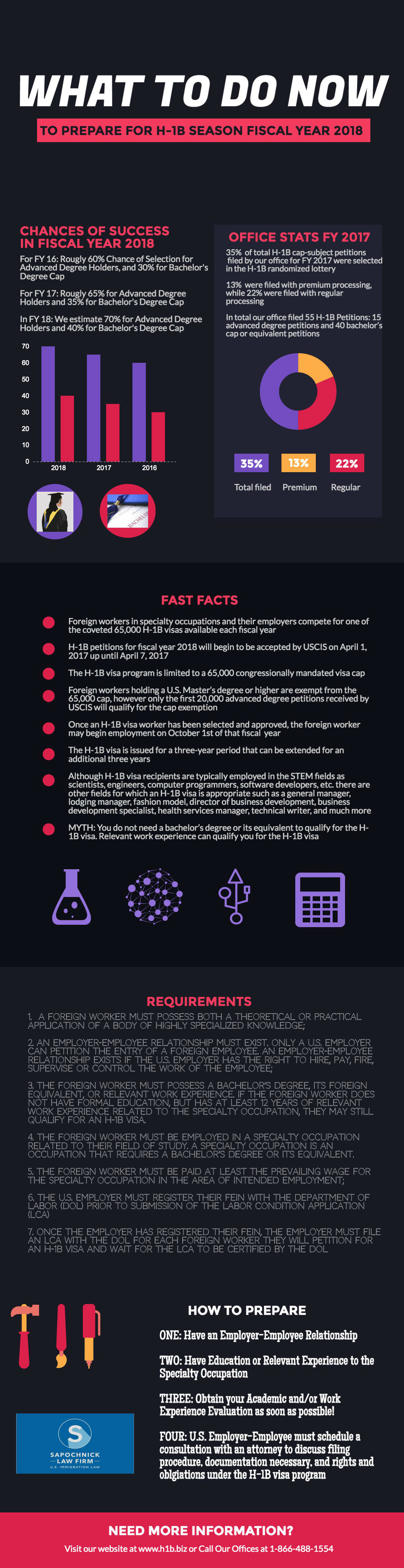
Throughout the next few months, USCIS will begin the process of returning H-1B petitions that were not selected in the H-1B lottery for fiscal year 2017. Each package will contain the respective H-1B petition along with a rejection notice specifying that the petition was not selected in the lottery. If you would like a copy of your rejection notice, please contact your employer or the attorney that filed your petition with USCIS. If you were not selected in the H-1B lottery for fiscal year 2017, there are a few visa options you may want to consider applying for. As always you can visit our website to read about the various different visa types that may be available to you. To discuss your options moving forward, please contact us for a consultation. Do not despair. Many applicants that were not selected in the H-1B lottery in previous years, have been chosen in subsequent years.

Long Term Options for Employment

Employment-Based Green Card

Typically, the employment-based green card application is the most permanent long term option for employment. The drawback is that obtaining an employment-based green card is a very long process that will require you to maintain another nonimmigrant status, while your green card application is pending. For more information on employment-based green cards please click here.

Family-Based Green Card (Adjustment of Status within the United States)

If you are the spouse, parent or child of a U.S. citizen, you may be eligible for family-based permanent residency. The green card application includes the application for employment authorization, which is granted within 3 months of filing. Employment authorization allows the applicant to work while their application is in process. Please be aware that the 3-month time frame for employment authorization is only for applicants applying for adjustment of status from within the United States. For more information about this process please click here.

Continue reading