Visa Lawyer Blog
 We would like to wish our clients a very happy Presidents Day! Please remember that our office is closed in observance of the holiday, but will reopen tomorrow. To read more about the services we offer please visit our website.


We would like to wish our clients a very happy Presidents Day! Please remember that our office is closed in observance of the holiday, but will reopen tomorrow. To read more about the services we offer please visit our website.

The H-1B visa is one of the most coveted visas in the United States for several reasons. One of the biggest perks of the H-1B visa is that it is granted for a period of three years, and can be extended for an additional three years. Recipients of the H-1B visa can also bring their dependents to live with them in the United States on an H-4 visa. The H-1B visa is also a popular option because it gives workers the flexibility of accepting and entering new employment, made possible by the portability provision of the H-1B program (8 U.S.C. § 1184(n)). The portability provision allows an H-1B worker to change jobs without having to risk falling “out of status.” Recently, USCIS also improved its portability provision with the passage of a new law that will give H-1B workers who have been laid off a 60-day grace period to transfer to a new employer. But perhaps the greatest upside to the H-1B visa however, is that it is one of the few visas that allows a nonimmigrant to apply for permanent residency as a beneficiary of an immigrant visa petition, without the immigrant petition having any negative affect on their H-1B status. This privilege is recognized in the law and is known as “dual intent.” Foreign nationals holding a “dual intent” visa such as an H-1B visa are allowed to file a green card petition, while continuing employment under the terms of their visa, and may also travel on their visa without seeking permission from USCIS.
In this sense, the H-1B visa is one of the few visas that opens a direct path to permanent residency. Other popular employment visas such as the E-2 treaty investor visa do not create a direct path to permanent residency and are not considered “dual intent” visas.
As many of you know the H-1B visa lottery for fiscal year 2018 is fast approaching. As usual, the competition will be fierce, as hundreds of thousands of highly skilled professionals prepare to file their H-1B visa petitions beginning April 1st through the April 7th deadline. While filing by April 1st (the first day that applications are accepted) certainly gives applicants greater peace of mind, filing before the April 7th deadline does not necessarily increase an individual’s chances of being selected in the lottery. Throughout the years, our office has seen the selection of many petitions that were filed on or close to the April 7th deadline. With that being said, we expect the competition this year to be even more intense, that is why we want to give you our top tips about what you should be doing NOW to prepare for H-1B season and increase your chances for success.
First some statistics on fiscal year 2017:
Chances of selection
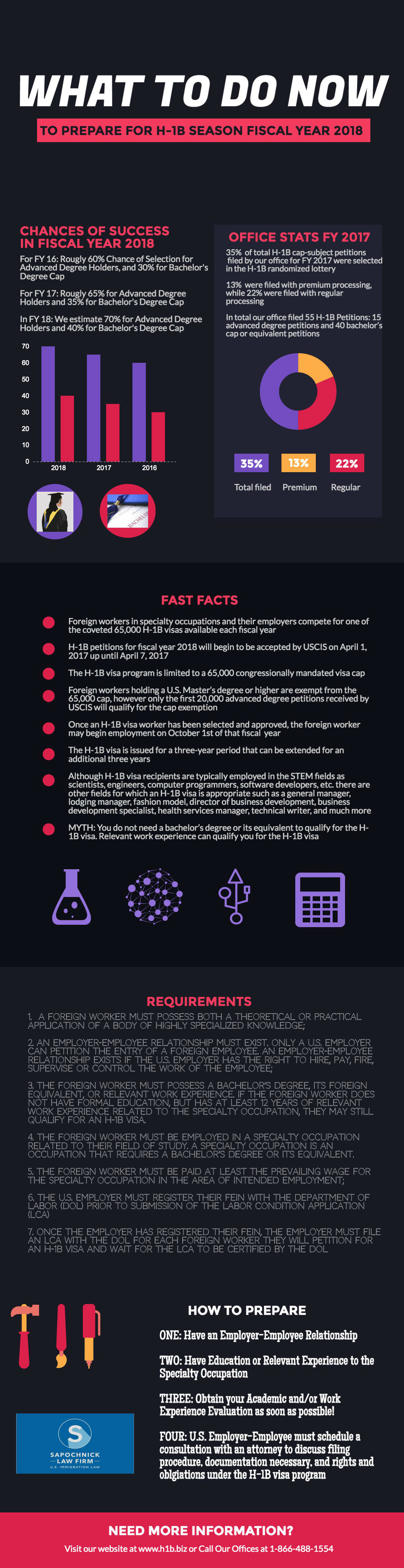
The chances of being selected in the lottery for fiscal year 2017 ran at roughly 65% for foreign workers holding a U.S. advanced degree, and roughly 35% for foreign workers holding a bachelor’s degree or equivalent. Compare this to the chances of being selected in the lottery during fiscal year 2016 which ran at 60% for U.S. advanced degree holders, and 30% for bachelor’s degree holders or the equivalent. We expect the percentage of selection to continue to increase for U.S. advanced degree holders and foreign workers holding bachelor’s degree or equivalent, by roughly 5% according to recent statistics. This of course will depend on the demand for the H-1B visa for fiscal year 2018.
Office Stats
For fiscal year 2017, 35% of H-1B cap-subject petitions that were filed by our office were selected in the H-1B randomized lottery that took place early April 2016. 13% of those petitions were filed with premium processing, while 22% were filed with regular processing. In total our office filed 55 H-1B Petitions: 15 advanced degree petitions and 40 bachelor’s cap or equivalent petitions. Of these, 46 were filed with regular processing and 15 with premium processing. The majority of these petitions were filed with the California Service Center. Of selected petitions for fiscal year 2017, the top specialty occupations included: Applications Developer, Market Research Analyst, and Software Engineer.
H-1B Overview
As in previous years H-1B petitions for fiscal year 2018 will begin to be accepted by USCIS on April 1, 2017 up until April 7, 2017. Foreign workers in specialty occupations and their employers will compete for one of the coveted 65,000 H-1B visas available each fiscal year. The H-1B visa program is limited to a 65,000 congressionally mandated visa cap. Foreign workers holding a U.S. Master’s degree or higher are exempt from the 65,000 cap, however only the first 20,000 advanced degree petitions received by USCIS will qualify for the cap exemption. In addition, certain foreign workers such as foreign workers who have been offered employment under U.S. Chile or U.S. Singapore free trade agreements, and foreign workers in the Commonwealth of the Northern Mariana Islands (CNMI) and Guam are exempt from the cap, according to the Consolidated Natural Resource Act of 2008 (CNRA). Advanced degree petitions received after the 20,000 spots have been allocated will count toward the regular cap along with foreign workers holding bachelor’s degrees (or equivalent including work experience in lieu of formal education). USCIS will receive more than the 65,000 petitions for the H-1B visa program during the first five business days that the application period is open, from April 1st to April 7th. When the cap has been reached, USCIS will make an announcement, in recent years this announcement has been made on April 7th and begin the selection process to fill the 65,000 cap through a randomized lottery system. Petitions that are not selected will be rejected along with their filing fees. Duplicate H-1B petitioners during the same fiscal year, are not allowed, and may be subject to sanctions. Employers may not file an H-1B petition on behalf of an employee more than 6 months before the employee’s intended start date. Once an H-1B visa worker has been selected and approved, the foreign worker may begin employment on October 1st of that fiscal year. The H-1B visa is issued for a three-year period that can be extended for an additional three years.
For years you have  put your trust in our office for all of your immigration needs and for that we thank you. We consider ourselves very fortunate to be able to serve you and your families. Throughout the years, we have helped thousands of immigrants from all over the world attain their American dream. Learning about their lives and their struggles has
always been an important part of our practice. Although many challenges lie ahead for immigration, we are confident that important changes will come about in the new year. Do not despair and know that our office will be with you every step of the way. We wish you and your families the happiest of holiday seasons.

The Department of Homeland Security is expected to publish a final rule tomorrow November 18, 2016 benefitting EB-1, EB-2, and EB-3 employment-based immigrant workers and highly-skilled nonimmigrant foreign workers. The final rule is effective January 17, 2017. The final rule will streamline the process for employment based sponsorship of nonimmigrant workers for lawsuit permanent resident status (LPRs), increasing job portability, and promoting stability, flexibility, and transparency in the way DHS applies its policies and regulatory practices to these programs. These changes were proposed in order to better equip U.S. employers to employ and retain highly skilled foreign workers who are the beneficiaries of employment-based immigrant visa petitions known as Form I-140 petitions. The new rule will allow foreign workers to have more flexibility, and affords workers the opportunity to further their careers by accepting promotions, giving them the freedom of being able to change positions with current employers, change employers, or pursue other employment.
The final rule conforms with longstanding policies and practices in accordance with the American Competitiveness and Workforce Improvement Act of 1998 (ACWIA) and the American Competitiveness in the Twenty-first Century Act of 2000 (AC21). The final rule seeks to further enforce the principles embodied in these pieces of legislation by providing nonimmigrant workers who have been sponsored for permanent residency based on the filing of an I-140 petition, greater flexibility and job portability, while expanding the competitiveness of American employers, boosting the U.S. economy, and protecting American workers. The final rule also clarifies and improves DHS policies and practices outlined in policy memoranda and precedent decisions of the Administrative Appeals Office. The final rule seeks to clarify regulatory policies in order to provide greater transparency to stakeholders. The final rule also clarifies interpretative questions related to ACWIA and AC21.

Today, October 24, 2016 the Department of Homeland Security published the final rule increasing fees for certain immigration and naturalization petitions processed by U.S. Citizenship and Immigration Services (USCIS). Overall the Department of Homeland Security increased filing fees for certain petitions by an average of 21 percent. The new fees will be enforced by USCIS beginning December 23, 2016. The fee schedule has been adjusted following the agency’s decision to conduct a comprehensive review of filing fees for fiscal year 2016/2017. USCIS determined that an adjustment in the filing fees would be necessary in order for USCIS to recover costs for services expended and maintain adequate service. The proposed fee schedule was first published on May 4, 2016. The final rule clarifies that all persons applying for immigration benefits may be required to appear for biometrics services or an interview, and thus must pay the biometrics services fee accordingly.
EB-5 Investor Visa Program
The EB-5 Immigrant Investor Visa Program will be most heavily impacted by the new fee schedule. The new filing fee for Form I-924, Application for Regional Center under the Immigrant Investor Pilot Program, will increase by a rate of 186% requiring Regional Centers seeking designation under the program, to pay a filing fee of $17,795 instead of the current rate of $6,230. Regional Centers will be required to pay a $3,035 annual fee to certify their continued eligibility for the designation.
The filing fee for the I-526 Immigrant Petition by Alien Entrepreneur, an application associated with the EB-5 visa program, will increase to $3,675, a 145% increase up from the current rate of $1,500. The filing fee for an investor’s petition to remove conditions on residence remains unchanged.
Naturalization
USCIS has established a three-tiered fee schedule for naturalization applicants filing Form N-400 Application for Naturalization. First, the fee schedule includes a standard filing fee for most applicants, from a rate of $595 to $640. Second, DHS has established a reduced fee of $320 for naturalization applicants whose household income is greater than 150% but less than 200% of the Federal Poverty Guidelines. Third, there will be no filing fee for naturalization applicants who are members of the military, applicants with approved fee waivers, and others who may qualify for a fee waiver according to sections 328 or 329 of the Immigration and nationality Act (INA).
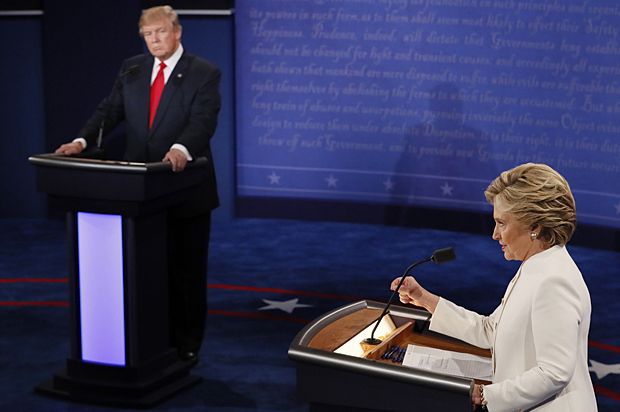
Yesterday, October 19th the third and final Presidential debate took place in Las Vegas, Nevada. This was the last opportunity Presidential candidates, Donald J. Trump, and Hillary R. Clinton, had to present their positions on various different issues, and make a final attempt to gain the support of undecided voters. The debate has left much to talk about, while many questions still remain unanswered. The moderator of the debate, Chris Wallace, of FOX news questioned the candidates on various different topics ranging from the Supreme Court nomination, economy, foreign policy, and more importantly the candidates’ positions on immigration reform.
On the subject of immigration, the moderator introduced his question on immigration by providing an overview of each candidate’s positions on immigration. Wallace discussed the fact that throughout his campaign, Donald Trump has staunchly advocated for mass deportations and the building of a more secure border, which he believes will successfully deter undocumented immigrants, criminals, and terrorists from entering the United States.
By contrast, Wallace highlighted the fact that Hillary Clinton has offered no specific plan on how she would secure our southern borders, where there is currently a massive influx of immigrants, specifically unaccompanied children from Central America, seeking refuge in the United States. Wallace reiterated Hillary Clinton’s commitment to offer a comprehensive immigration reform package within the first 100 days she is in office that includes a pathway to citizenship for undocumented immigrants, with proven ties to the United States.
Each candidate was asked to discuss why their immigration policy is the best, and why their opponent is wrong. Donald Trump was given the first opportunity to respond. Trump opened the conversation on immigration by taking the position that providing amnesty for undocumented immigrants would be a ‘disaster’ for various different reasons. First, he stated that it would be unfair for undocumented immigrants to be given a path to citizenship, while immigrants wishing to enter the United States legally, are forced to wait many years to obtain permanent residence. Second, he emphasized that securing our country’s borders is his number one priority. Trump bolstered his claim that strong borders are necessary, by referring to mothers he had met on the campaign trail, whose children were brutally killed by people he claims entered the country illegally. He also stated that for the first time ever he has been endorsed by 16,500 Border Patrol Agents, as well as ICE who share in his belief that our country needs strong borders. Third, Trump claims that strong borders are necessary to deter the thousands of people who are coming into the country illegally, and to prevent drugs from pouring into the United States. Lastly, he stated that the war on drugs is the biggest problem the United States is facing today, thus in his view this presents an even greater obligation to secure our borders. He blamed the Obama administration for its failure to deter illegal immigration, illicit drugs from coming into the United States, and for allowing criminals to enter the United States.
In this segment, we answer 5 of your most frequently asked questions received on our social media platforms and our website. Please remember that every case is different and every immigration journey is unique. You should not compare your situation to anyone else’s. We hope that our answers will provide you with further guidance while you embark on your immigration journey. If you have any further questions, please call our office to schedule a free first time consultation. We serve international clients and domestic clients in all 50 states. We thank you for your continued trust in our law office. Do you want us to answer your question? Please submit your questions to us through our website, or our Facebook page. For more information on the services we offer please click here.
The Affidavit of Support: Using Assets to Supplement Income
Q: I will be petitioning my spouse for permanent residence soon and have a question about the affidavit of support. If I do not have the support of a joint sponsor and my income does not meet 125% of the federal poverty line, can I use my assets?
A: Yes, you may use your assets to supplement your income if your total income does not meet the income requirements of the 2016 HHS poverty guidelines according to your household size, as specified by the charts below. If your total income falls short, you may submit evidence to demonstrate the value of your assets, or the sponsored immigrant’s assets, and/or the assets of a household member with their consent. Not only can the assets of the petitioner, immigrant, or household member be used to supplement any deficient income, but the assets of these persons can be combined to meet the necessary financial requirement. In order to use assets, the total value of the assets must equal at least five times the difference between your total household income amount and the current Federal Poverty Guidelines for your household size. An exception exists for U.S. citizens sponsoring a spouse or minor child. In this case, the total value of the assets must only be equal to at least three times the difference. Not all assets may be used to supplement income. Assets that can be converted to cash within one year without hardship or financial harm may only be used to supplement income. The owner of the asset must provide a detailed description of the asset (if the asset is property, an appraisal can be included or online listing from a reputable website showing the estimated value of the asset), proof of ownership of the asset (title, deed, etc.), and the basis for the owner’s claim of its net cash value. If you are using your home as an asset, you must use the net value of your home (the appraised value minus the sum of all loans secured by a mortgage, trust deed, or other lien on the home). You may use the net value of an automobile only if you can show that you own more than one automobile, and at least one automobile is not included as an asset. Other examples of typical assets used to supplement income include property, 401k, IRA, mutual investment fund, etc.
In this segment, we would like to keep our readers informed on Visa Bulletin projections for the month of October. Charles Oppenheim, Chief of the Visa Control and Reporting Division of the U.S. Department of State provides a monthly analysis of each month’s Visa Bulletin including discussion of current trends and future projections for immigrant preference categories.
Family-Based Categories:
An increase in returned unused visa numbers for the month of July and weak demand for the F-2A and F-4 categories will keep movements in family-based categories steady for the month of October.
F-4 Worldwide has advanced only slightly. All family Worldwide categories have experienced minor advances except F-2B Mexico.
The Department of State plants to comply with the Administration’s Visa Modernization Proposal, an initiative which aims to advance the dates of family-based categories as aggressively as possible during the first three quarters of the fiscal year, with the purpose of maximizing the usage of available numbers, and reducing available numbers for use in the final quarter. This initiative will likely cause similar retrogressions as in the F-4 China and India preference categories.
Employment Categories:
EB-4 and SR (Religious Worker) Preference Categories: For Special Immigrant Juvenile Status (SIJS) applicants subject to priority date backlogs, it is recommended that applicants and/or their counsel request USCIS to forward their file to the National Benefits Center (NBC), at the conclusion of their I-485 interview. This will allow the applicant’s case to remain in a “pending demand” file, to give the Department of State a sense of the demand for this category, and streamline the approval process of these applications once the priority date has become current. While USCIS adjudicators cannot request a visa number for the applicant if the priority date is not current, the National Benefits Center (NBC) has the ability to request a visa number for the applicant upon receipt of the file.
EB-4 India and Mexico; Final Action Dates El Salvador/Guatemala/Honduras: New visa number for FY 2017 are expected to bring the EB-4 India and Mexico categories current in the month of October. The final action date for EB-4 El Salvador, Guatemala, and Honduras will fall somewhere around the summer of 2015 or beyond. There is high applicant demand for El Salvador which may advance the final action date for Guatemala and Honduras.