Articles Posted in Presidential Proclamation

kelly-sikkema-kp7ENPlp8no-unsplash-scaled

We have received an outpouring of emails, comments, and messages from our loyal followers asking when Consular posts and Embassies worldwide will reopen. We understand the frustration that our readers feel and sympathize with the world situation.

While USCIS has announced that in person appointments will resume on June 4th, the Department of State has not yet released any updates regarding procedures for reopening Consulates and Embassies nationwide. Given that the pandemic is a fluid situation and travel restrictions vary from country to country, each Consulate and Embassy will reopen for in person services at a different pace.

For the moment, emergency consular services continue to be available and appointments can be scheduled for emergency related issues by contacting the US Consulate or Embassy directly. Click here for a complete list of US Consulate and Embassies including their contact information.

Outside of emergency services, the vast majority of consulates and embassies will continue to remain closed for in-person appointments for the time being. Most consulates and embassies have provided the following message on their webpage regarding availability of visa appointments:

We will resume routine visa services as soon as possible but are unable to provide a specific date at this time. The MRV fee is valid and may be used for a visa application in the country where it was purchased within one year of the date of payment. If you have an urgent matter and need to travel immediately, please follow the guidance provided at https://ais.usvisa-info.com/ to request an emergency appointment or contact AIS by phone by dialing the local number: +374 60 465 986. If calling from the U.S. dial +1-703-520-2525 or contact by email weeac_contactus+gb+info+en@visaops.net to request an emergency appointment.

You can find the local AIS number by clicking on your country on the AIS website then scrolling to the bottom of the website and clicking on “Contact Us” under the “Help” section.

Continue reading

bulletin-board-3655760_1920

The Department of State has released the visa bulletin for June 2020 outlining the availability of immigrant visa numbers for the upcoming month.


NOTE: Adjustment of Status Filing Charts June 2020

For Family-Sponsored Filings:
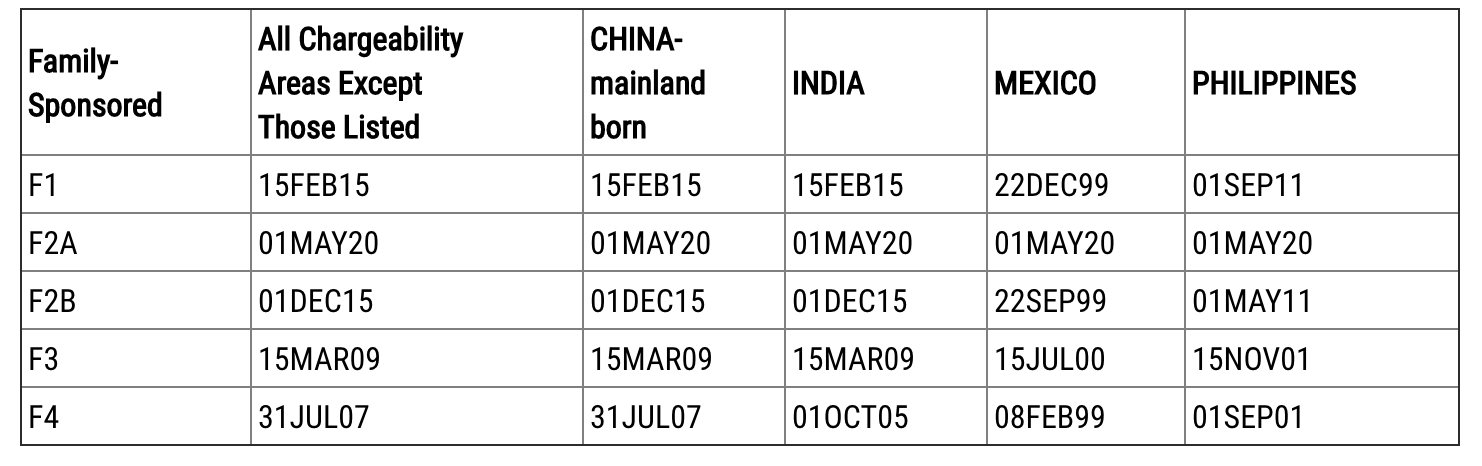
In the F2A category, there is a cutoff date on the Dates for Filing chart.  However, the category is “current” on the Final Action Dates chart.  This means that applicants in the F2A category may file for adjustment applications using the Final Action Dates chart for June 2020.

For all the other family-sponsored preference categories, you must use the Dates for Filing chart in the Department of State Visa Bulletin for June 2020

For Employment-Based Preference Filings:
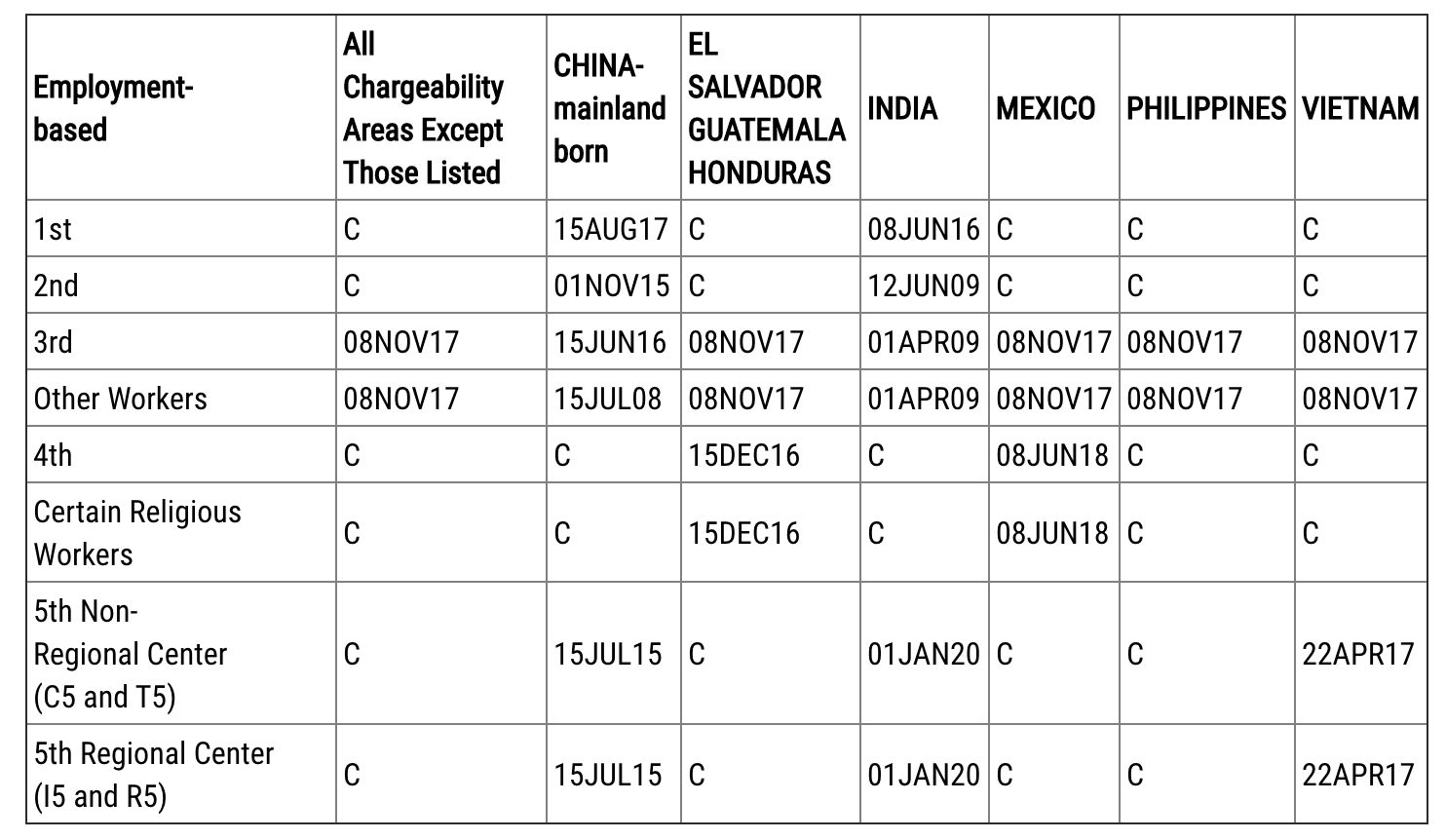
For all employment-based preference categories, you must use the Final Action Dates chart in the Department of State Visa Bulletin for June 2020.


June Visa Bulletin Cutoff Dates


Employment Based Categories

According to the Department of State’s June Visa Bulletin, the following cutoff dates will apply for the issuance of an immigrant visa for employment-based categories:

  • EB-1: All countries remain current during the month of June except for China and India. EB-1 China moved forward by one month to August 15, 2017, while EB-1 India moved forward by more than 10 months to June 8, 2016.
  • EB-2: All countries remain current during the month of June except for China and India. EB-2 China moved forward by one month to November 1, 2015, and India moved forward by 10 days to June 12, 2009.
  • EB-3 Professional and Skilled Workers: All countries remain current except for India and China. Except for India and China all countries moved forward by more than ten months to November 8, 2017. Cutoff dates for China and India advanced by one month, with China moving ahead to June 15, 2016, and India moving ahead to April 1, 2009.
  • EB-5: Most countries remain current. EB-5 China moved forward by two weeks to July 15, 2015; EB-5 India moved forward by three months to January 1, 2020; and Vietnam moved forward by three weeks to April 22, 2017.

Cutoff dates in the Dates for Filing Chart for June have remained mostly the same in comparison to the previous month, the only change is for EB-4 El Salvador, Honduras, and Guatemala which moved forward four and a half months to February 1, 2017.  USCIS will accept adjustment applications based on the Final Action Dates chart for June 2020, the same as last month.

Final Action Dates Charthttps://www.visalawyerblog.com/files/2020/05/Screen-Shot-2020-05-22-at-1.53.46-PM.png

 Family-Sponsored Categories

According to the Department of State’s June Visa Bulletin, the following cutoff dates will apply for the issuance of an immigrant visa for family-sponsored categories:

**Note only applicants in the F2A category may file using the Final Action Dates chart for June 2020 to file adjustment applications. All other family-sponsored preference categories must use the Dates for Filing chart.

Dates for Filing Charthttps://www.visalawyerblog.com/files/2020/05/Screen-Shot-2020-05-22-at-1.47.01-PM.png


Alert Regarding the April 22nd Presidential Proclamation


As you may be aware President Trump’s April 22nd presidential proclamation suspends the issuance of immigrant visas at U.S. Consulates worldwide for certain classes of immigrants until June 22, 2020, assuming the proclamation is not extended beyond this date. As Consulates worldwide begin to reopen, consular officers will enforce the presidential proclamation by refusing immigrant visas to those who were outside of the United States as of 11:59 p.m. EDT on April 23, 2020, have not been issued an immigrant visa or similar U.S. travel document, and are not otherwise exempt from the proclamation. The following types of immigrants have been specifically exempted from the proclamation and are eligible for visa issuance in June:

  • Applicants for EB-5 immigrant visas;
  • Spouses of U.S. citizens;
  • Children under 21 of U.S. citizens and prospective adoptees in the IR-4 or IH-4 visa classifications;
  • Foreign nationals seeking to enter on an immigrant visa as a physician, nurse or other healthcare professional, as well as their spouse and unmarried children under 21;
  • Foreign nationals whose entry would further important U.S. law enforcement objectives;
  • Members of the U.S. armed forces and the spouses and children of such individuals;
  • Foreign nationals seeking to enter as Special Immigrants in the SI or SQ classification, and the spouse and children of such individuals; and
  • Foreign nationals whose entry is in the U.S. national interest.

Continue reading

bill-oxford-OXGhu60NwxU-unsplash-scaled

It’s been just a few days since President Trump signed his long awaited executive order entitled, “Proclamation Suspending the Entry of Immigrants Who Present Risk to the U.S. Labor Market During the Economic Recovery Following the COVID-19 Outbreak,” and already it is being challenged in federal court.

On April 25, 2020, the first of what is sure to be many lawsuits, Doe v. Trump, was filed in the United States District Court for the District of Oregon challenging the President’s new executive order.

The lawsuit was filed by several individuals and the organization Latino Network against President Trump and the federal government.

Plaintiffs in this case have filed an emergency motion for a temporary restraining order to block the government from enforcing the new executive order, because the executive order does not contain exceptions that preserve the opportunity to request urgent or emergency services for immigrant visa applicants, including for children of immigrants who are at risk of aging out of their current visa eligibility status “by the simple passage of time.”

The lawsuit is concerned specifically with children who are in danger of aging out of their place in the visa queue because they do not have access to emergency services that would have otherwise been available had the proclamation not been issued.

“Without access to such emergency services, children whose underage preference relative status will result in unnecessary and prolonged family separation “for years—or even decades,” the lawsuit says.

Continue reading

donald-trump-4817333_1280

The long-awaited Executive Order temporarily suspending the immigration of certain aliens into the United States has been released.


WHO IS IMPACTED BY THE EXECUTIVE ORDER?


The order entitled, “Proclamation Suspending the Entry of Immigrants Who Present Risk to the U.S. Labor Market During the Economic Recovery Following the COVID-19 Outbreak,” suspends and limits the entry of the following types of aliens (for a 60-day period) beginning 11:59 p.m. eastern daylight time on April 23, 2020.


Your entry is suspended and limited if all of the following are true:

THREE PART TEST


  • You are an alien outside of the United States on the effective date of the Proclamation (April 23rd)
  • You are an alien that does not have an immigrant visa that is valid on the effective date of the Proclamation (April 23rd) and
  • You are an alien that does not have an official travel document other than a visa on the effective date of the proclamation (April 23rd) or issued on any date thereafter that permits him or her to travel to the United States and seek entry or admission
    • Official travel documents include a transportation letter, an appropriate boarding foil, or advance parole document.

ENFORCEMENT


This Proclamation shall be enforced by U.S. Consulates worldwide at their discretion giving them the power to determine whether an immigrant has established his or her eligibility and is otherwise exempted from the Proclamation. The Department of State will implement the proclamation as it applies to immigrant visas, at the discretion of the Secretary of State in consultation with the Secretary of Homeland Security.

The Department of State governs the immigration process outside of the United States, while the Department of Homeland Security governs the immigration process within the United States and guides the United States Citizenship and Immigration Services (USCIS).


WHO IS EXEMPT FROM THE EXECUTIVE ORDER?


The order expressly exempts:

  • Lawful Permanent Residents of the U.S.
  • Aliens who are the spouses of U.S. Citizens
  • Members of the U.S. Armed Forces and any spouse and child of a member of the U.S. Armed Forces
  • Aliens under 21 years of age who are children of United States Citizens and prospective adoptees
  • Aliens seeking to enter the U.S. on an immigrant visa as a physician, nurse, or other healthcare professional
  • Aliens seeking to enter the U.S. to perform medical research or other research intended to combat the spread of COVID-19
  • Any spouse any unmarried child under 21 years of age of any such alien who is accompanying or following to join the alien
  • Any alien applying for a visa pursuant to the EB-5 Immigrant Investor Program
  • Aliens whose entry furthers important United States law enforcement objectives
  • Any alien seeking entry pursuant to a Special Immigrant Visa in the SI or SQ classification, and any spouse and child of any such individual
    • SI: Certain aliens employed by the U.S. Government in Iraq or Afghanistan as translators or interpreters
    • SQ: Certain Iraqis or Afghans employed by or on behalf of the U.S. Government
  • Any alien whose entry would be in the national interest of the United States (national interest waivers)
  • Aliens seeking entry for asylum, refugee status, withholding of removal, or protection under the Convention Against Torture and Other Cruel, Inhuman or Degrading Treatment or Punishment

Continue reading

hands-998986_1920

With just a few weeks into the new year, the judicial branch has been hard at work issuing decisions that spell trouble for the Trump administration.

On Wednesday, January 15th a federal judge in Maryland issued a temporary injunction preventing the Trump administration from implementing the President’s executive order “Enhancing State and Local Involvement in Refugee Resettlement,” issued by the President on September 26th of last year.

As part of the executive order, the President authorized state and local governments to refuse the placement or resettlement of refugees in their communities stating that, the Federal government, as an exercise of its broad discretion, “should resettle refugees only in those jurisdictions in which both the State and local governments” consent to receive refugees under the Department of State’s Reception and Placement Program.

The government by its order sought to tighten the placement of refugees in the United States by allowing refugees into the United States only if both the State and local government consent to their placement in the State or locality.

In response to a lawsuit filed by refugee-resettlement organizations challenging the executive order, U.S. District Judge Peter Messitte said that the plaintiffs were “clearly likely to succeed in showing, that, by giving states and local governments veto power over the resettlement of refugees within their borders, the [executive] order is unlawful.”

To preserve the status quo, until a final decision is made on the merits, Judge Messitte issued a temporary injunction blocking the government from enforcing any part of the executive order on a nationwide basis.

Continue reading

new-year-4427195_1920

Welcome to 2020! It’s a new year and a brand-new decade. In this post, we cover the things you need to watch and groundbreaking events taking place in 2020 that will shape the future of immigration for years to come.

2020 Presidential Election

One of the most momentous events in American history will take place November 3, 2020, as Americans head to the polls to vote for the next President of the United States. The winner of the 2020 presidential election will be inaugurated on January 20, 2021.

Candidates for the Presidency will take part in dozens of debates leading up to the presidential election during the next few months. As it stands, fourteen Democratic nominees remain in the 2020 presidential race vying for an opportunity to oppose President Donald Trump come November.

The top Democratic candidates include Joe Biden, Bernie Sanders, Pete Buttigieg, and Elizabeth Warren. On February 3, 2020 these candidates will participate in the Iowa Democratic caucuses, the first nominating contest in the Democratic Party presidential primaries.

For its part, the Republican National Committee has pledged its support to President Trump in his re-election bid, meaning that Donald Trump will likely be unopposed in the 2020 Republican Party presidential primaries. Only two other Republican candidates have formally announced their intent to take part in the presidential race, including Joe Walsh and Bill Weld.

As previously reported, the outcome of the 2020 Presidential election will have a profound effect on the future of immigration, given the central role that the topic has had in American politics during the Trump administration, and its continued level of importance in the 2020 election.

The Supreme Court will take on the issue of DACA

During the Spring of 2020, several big decisions will be made on immigration by a conservative Supreme Court.

On June 28, 2019, the U.S. Supreme Court agreed to hear lawsuits filed against the Trump administration challenging the President’s decision to abruptly terminate Deferred Action for Childhood Arrivals (DACA). Oral arguments began on November 12, 2019 in Washington D.C., and a final decision is expected to be handed down by the court this spring.

Currently five conservative justices sit on the bench (Chief Justice Roberts, Clarence Thomas, Samuel Alito, Neil Gorsuch, and Brett Kavanaugh), tipping the scales in favor of conservatives with regard to the future of DACA.

A decision in favor of the President would mean the end of the program and no legislative solution to shield Dreamers from deportation. Perhaps more importantly, the decision would re-energize the President’s base, increasing the President’s chances for re-election.

While a decision against the Trump administration would preserve the DACA program and allow Dreamers to continue to live and work in the United States without fear of deportation. Such a decision would also impact the outcome of the Presidential election, given that it would unify the Democratic party and supports sympathetic to the plight of Dreamers.

Continue reading

element5-digital-T9CXBZLUvic-unsplash

In this article, we will discuss how the upcoming Presidential election could impact immigration for years to come.

On November 3, 2020 Americans will head to the polls to cast their votes for the next President of the United States. While the upcoming presidential election seems far into the future, Americans must now begin to consider how their votes could impact the future of immigration.

During the 2016 election, the topic of immigration took center stage and has continued to remain a prominent topic of contention among Democrats in Republicans. In part immigration was catapulted to mainstream media by then Presidential nominee Donald Trump, who made the topic of immigration a central issue of his campaign, by means of his campaign logo “Make America Great Again,” to highlight the discontent that many Americans felt regarding illegal immigration, the availability of jobs in the United States, and the country’s general loss of “status” in relation to other countries. Throughout his campaign, Donald Trump consistently made pledges to his supporters with respect to immigration, including a promise to build a wall and ensuring Mexico pay for it, ending birthright citizenship, ending “mass” migration of Syrian refugees, removing undocumented immigrants from the United States, and limiting legal immigration, to name a few of his campaign promises. The President also vowed to serve the interests of America and its workers, calling them “the forgotten people.” This rhetoric proved to be successful as disenchanted Americans across the country began to rally in support of Donald Trump helping him win the Presidency.

The President’s strategy was so successful, that other Republicans have taken a page out of Donald Trump’ s playbook, using the same rhetoric to gain the support of rural Americans.

This same anti-immigrant rhetoric is expected to take center stage during the upcoming presidential election. Republicans have remained united on the issue of immigration and have consistently supported Trump’s policies even where courts have struck down the President’s orders with respect to ending DACA.

Today, Americans remain largely divided on the issue of immigration, making the outcome of the Presidential election all the more unpredictable. The President’s current impeachment proceedings have also thrown a wrench into the process, creating deep divisions among party lines.

Continue reading

trump-1843504_1920

As we approach the end of the year, in this blog post, we look back at the major policy changes implemented by the Trump administration in the year 2019 that have had a profound impact on the way our immigration system functions today.

JANUARY 

Government Shutdown Woes

The start of 2019 began on a very somber note. From December 22, 2018 to January 25, 2019 Americans experienced the longest government shutdown in American history (lasting a period fo 35 days) largely due to political differences between the Republican and Democratic parties on the issue of government funding to build a border wall along the U.S. Mexico border.

The government shutdown created a massive backlog for non-detained persons expecting to attend hearings in immigration court. Because of limited availability of federal workers, non-detained persons experienced postponements and were required to wait an indeterminate amount of time for those hearings to be re-scheduled.

To sway public opinion, 17 days into the government shutdown, the President delivered his first primetime address from the Oval office where he called on Democrats to pass a spending bill that would provide $5.7 billion in funding for border security, including the President’s border wall.

With no agreement in sight, on January 19, 2019, the President sought to appease Democrats by offering them a compromise solution. In exchange for funding his border wall and border security, the President announced a plan that would extend temporary protected status of TPS recipients for a three-year period and provide legislative relief to DACA recipients for a three-year period. The President’s proposal however did not provide a pathway to residency for Dreamers, and was quickly rejected by Democrats.

On January 25, 2019, with still no solution and pressure mounting, the President relented and passed a temporary bill reopening the government until February 15, 2019.

Meanwhile, immigration courts across the country were forced to postpone hundreds of immigration hearings, with Minnesota, Pennsylvania, and Kentucky being the most deeply affected by the shutdown.

Changes to the H1B Visa Program

On January 30, 2019, the Department of Homeland Security announced proposed changes to the H-1B visa program including a mandatory electronic registration requirement for H1B petitioners filing cap-subject petitions beginning fiscal year 2020, and a reversal in the selection process for cap-subject petitions. The government outlined that it would first select H-1B registrations submitted on behalf of all H-1B beneficiaries (including regular cap and advanced degree exemption) and then if necessary select the remaining number of petitions from registrations filed for the advanced degree exemption. Moreover, only those registrations selected during fiscal year 2020 and on, would be eligible to file a paper H1B cap petition.

Continue reading

healthcare-4235817_1920

The President has once again targeted the immigrant population by signing a Presidential Proclamation suspending the entry of any immigrant who will “financially burden the United States healthcare system.”

While the Presidential Proclamation is likely to encounter resistance in court, as it stands the Proclamation is slated to become effective on November 3, 2019.

According to the Proclamation, a person seeking to immigrate to the United States will be found to be a financial burden on the U.S. healthcare system, unless they can prove either one of the following:

  • They are covered by approved health insurance, within 30 days of their entry to the United States, or
  • They have the financial resources to pay for reasonably foreseeable medical costs.

Beginning November 3, 2019, prior to the adjudication and issuance of an immigrant visa, a non-citizen seeking to immigrate to the United States, must establish to the satisfaction of a consular officer that they will not become a burden on the health care system by either of the means outlined above.

Who does the Proclamation apply to?

Only non-citizens seeking to enter the United States pursuant to an immigrant visa.

Continue reading