6855902540_2e5c5034a1_z

Throughout the next few months, USCIS will begin the process of returning H-1B petitions that were not selected in the H-1B lottery for fiscal year 2017. Each package will contain the respective H-1B petition along with a rejection notice specifying that the petition was not selected in the lottery. If you would like a copy of your rejection notice, please contact your employer or the attorney that filed your petition with USCIS. If you were not selected in the H-1B lottery for fiscal year 2017, there are a few visa options you may want to consider applying for. As always you can visit our website to read about the various different visa types that may be available to you. To discuss your options moving forward, please contact us for a consultation. Do not despair. Many applicants that were not selected in the H-1B lottery in previous years, have been chosen in subsequent years.

Long Term Options for Employment

Employment-Based Green Card

Typically, the employment-based green card application is the most permanent long term option for employment. The drawback is that obtaining an employment-based green card is a very long process that will require you to maintain another nonimmigrant status, while your green card application is pending. For more information on employment-based green cards please click here.

Family-Based Green Card (Adjustment of Status within the United States)

If you are the spouse, parent or child of a U.S. citizen, you may be eligible for family-based permanent residency. The green card application includes the application for employment authorization, which is granted within 3 months of filing. Employment authorization allows the applicant to work while their application is in process. Please be aware that the 3-month time frame for employment authorization is only for applicants applying for adjustment of status from within the United States. For more information about this process please click here.

Continue reading

8168034654_b59a79c5ba_bConditional Permanent Residence

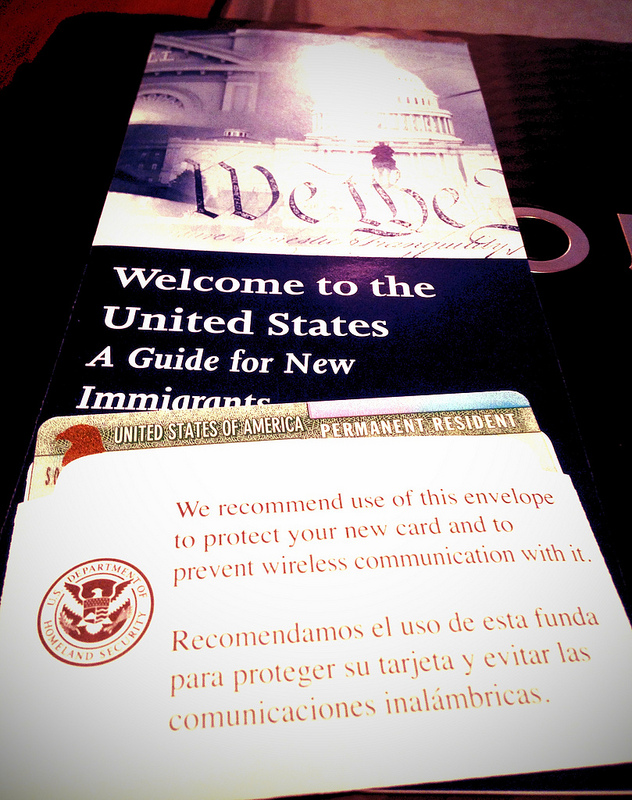
If you have received a two-year conditional permanent resident card, based on your marriage to a United States citizen, you are required to remove the conditions on your green card before the expiration date, by filing the Form I-751 Application for Removal of Conditions jointly with your spouse. Many clients often ask, “how do I know if I am a conditional permanent resident?” You will know if you are a conditional permanent resident if your green card contains the abbreviations ‘CR’ under the immigrant ‘category.’ Foreign spouses of US Citizens will be able to locate the abbreviation ‘CR 6’ on their green cards. If this abbreviation applies to you, you must file the I-751 removal of conditions application jointly with your spouse, within the 90-day window immediately before your conditional green card expires. For example, if your two-year green card expires on August 7, 2016, the earliest day to file your removal of conditions application would be May 9, 2016 up to the date of expiration. If you are no longer married to the US Citizen spouse through which you gained conditional permanent residence, you may seek a waiver of the joint filing requirement and file the application alone.

Proper and Timely Filing of the I-751 Removal of Conditions Application

USCIS must receive your properly completed removal of conditions application along with the filing fee, during this 90-day window, otherwise your application will be rejected if you do not have a legitimate reason for filing your application outside the deadline. If you are unsure of the time period in which you must file your I-751 application, you should consult with a licensed immigration attorney early on in the process. If you have decided to file the I-751 application on your own, without the assistance of an attorney, you must read the I-751 Form Instructions VERY CAREFULLY and contact the USCIS National Customer Service Line with questions.

Why do I need to file the removal of conditions application?

USCIS grants two-year conditional green cards to foreign spouses of U.S. Citizens, if the foreign spouse has been married to the US Citizen spouse for less than two years (on the date that they are granted permanent residence). Foreign spouses who have been married to their US Citizen spouse for more than two years (on the date they are granted permanent residence), receive permanent ten-year green cards. Permanent residents, as opposed to conditional permanent residents, do not need to file the I-751 removal of conditions application, because they already have been granted the ten-year green card.

Clients typically ask us; why must I file the removal of conditions application if I have already gone through the rigorous green card process with my spouse?

USCIS requires you to jump yet another hurdle in order to ensure that you have entered your marriage in good faith, and not to gain an immigration benefit. The I-751 therefore, is a fraud prevention mechanism for newly married couples, requiring them to prove that they did not get married to evade the immigration laws of the United States. As part of the removal of conditions application process, the couple must provide documented evidence showing that they have been living together from the date of marriage to the present (joint lease agreement), that the couple has commingled their finances during their marriage (joint income tax returns, joint bank accounts, joint insurances, joint loans, etc.), that the couple shares joint responsibility of assets and liabilities within the household (joint utility bills, joint insurance policies, joint financial responsibilities), and that the couple spends time together on a regular basis (photographs of the couple from date of marriage to present, phone records, e-mails, text-messages, social media correspondence, hotel/flight reservations, evidence of joint trips taken together, affidavits from friends and family members, etc.)

Continue reading

26762616905_3855617f27_zAs previously reported, the Department of Justice is currently facing off in court against a federal judge from the State of Texas, who has accused federal prosecutors of misrepresenting, and withholding information in federal court, related to the implementation of the expanded Deferred Action for Childhood Arrivals (DACA) program and new Deferred Action for Parents of Americans and Lawful Permanent Residents (DAPA) program that was scheduled to take effect on February 18, 2015, as part of President Barack Obama’s executive actions on immigration. All of that changed, when Judge Hanen filed a temporary injunction in court, blocking these executive orders from taking effect, just days before February 18, 2015. Judge Hanen is asking the court to punish federal prosecutors working for the Department of Justice by forcing them to attend mandatory ethics courses.

In addition, Hanen has requested that the Department of Homeland Security hand over the names, addresses, and other information of individuals who were unlawfully granted immigration benefits under these programs. On Friday, a group of undocumented individuals came forward, asking an appellate court to respect their privacy by not turning over their personal information to the State of Texas, and other interested parties. This group of undocumented individuals is currently being represented by the American Civil Liberties Union (ACLU) and the National Immigration Law Center (NILC). Attorneys for the group are expected to argue before the U.S. Court of Appeals for the Fifth Circuit in order to block Judge Hanen’s order.

Continue reading

5132848528_8a47684a87_z

Massachusetts Governor Charlie Baker has proposed a new policy that will allow State Police to contact federal immigration authorities for the purposes of verifying the immigration status of suspects already in custody on state criminal charges. In taking this step, Governor Baker, a Republican, is undoing the actions of his Democratic predecessor, ex-governor Deval Patrick. This new proposal will be put in place to allow federal law enforcement officials to better combat terrorism, gangs, and other activity of a criminal nature in the state of Massachusetts. This policy will affect undocumented immigrants, as well as legal permanent residents, with extensive criminal records or those convicted of serious crimes of moral turpitude.

State police will not be able to apprehend individuals based on immigration violations alone. Instead, as a result of this new policy, state troopers will be able to contact Immigration and Customs Enforcement (ICE) and inquire with ICE whether a person in custody is considered a ‘priority target.’ A ‘priority target’ is someone who has extensive criminal history or poses a security risk. By law, state police cannot enforce federal immigration law, but they will be able to assist federal law enforcement officials in detaining individuals in custody who pose a significant threat to the country’s national security.

Continue reading

15531282194_c5c9b33b52_bToday May 31, 2016 the United States Department of Justice (DOJ) filed an emergency motion to prevent a federal judge from the State of Texas from imposing sanctions on DOJ prosecutors, requiring them to attend mandatory ethics classes. The federal judge in question is Andrew Hanen, the same judge who issued a temporary injunction blocking the expanded DACA and DAPA programs from taking effect on February 18, 2015, as originally intended by the Obama administration. The case United States v. Texas has made its way up to the Supreme Court of the United States. An official ruling assessing the legality of the expanded DACA and new DAPA program is expected this summer.

Judge Hanen filed the judicial order after federal prosecutors acknowledged that they were not completely transparent in regards to implementation of the expanded DACA and new DAPA program. Hanen argues that he was assured that the government would not start implementation of these programs until February 18, 2015 when in fact the government implemented a portion of the program before February and granted more than 100,000 applications. After reading government briefs acknowledging this information, Judge Hanen claimed that attorneys for the Department of Justice were not only knowledgeable of the facts, but were guilty of misrepresenting them in federal court.

In addition to ordering sanctions on federal prosecutors, Judge Hanen has ordered the Department of Homeland Security (DHS) to provide the names of individuals who were granted benefits under these programs, despite not being eligible to receive those benefits. This move would require the Department of Justice to release the records of more than 50,000 people.

14088211137_c71a919911_zOn behalf of our Law Office, we would like to wish you a safe and Happy Memorial Day as you spend it with your loved ones. Thank you for your service.

For more information about the services we offer please click here.


Screen Shot 2016-05-26 at 2.59.40 PM

The state of Colorado is set to pass a new bill known as HB16-1391 that will prosecute non-attorneys posing as licensed immigration attorneys or legal representatives in matters relating to immigration. Colorado Senator Dan Pabon, first introduced the bipartisan bill, HB 16-1391 the Immigration Consultants Deceptive Trade Practice, before the Colorado Senate earlier this year. The focus of HB16-1391 is to crackdown on “notarios” targeting the Hispanic community, who are not licensed to practice law in the United States. The word “notario” in some Latin American countries refers to a person that is either highly trained to conduct legal matters or is an attorney. The word notary in the United States takes on a different meaning. A notary public in the United States is not an attorney and cannot conduct legal matters. They cannot provide legal advice nor represent individuals before court. Instead, a notary public can attest or certify writings to make them authentic. Notary publics are typically involved in the certification of affidavits, depositions, and other negotiable documents. In the United States they witness the making of documents and sign in order to attest that documents are authentic. The Hispanic community is often misled by these “notarios” who advertise themselves as authorized legal representatives and/or attorneys for compensation. Despite the fact that these “notarios” are not authorized to offer legal consultations, they often do causing irreparable damage to the people they serve. They often give false hope to people in the United States unlawfully and mislead them into applying for an immigration benefit they are not eligible to receive, prompting their removal from the United States. The bill, Immigration Consultants Deceptive Trade Practice, will prohibit non-attorneys from conducting consultations, receiving compensation, and providing legal services to individuals related to immigration.

Continue reading

6431170125_725b09e571_z

The U.S. Department of State (DOS) recently released the June Visa Bulletin. The Chief of Visa Control and Reporting Division, Charles Oppenheim has provided new insights and developments pertaining to the June 2016 Visa Bulletin. Cutoff dates listed below form part of the final action (FA) chart of the Visa Bulletin. Currently, USCIS has advised adjustment of status family-sponsored and employment-based applicants to refer to cutoff dates that appear on the final action chart for the month of June, and not the date of filing chart.

Employment-Based, First Preference (EB-1)

Demand for the EB-1 category remains at a very high level. DOS has said that should demand continue to remain at the same rate, some form of “corrective action” would be necessary before the close of the fiscal year to regulate worldwide visa numbers. This may require the establishment of a cutoff date or other form of regulation.

India Employment-Based, Second Preference (EB-2)

Demand for the EB-2 category is also very high. Due to increasing demand, there will no longer be unused numbers available in excess of the normal EB-2 per-country limit. EB-2 Worldwide and EB-2 India demand is expected to increase. The high level of demand for visa numbers in the EB-2 India Category and lack of excess numbers from EB-2 worldwide has caused the EB-2 India final action date to retrogress to October 1, 2004 for the month of June.The DOS expects that the EB-2 India cutoff date will advance slowly for the rest of the fiscal year, at a pace similar to the EB-3 advancement.

Continue reading

1a233a6

In this segment, we answer 4 of your most frequently asked questions received on our social media platforms and our website. Please remember that every case is different and every immigration journey is unique. You should not compare your situation to anyone else’s. We hope that our answers will provide you with further guidance while you embark on your immigration journey. If you have any further questions, please call our office to schedule a free first time consultation. We serve international clients and domestic clients in all 50 states. We thank you for your continued trust in our law office. For more information on the services we offer please click here.

Consular Report of Birth Abroad (CRBA) and the Affidavit of Support

Q:  I am a US Citizen married to a foreign national. We have a child together. We recently moved to the United States from abroad.  My husband and son entered the United States on a B-2 visa and we are planning to apply for their adjustment of status. My question is regarding the Form I-864 Affidavit of Support. I have just secured employment and will be able to sponsor my family. I want to know what documents are required in support of the Affidavit of Support as proof that I have sufficient income to support my family. At the moment I do not have pay stubs. I plan to start my employment next month.

A: Thank you for your question. If your child was born abroad, your child may acquire U.S. Citizenship by filing for a Consular Report of Birth Abroad (CRBA, Form FS-240) before your child reaches their 18th birthday. To do so, the U.S. Citizen parent must report the birth of the child at their nearest U.S. Embassy or Consulate. Anytime that a child of a U.S. Citizen parent is born abroad, the parent must report the birth to nearest U.S. Consulate as soon as possible. This will allow the Consulate to issue a Consular Report of Birth Abroad as an official record of your child’s claim to U.S. Citizenship. The CRBA may be used as proof of your child’s U.S. Citizenship and allows the child to obtain a U.S. passport. A child with a consular report of birth abroad receives the same privileges as a child born in the United States. It is recommended that you first contact your closest U.S. embassy or Consulate before filing a petition for your son, because it is likely that you will not need to go through the immigration process for your son.

Continue reading

2982449071_57fc209774_z
According to a new study by the Pew Research Center, the number of permanent residents applying for U.S. Citizenship has risen 5% when compared to the 2012 election cycle. This fiscal year USCIS received the highest number of applications for naturalization in four years. The Pew Research Center suggests that the recent surge in applications for naturalization is not due to political reasons.

This fiscal year approximately 249,609 permanent residents applied for naturalization, a 13% increase from the previous fiscal year, according to preliminary data provided by the U.S. Citizenship and Immigration Services. During the last election cycle, in fiscal years 2011 and 2012, there was a 19 % increase in applications, compared to this year’s election cycle at 13%. Research conducted by the Pew Research Center indicates that the increase in the number of applications is due to practical reasons, such as avoiding fee increases and criminal prosecution, and not for political reasons. For instance, during fiscal years 2007 and 2008, the number of naturalization applications decreased by 62%, at a time when USCIS announced an increase in the application fee for adults, from $330 to $595, taking place on July 30, 2007. As a result of this announcement, an unusual number of applications were filed before the planned increase in filing fees. In fiscal year 2007, before the increase in filing fees, the number of naturalization applications increased by 89% compared to fiscal year 2006. This was the largest increase in naturalization applications ever seen since 1907.

From fiscal year 1995 to 1998, more than 900,000 people applied for citizenship every fiscal year, reaching a record high 1.4 million naturalization applications in fiscal year 1997, due to a series of Congressional legislation enacted in the mid 1980s. According to the Pew Research Center, one such legislation was the Immigration Reform and Control Act of 1986, which gave approximately 2.7 million undocumented immigrants the opportunity to become legal permanent residents. This piece of legislation increased the pool of potential citizens who would apply for naturalization within 5-10 years. By 2009, nearly 40% of permanent residents had become U.S. Citizens. In 1996 Congress passed laws restricting public benefits and legal protections of noncitizens, and expanded the list of offenses for which legal permanent residents could be prosecuted and deported. These laws prompted millions of permanent residents to apply for naturalization out of fear of deportation.