Articles Posted in National Visa Center

8730510414_5b1c164d98_c

On September 21, 2016 the United States Citizenship and Immigration Services (USCIS) posted the adjustment of status filing dates for October 2016.

If you are waiting to apply for permanent residence based on an approved family-sponsored petition (I-130) or based on an approved employment-based petition (I-140), USCIS has advised that you refer to the ‘Dates for Filing Applications’ chart on the October Visa Bulletin to determine when to file your application for permanent residence according to your priority date (the date when your relative or employer properly filed your immigrant visa petition with USCIS) and your preference category. Generally, applicants who have filed the immigrant petition and have been approved, must wait in line until an immigrant visa becomes available, before seeking adjustment of status to permanent resident. This is because availability of immigrant visas for certain classes of immigrants are limited. These preference categories appear in the Visa Bulletin, as well as the number of visas available for each preference category.

Note: For employment-based petitions if a labor certification is required to be filed with your immigrant visa petition, the priority date is the date the labor certification application was accepted for processing by the Department of Labor.

What is the Visa Bulletin and the Dual Chart System?

Every month, the Department of State releases a monthly Visa Bulletin which provides estimates on immigrant visa availability according to family-sponsored and employment-based preference categories. As you may recall, in September of last year, USCIS introduced a new chart called the ‘Dates for Filing Applications’ chart in addition to the ‘Application Final Action Date’ chart. Together this dual chart system governs when applicants may file their applications for permanent residence according to visa availability, the applicant’s preference category, and the date of filing (priority date).
Continue reading

1325250967_567-armresling-simvol

Our clients often ask us what the difference is between adjusting their status within the United States versus applying for a green card at a United States consulate abroad. In order to adjust your status to permanent resident within the United States by filing Form I-485, you and your spouse must be living inside of the United States at the time of filing. The intending immigrant must also have entered the United States legally in order to adjust status within the United States, although there are few exceptions (as is the case of individuals who qualify for 245i). This means that generally, in order to qualify for adjustment of status, you must have been inspected by a U.S. Customs official at a United States port of entry. As part of the Adjustment of status process, the green card applicant must be able to prove that they were inspected upon entry by showing their I-94 arrival/departure record. The I-94 is a small white paper that is placed in the passport containing a stamp of admission with the date of entry, place of entry, the person’s name, I-94 number, and other important details.

I-94A

Sample I-94 arrival/departure record

If you did not receive a paper I-94 in your passport, you may obtain your I-94 electronically by visiting the DHS website.

Consular processing on the other hand is an option that is typically utilized for spouses of US Citizens residing abroad and/or foreign spouses who have never visited the United States, do not have a United States visa, or cannot obtain one, because they are already married to a US Citizen. Foreign spouses who are obligated to travel frequently such as businesspersons may also prefer to obtain an immigrant visa through ‘consular processing’ because this process does not prohibit international travel. Adjustment of status applicants on the other hand are prohibited from traveling internationally once the I-485 green card application has been filed, unless they have received travel permission from USCIS known as an advance parole document. If the applicant travels without this advance parole document, the I-485 application will be considered abandoned.

Advance Parole for Adjustment of Status Applicants

In order to receive this advance parole document, the applicant must file Form, I-131 Application for Travel Document at the same time as Form, I-485 in order to return to the United States after temporary foreign travel. If the applicant wishes to apply for a work permit they must also file Form, I-765 Application for Employment Authorization. There is no additional fee for the I-131,765 applications if the applicant has a pending I-485 application with USCIS. The I-131,765 applications take approximately 90 days to process from date of filing and culminate in a travel/work permit combo card known as the EAD (Employment Authorization Document). This document allows the applicant to work, travel, obtain a SSN number, and driver’s license. Consular Processing applicants do not receive any travel or employment authorization and cannot obtain a driver’s license or SSN until they have received their green card once they enter the United States with an immigrant visa.

Adjustment of Status Benefits

There are many benefits that come with adjusting your status within the United States however to qualify you and your spouse must be living in the United States and you must have been inspected upon entry to the United States (with few exceptions), otherwise you are not eligible to apply for adjustment of status within the United States. If you have committed any immigration violations or have a serious criminal history, you must consult an attorney.

Continue reading

1a233a6

In this segment, we answer 4 of your most frequently asked questions received on our social media platforms and our website. Please remember that every case is different and every immigration journey is unique. You should not compare your situation to anyone else’s. We hope that our answers will provide you with further guidance while you embark on your immigration journey. If you have any further questions, please call our office to schedule a free first time consultation. We serve international clients and domestic clients in all 50 states. We thank you for your continued trust in our law office. For more information on the services we offer please click here.

Consular Report of Birth Abroad (CRBA) and the Affidavit of Support

Q:  I am a US Citizen married to a foreign national. We have a child together. We recently moved to the United States from abroad.  My husband and son entered the United States on a B-2 visa and we are planning to apply for their adjustment of status. My question is regarding the Form I-864 Affidavit of Support. I have just secured employment and will be able to sponsor my family. I want to know what documents are required in support of the Affidavit of Support as proof that I have sufficient income to support my family. At the moment I do not have pay stubs. I plan to start my employment next month.

A: Thank you for your question. If your child was born abroad, your child may acquire U.S. Citizenship by filing for a Consular Report of Birth Abroad (CRBA, Form FS-240) before your child reaches their 18th birthday. To do so, the U.S. Citizen parent must report the birth of the child at their nearest U.S. Embassy or Consulate. Anytime that a child of a U.S. Citizen parent is born abroad, the parent must report the birth to nearest U.S. Consulate as soon as possible. This will allow the Consulate to issue a Consular Report of Birth Abroad as an official record of your child’s claim to U.S. Citizenship. The CRBA may be used as proof of your child’s U.S. Citizenship and allows the child to obtain a U.S. passport. A child with a consular report of birth abroad receives the same privileges as a child born in the United States. It is recommended that you first contact your closest U.S. embassy or Consulate before filing a petition for your son, because it is likely that you will not need to go through the immigration process for your son.

Continue reading

294797273_6efed53754_o

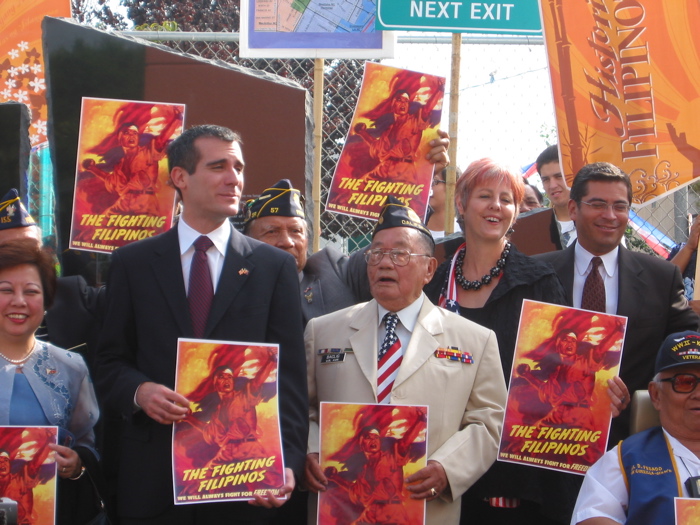
The United States Citizenship and Immigration Services will allow the families of certain Filipino World War II veterans to reunite with veterans beginning June 8, 2016 as a result of a new policy change called Filipino World War II Veterans Parole Policy. In order to qualify, extended family members of veterans must be beneficiaries of approved family-based immigrant visa petitions, and be awaiting the availability of an immigrant visa. Certain extended family members of U.S. Citizen or LPR Filipino World War II Veterans will have the opportunity to receive advance parole on a ‘discretionary’ case-by-cases basis in order to travel to the United States to be with their loved ones, while they await an immigrant visa to become available. In addition, certain relatives of deceased Filipino World War II veterans, will be able to seek parole for themselves. This new policy change has been implemented to honor Filipino veterans who enlisted in the World War II Veterans Parole Program to fight for our country during World War II. The initiative will also allow extended family members to care and support their U.S. Citizen or LPR veteran family members during the advanced stages of their life. According to the policy, approximately 2,000 to 6,000 family members will be able to benefit from this new policy change. Applications for the the Filipino World War II Veterans Parole Program will not be accepted until June 8, 2016.

Presently, the process of immigrating extended family members of U.S. Citizens and Legal Permanent Residents residing abroad is a very complex and antiquated process. This is because there is a limit to the number of immigrant visa applications that can be issued for extended family members. The Visa Bulletin outlines the numerical immigrant visa limitations for family-sponsored and employment-based preference categories established by the Immigration and Nationality Act (INA).

Continue reading

5086531784_ed4e1a8a69_z
For this blog we are answering 5 questions we have recently received through our social media platforms and our website. Please remember that every case is different and every immigration journey is unique. You should not compare your situation to anyone else’s. We hope that our answers will provide you with further guidance while you embark on your immigration journey. If you have any further questions, please call our office for a free legal consultation. We serve international clients and domestic clients in all 50 states. We thank you for your continued trust and interest in our law office.

Change of Status B-2 to F-1

Q: I need advice regarding my change of status. I am currently in the United States on a B-2 tourist visa. I have filed a change of status application to change my status to F-1 student. My B-2 duration of stay will expire today and my change of status application to F-1 student is still pending with USCIS. I informed my school that I will be postponing my classes and was notified that I need to file a new I-20 and provide some missing information. I have time to make adjustments to my application but I would like to know the steps to correct any missing information. I also wanted to know if I need to leave the United States immediately since my F-1 application is still pending. Please assist.

9033805851_a19992134e_z

On Thursday, December 31, 2015 the Department of Homeland Security published a new proposed rule affecting highly skilled immigrant and non-immigrant workers alike. The proposed rule, introduced in last week’s federal register, aims to improve the ability of American employers to hire and retain highly skilled workers waiting to receive their employment-based lawful permanent residence in the visa bulletin backlogs. Additionally, the proposed rule aims to enhance opportunities for such workers allowing them to be more easily promoted, to accept lateral positions with their current employers, change employers, and pursue other employment. While the proposed rule is not groundbreaking, it does address important challenges employers and their highly skilled workers have faced as the law stands today and makes recommendations for such relief. The proposed rule will be open for comment until February 29, 2016.

You may remember that on November 20, 2014 the President highlighted, as part of his executive actions on immigration, that the employment-based immigration system needed to be amended to modernize, improve, and clarify immigrant and nonimmigrant visa programs in order to create more jobs, foster innovation at home, retain a highly skilled workforce that would allow the United States to compete with other countries, and to stimulate the American economy overall.  In order to modernize the employment based immigration system, USCIS would be required to work with the Department of State to modernize and simplify the immigrant visa allocation process. Part of this process would require the Department of State to make reasoned projections of employment-based immigrant visa availability on the visa bulletin, that could be relied upon by employers and their highly skilled workers.

Presently, immigrant workers from India and China are experiencing extraordinary delays in the employment-based queue for permanent residence, while other highly skilled workers are forced to wait over a five-year period to receive company sponsorship and lawful permanent residence. Furthermore, such workers are forced to remain on temporary employment-sponsored visas in the United States while waiting for an immigrant visa to become available to them. This puts the immigrant worker in a predicament giving the employer the upper hand, while restricting the employee from seeking advancement and discouraging new employment, since this would require the employer to file a new petition and incur the expensive fees required for filing. Highly skilled works facing extortionate delays in the visa backlogs have experienced hindered employer/employee career advancement and job mobility. The new rules will provide limited relief in this area.

Continue reading

3285309862_e84a0f6bae_z

The December visa bulletin was recently released by the DOS on November 9, 2015. For the month of December CIS has announced that family based applicants must use the ‘date of filing’ chart to determine when their adjustment of status applications may be filed. This means that for family based preference categories, there are presently immigrant visas available and demand has not yet been met for the fiscal year. Employment based applicants must refer to the ‘final action date’ chart as a basis for applying for adjustment of status. This means that presently there is more demand than immigrant visas available for employment based categories. For the month of December, filing dates have remained unchanged. The impact of the dual chart system will not be felt until CIS requests visa numbers from the DOS in April 2016 for adjustment of status filings based on the October Visa Bulletin. In this post we will discuss new announcements that have appeared on the December visa bulletin and projections for EB-2 India, EB-2 and EB-3 China, F-2A, and F-2B. These projections are based on guidance provided by the Chief of the Visa Control and Reporting Division, Charles Oppenheim. While they do not guarantee actual immigrant visa availability, these projections are helpful reference points.

Replacement of Foreign Affairs Manual (FAM) and New Visa Waiting List

The December visa bulletin has announced that the Foreign Affairs Manual (FAM) used internally by the Department of States will be replaced with 9 FAM-e beginning November 18, 2015. Public release of the new FAM has not yet been announced.

Additionally, a ‘Visa Waiting List’ will be released beginning with the January Visa Bulletin which will provide applicants information on the National Visa Center waiting list starting November 1, 2015.

Continue reading

5472552839_62d81a34e8_z

In this blog we are answering 5 of your most frequently asked questions received on our social media platforms and our website. Please remember that every case is different and every immigration journey is unique. You should not compare your situation to anyone else’s. We hope that our answers will provide you with further guidance while you embark on your immigration journey. If you have any further questions, please call our office for a free legal consultation. We serve international clients and domestic clients in all 50 states. We thank you for your continued trust in our law office.

Qualifying for 245i and Adjustment of Status

Q: My ex-husband filed an adjustment of status application on my behalf based on 245i. We separated before we received our initial interview appointment and later divorced. I have since remarried. Can my husband apply for my permanent residence now that we are married?

A: Thank you for your question. Certain individuals who have a qualifying relative willing to file an immigrant visa petition on their behalf, are eligible to adjust their status under 245i Immigration and Nationality Act if they entered the country without inspection (unlawfully) and were the beneficiary of a visa petition or application for labor certification filed on specific dates outline below. Before proceeding with a new green card application, you should make sure you qualify for 245i and have all of the necessary documents to prove your eligibility. 245i applicants must provide documented evidence of their physical presence in the United States and evidence that the visa petition or application for labor certification was filed on their behalf by providing the receipt notice of the petition also known as the I-797 Notice of Action.

Continue reading

ellis

Photograph taken at Ellis Island

Further changes have been made to the November Visa Bulletin published earlier this month by the Department of State. The dual chart system remains in place including the ‘final action date’ chart and ‘date of filing’ chart. So what has changed? USCIS has become more involved in the application process for family-sponsored and employment-based immigrant applications since the introduction of the date of filing chart. A disclaimer has now been added to the November Visa Bulletin above the date of filing chart which instructs applicants to visit the USCIS website for more instructions on how and when the chart is to be used. USCIS has created this new web page to notify applicants whether they can proceed with applications for permanent residence based on the date of filing chart published monthly on the Visa Bulletin. The website will be updated within about a week of the publication of the Visa Bulletin every month. The webpage is intended to provide applicants information in regards to visa availability for family-sponsored and employment-based immigrant visas for each fiscal year, letting applicants know whether the filing date chart is enforceable. So far, USCIS has indicated that the filing date chart for October and November 2015 is enforceable.

Continue reading

1

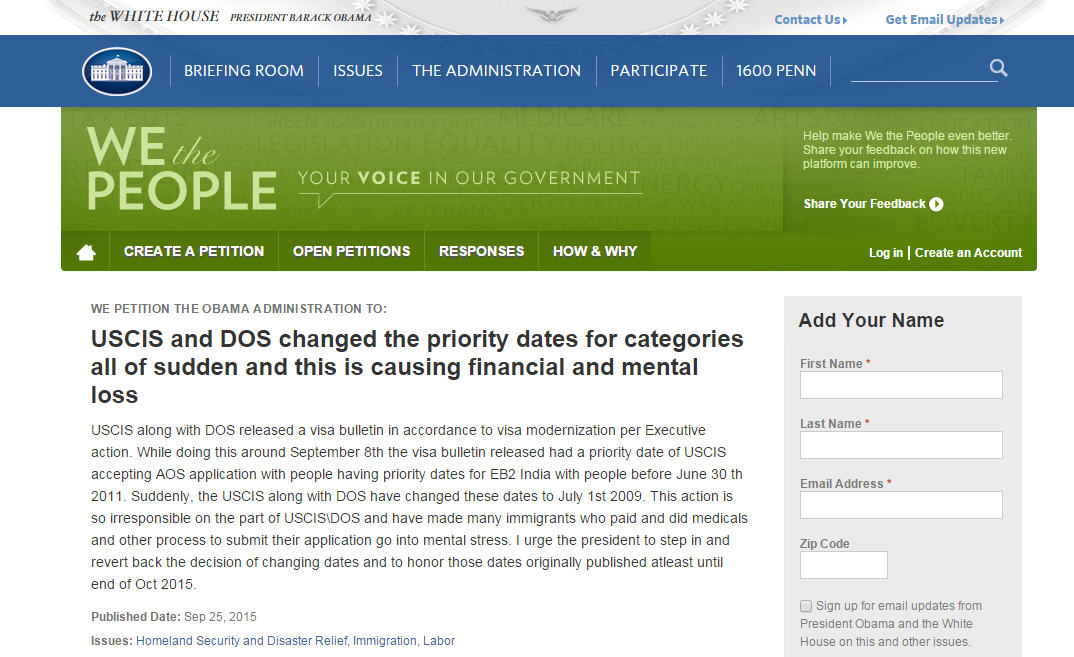
Last week, we reported to our readers that on September 25th the Department of State and USCIS re-issued the October Visa Bulletin and changed the date of filing chart drastically, rolling back the ‘Dates of Filing’ for heavily used visa categories, including employment based and family-sponsored petitions. The American Immigration Lawyers Association, along with policymakers, and immigration advocates, are urging Congress, the White House, USCIS, and Department of State to restore the initial dates of filing that were authorized and released on September 9th 2015 with the October Visa Bulletin.

If you would like to pressure the government to honor the initial dates of filing, released on September 9th, we invite you to sign the White House petition by clicking here. We must hold the government accountable for their actions by advocating for the restoration of the initial dates of filing. With the release of the October Visa Bulletin, the DOS introduced a dual chart system for the first time in history which included a new ‘date of filing’ chart. The new date of filing chart would have allowed thousands of foreign nationals to file their adjustment of status and employment authorization applications, before a visa became available to them. This action was made by the DOS in an effort to modernize and streamline our immigration system as part of President Obama’s Executive Actions on Immigration announced on November 20th of last year. Due to the recent drastic changes that have been made to the date of filing chart, we encourage you to become involved by signing the petition or writing to your local Congressman/Congresswoman. Thousands of foreign workers and family members of foreign nationals have been impacted by the recent changes, given that the majority of applicants who would have been eligible to file for their green card applications and employment authorization cards, will no longer be able to do so. They must continue to wait until their priority date becomes current on the date of filing chart.

Continue reading