Articles Posted in Students

36952236081_5179c7d2d3_z

Source: Flickr Creative Commons Attribution mollyktadams

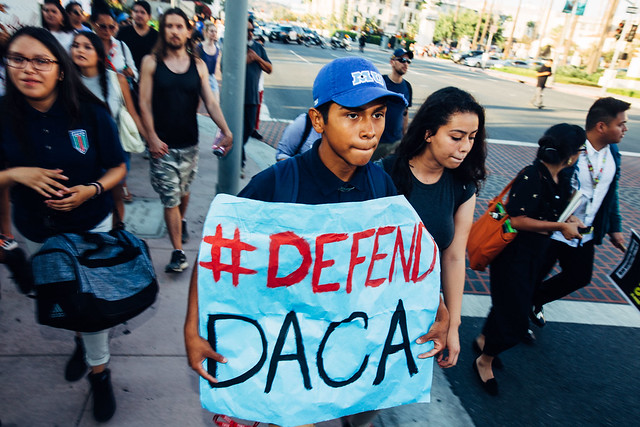
Recent court documents submitted by the government in the case, State of Texas v. United States of America (1:18-cv-00068), reveal that the U.S. Citizenship and Immigration Services (USCIS) may soon resume processing initial DACA applications for individuals living outside of Texas.

Since 2021, new DACA requests had been halted due to a court order which was later applied only to the state of Texas.

Under the proposed plan, USCIS would process initial applications for applicants residing outside of Texas. For those living in Texas, the government would only grant deferred action, without employment authorization or recognition of lawful presence. Moving to Texas could jeopardize a DACA recipient’s work authorization.

The government’s plan still requires court approval, and USCIS has not yet shared any timeline or implementation details if it moves forward.

DACA Refresher


Deferred Action for Childhood Arrivals (DACA) is a program that allows individuals who were brought to the United States as children to remain in the United States temporarily and apply for work permits. While it does not grant legal status, it offers protection from deportation.

Those eligible for DACA include individuals who entered the country as children before their 16th birthday, were under 31 years old as of June 15, 2012, and have not been convicted of a felony, a significant misdemeanor, or three misdemeanors.

Continue reading

people-4009327_1280On September 24, 2025, the Department of Homeland Security (DHS) issued a proposed rule that would change the current selection process for selecting H-1B visa petitions subject to the annual numerical limits established by the Immigration and Nationality Act.

Under the proposed rule, the current random lottery system would be replaced with a wage-based selection process that prioritizes the selection of H-1B workers offered higher salaries by sponsoring employers.

The goal is to better align the H-1B program with U.S. labor market needs by increasing the chances of selection for higher-paid, and presumably higher-skilled, foreign workers. This change aims to reduce the potential for abuse in the system, discourage mass low-wage registrations, and ensure that the most economically valuable positions are filled through the H-1B program.

What may change


Currently, the U.S. government selects H-1B visa petitions through a randomized lottery system due to the annual numerical cap on available visas. Employers first submit electronic registrations for each prospective H-1B worker during a designated registration period, typically held in March. Because the demand for H-1B visas consistently exceeds the supply, the U.S. Citizenship and Immigration Services (USCIS) conducts a lottery to determine which petitions can proceed with applying for H-1B visas.

There are two separate caps under the H-1B program: the regular cap of 65,000 visas and an additional 20,000 visas reserved for individuals who hold advanced degrees from U.S. institutions (commonly referred to as the master’s cap). All registered beneficiaries, including those with U.S. advanced degrees, are first entered into the regular cap lottery. After 65,000 are selected, those with U.S. master’s degrees who were not chosen in the initial round are entered into a second lottery for one of the 20,000 advanced degree slots.

This current system does not prioritize applicants based on wage levels, qualifications, or skills. Selection is purely random as long as the minimum eligibility requirements are met.

However, the Department of Homeland Security (DHS) is proposing changes that would shift the selection process to favor higher-paid workers.

Continue reading

interview-7323656_1280Starting September 2, 2025, the U.S. Department of State will implement major changes that limit eligibility for nonimmigrant visa interview waivers.

Under the State Department’s new revised policy, most applicants—including children under 14 and adults over 79—will be required to attend an in-person interview with a U.S. consular officer, with limited exceptions.

This new policy replaces the previous Interview Waiver Update issued on February 18, 2025, and will significantly impact individuals seeking to travel to the United States on a nonimmigrant visa including workers seeking to renew their visas.


Who Can Still Qualify for an Interview Waiver After September 2?


Although the new rules tighten overall interview requirements, certain applicants may still be eligible for an interview waiver, including:

  1. Certain Diplomatic and Official Visa Holders

Applicants under the following visa classes are exempt from the interview requirement:

  • A-1, A-2 (representatives of foreign governments)
  • C-3 (excluding attendants or personal staff)
  • G-1 through G-4 (representatives of international organizations)
  • NATO-1 through NATO-6
  • TECRO E-1 (Taipei Economic and Cultural Representative Office officials)
  1. Diplomatic or Official-Type Visa Applicants

Those applying for visas that support diplomatic or governmental missions may still be eligible for interview waivers.

  1. Applicants Renewing Certain B Visas or Border Crossing Cards

Applicants may qualify for an interview waiver if they meet all the following conditions:

Continue reading

media-998990_1280On June 18, 2025, the State Department announced that U.S. Embassies and Consulates around the world will resume scheduling appointments for F, M, and J nonimmigrant visas, introducing new guidance that includes stricter vetting procedures and an expanded review of applicants’ social media activity.

Moving forward, all F, M, and J nonimmigrants applying for visas at U.S. Consulates overseas will be instructed to change their social media privacy settings to “public” so that they can be reviewed by Consular officers. Those who fail to comply may be presumed to be evading the vetting process and risk having their application denied.

Under the State Department’s new policy that views a U.S. visa as a privilege rather than a right, these enhanced screening and vetting measures aim to identify individuals who may present a threat to our national security.

As part of the process, visa officers will closely examine applications to confirm both the applicant’s eligibility for the requested visa and their intent to carry out activities aligned with the purpose of their entry into the United States. Internal guidance sent to Consular officers also states that officers should look for, “any indications of hostility toward the citizens, culture, government, institutions, or founding principles of the United States.”

Continue reading

passport-8621284_1280

Harvard Travel Ban Blocked by Federal Judge

Earlier this month President Trump had signed an Executive Order suspending the entry of all nonimmigrants and exchange visitors attending Harvard University, for a period of 6 months starting June 4th (the effective date of the proclamation).

Those affected by the executive order were F, J, and M visa holders outside of the United States as of the date of the proclamation. The suspension did not apply to nonimmigrants entering the United States to attend other universities.

Shortly after the executive order was issued, a federal judge granted a preliminary injunction, temporarily halting its enforcement until the court can rule on the merits of the case.

Following the court’s actions, the State Department ordered embassies and consulates around the world to resume visa processing for Harvard University students and exchange visitors.

As a result, Harvard students can breathe easier. While the preliminary injunction remains in effect, consulates are barred from denying visas to Harvard students and exchange visitors, and visa holders attending Harvard cannot be refused entry to the United States.

For more information, please click here.

Continue reading

beverly-kimberly-tfiGOGEmJVI-unsplash-scaledOn June 4, 2025, President Trump continued his ongoing assault on Harvard University with a new Executive Order entitled, “Enhancing National Security by Addressing Risks at Harvard University.”

Effective June 4th, the order suspends the entry of all nonimmigrants and exchange visitors bound for Harvard University for a period of 6 months, citing national security concerns over Harvard’s failure to police foreign students and ensure that foreign nationals admitted on student and exchange visitor visas remain in compliance with Federal law.

The executive order also accuses Harvard of having extensive entanglements with foreign adversaries including China.

Who is affected?


All nonimmigrants who enter or attempt to enter the United States to begin attending Harvard University through the Student and Exchange Visitor Program (SEVP) after the effective date of the proclamation (June 4, 2025).

The executive order further empowers the Secretary of State Marco Rubio to consider in his discretion whether foreign nationals who currently attend Harvard University and are in the United States pursuant to F, M, or J visas, should have their visas revoked pursuant to the proclamation.

Who is not affected?


The suspension does not impact Harvard students who are already inside the United States with a valid student visa as of the effective date of the proclamation.

The suspension also does not apply to any alien who enters the United States to attend other universities through the Student and Exchange Visitor Program (SEVP).

It also does not apply to any alien whose entry would be in the national interest, as determined by the Secretary of State, the Secretary of Homeland Security, or their designated representatives.

Impact on Harvard Students Currently in the United States


The executive order does not:

  • Restrict change or extension of status applications filed with U.S. Citizenship and Immigration Services (USCIS)
  • Revoke existing visas, I-94, or STEM OPT work authorization status for students currently in the United States

Continue reading

manu-ros-wvlwZ00eIRk-unsplash-scaledIn recent days, the Trump administration has launched an aggressive campaign targeting international students studying at colleges and universities throughout the United States.

These attacks escalated Thursday last week when the administration first announced that it would be halting Harvard University’s ability to enroll international students by revoking their Student and Exchange Visitor Program (SEVP) certification—a certification that is necessary for U.S. schools to enroll and issue Forms I-20 to F and M international students.

The move sent shockwaves throughout the academic community because it meant Harvard could no longer enroll foreign students, and its more than 7,000 existing international students would be required to transfer or lose their legal status in the United States.

According to the Secretary of the Department of Homeland Security Kristi Noem, such drastic steps were taken due to Harvard’s alleged failure to comply with Student Exchange Visa Program (SEVP) regulations, as well as “encouraging and allowing antisemitic and anti-American violence to rage on its campus and coordinating with Chinese Communist Party officials on training that undermined American national security.”

Less than 24 hours later, Harvard filed a lawsuit in federal court requesting and obtaining a temporary restraining order to block the Trump administration from cutting off its ability to enroll foreign students. The judge found that absent the court order, Harvard would “suffer immediate and irreparable injury.”

Today, that same judge granted Harvard a preliminary injunction extending Harvard’s ability to maintain its SEVP certification intact while the lawsuit moves forward in federal court. This action effectively protects Harvard’s students and allows them to remain in the United States.

Continue reading

engineer-4690505_1280The United States Citizenship and Immigration Services (USCIS) recently released detailed statistics and data regarding the number of beneficiaries selected during the fiscal year 2026 H-1B cap season, highlighting the highly competitive nature of the visa process.

Each year, the H-1B visa program allows U.S. employers to temporarily employ foreign workers in specialty occupations, and demand for these visas has consistently gotten tougher throughout the years.

The FY 2026 data shows a significant drop in H-1B registrants, with 126,361 fewer applicants compared to the previous year.

Overview


During the fiscal year 2026 H-1B cap season:

  • USCIS received eligible registrations for 336,153 unique beneficiaries and selected just 118,660 – or approximately 35.3% – of these beneficiaries.
  • The overall number of registrations submitted in FY 2026 decreased dramatically from 470,342 eligible registrations filed last year to just 343,981 eligible registrations filed this year.
  • On average, each beneficiary only had approximately one registration submitted on their behalf.
  • USCIS is not expected to announce a second cap lottery until at least July 2025, after the current H-1B filing period closes.

Continue reading

sam-balye-w1FwDvIreZU-unsplash-scaled

Following a wave of lawsuits from international students whose visas and Student and Exchange Visitor Information System (SEVIS) records were terminated without prior notice, the Trump administration has suddenly changed its course.

In recent weeks, U.S. Immigration and Customs Enforcement (ICE) has begun reinstating SEVIS records that were previously terminated, after seemingly recognizing that the government did not go through the appropriate channels to do so.

Over the past month, it is estimated that the State Department and ICE collectively cancelled over 300 F-1 student visas and terminated more than 4,736 SEVIS records primarily due to student encounters with law enforcement, criminal charges that were dismissed, and old misdemeanors pre-dating visa issuance. These SEVIS terminations automatically exposed students to unlawful presence in the United States, and the risk of deportation.

It was further discovered that ICE utilized AI assisted programs to screen the social media posts of F-1 international students and terminated their legal status based on antisemitic activity or alleged support for terrorist organizations such as Hamas and Hezbollah.

In response, students across the country sued the government to preserve their status, leading federal judges to issue a series of emergency orders to stop the government from cancelling visas and SEVIS records.

Continue reading

student-5473769_1280F-1 International Students at university campuses across the country have been rocked by alarming reports that their visas and SEVIS records have been suddenly terminated by U.S. Immigration and Customs Enforcement (ICE), without any prior notice to the university or the student.

This new wave of SEVIS terminations which began early this month has led to a string of lawsuits filed in federal district court, challenging the legality of the terminations.

School officials became aware of terminated F-1 student records only after conducting checks of the Student & Exchange Visitor Information System (SEVIS) system. The records of those impacted simply state that the visa revocations were due to an immigration status violation.

The following three generic classifications have been provided for the terminations:

  • Termination based on serious adverse foreign policy consequences
  • Student identified in a criminal records check
  • Student identified in criminal check and/or has had their visa revoked

No further details regarding the reason for the terminations have been provided by the government, nor were school officials notified of actions taken.


What is SEVIS?


The Student and Exchange Visitor Information System (SEVIS) is an online system used by the U.S. Department of Homeland Security (DHS) to maintain information on Student and Exchange Visitor Program (SEVP)-certified schools, F-1 and M-1 students who come to the United States to begin a program of student.

Designated school officials use SEVIS to issue Forms I-20 to specific nonimmigrants to obtain F or M status while enrolled at the school and to satisfy their legal responsibilities.

Continue reading