Articles Posted in Undocumented Immigrants

boy-5752925_1280
San Diego’s immigration community has been rattled by new reports that Immigration and Customs Enforcement (ICE) is arresting individuals with no criminal history during routine green card interviews at USCIS offices—a practice that is historically unprecedented and deeply alarming.

What’s Happening


Starting in early November, immigration attorneys began reporting that ICE agents had been detaining green card applicants at routine interviews conducted at USCIS field offices.

cityscape-5351686_1280A federal judge has issued a court order requiring that immigrants detained at a U.S. Immigration and Customs Enforcement (ICE) processing center in downtown Los Angeles be granted access to their attorneys in a timely manner.

The ruling comes after lawyers reported that detainees were frequently denied phone access, had in-person meetings canceled, and faced pressure to sign legal documents without private counsel.

The B‑18 facility, originally designed as a short-term holding space, lacks basic amenities such as beds, showers, and adequate medical services. Advocates say ICE has effectively turned it into a long-term detention site, restricting detainees’ ability to communicate with the outside world.

36952236081_5179c7d2d3_z

Source: Flickr Creative Commons Attribution mollyktadams

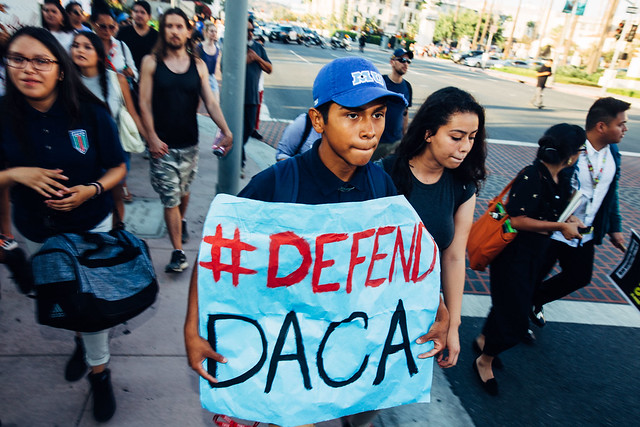
Recent court documents submitted by the government in the case, State of Texas v. United States of America (1:18-cv-00068), reveal that the U.S. Citizenship and Immigration Services (USCIS) may soon resume processing initial DACA applications for individuals living outside of Texas.

Since 2021, new DACA requests had been halted due to a court order which was later applied only to the state of Texas.

Under the proposed plan, USCIS would process initial applications for applicants residing outside of Texas. For those living in Texas, the government would only grant deferred action, without employment authorization or recognition of lawful presence. Moving to Texas could jeopardize a DACA recipient’s work authorization.

The government’s plan still requires court approval, and USCIS has not yet shared any timeline or implementation details if it moves forward.

DACA Refresher


Deferred Action for Childhood Arrivals (DACA) is a program that allows individuals who were brought to the United States as children to remain in the United States temporarily and apply for work permits. While it does not grant legal status, it offers protection from deportation.

Those eligible for DACA include individuals who entered the country as children before their 16th birthday, were under 31 years old as of June 15, 2012, and have not been convicted of a felony, a significant misdemeanor, or three misdemeanors.

Continue reading

prison-370112_1280Introducing sweeping changes, U.S. Citizenship and Immigration Services (USCIS) has expanded its role by gaining law enforcement powers previously limited to agencies like Immigration and Customs Enforcement (ICE) and Customs and Border Protection (CBP).

Under a new final rule published today, USCIS will now recruit 1,811-classified special agents—fully empowered officers with authority—to investigate, arrest, and prosecute individuals violating U.S. immigration laws.

What’s Changed?


  • Law Enforcement Authority: The newly designated USCIS special agents are authorized to carry firearms, execute search and arrest warrants, make arrests, and use force—including in pursuit and potentially lethal situations—under standard federal law enforcement protocols.
  • Operational Autonomy: Previously, USCIS investigations—especially those involving criminal violations—were referred to Immigration and Customs Enforcement (ICE).
  • Enforcement Agency: Now, USCIS itself can manage law enforcement investigations from start to finish, including investigating civil and criminal violations within the jurisdiction of USCIS and ordering expedited removal when warranted.

Continue reading

update-1672349_1280On September 3, 2025, the Department of Homeland Security (DHS) announced the termination of the 2021 designation of Temporary Protected Status (TPS) previously granted to Venezuelans by President Biden.

The government’s actions mean that the 2021 designation for Venezuela TPS and any associated TPS-related protection and documentation for beneficiaries will expire on September 10, 2025. The termination becomes effective 60 days after publication of the Federal Register notice.

Venezuelans have long been targeted by the Trump administration due to organized crime from violent Venezuelan gangs such as the Tren de Aragua.

Therefore, it comes as no surprise that President Trump has called to dismantle TPS protections for Venezuelan nationals.

What this means


  • 2021 Venezuela TPS Designation: TPS will remain valid for current beneficiaries until September 10, 2025. The termination of the 2021 designation cannot take effect until 60 days after the termination notice is published in the Federal Register.

All TPS protection and associated work authorization will expire on the dates indicated above.

Continue reading

the-now-time-KXUKLB-_Sb0-unsplash-scaledOn August 1st the U.S. Citizenship and Immigration Services (USCIS) announced new policies that could make immigrants applying for green cards through family-based petitions more vulnerable to deportation.

The changes appear in various updates to USCIS’ Policy Manual which states that immigration officials can begin removal proceedings for immigrants who lack legal status and apply to become permanent residents through family-based petitions.

According to the Policy Manual, “if USCIS determines the alien beneficiary is removeable and amenable to removal from the United States, USCIS may issue a Notice to Appear (NTA) [in immigration court] placing the beneficiary in removal proceedings. Petitioners and alien beneficiaries should be aware that a family-based petition accords no immigration status nor does it bar removal.”

The new policy went into effect immediately and applies to pending requests for a green card, and those filed on or after August 1st.

While the practical impact of this policy is yet to be seen, it provides immigration officials with more discretion to initiate removal proceedings even where a green card application is pending with USCIS, for those who entered the U.S. illegally, overstayed a U.S. visa, or otherwise failed to maintain their legal status.

These policy changes underscore the importance of maintaining underlying legal status throughout the green card process. Those who lack legal status or who lost their status during the green card process may be most at risk.

Continue reading

judge-8779957_1280In a significant victory for civil rights and immigrant advocacy groups, a federal appeals court has upheld a lower court’s decision to temporarily block federal immigration agents from conducting immigration-related arrests in Los Angeles without reasonable suspicion.

The Ninth Circuit Court of Appeals issued the ruling late Friday, marking a major legal development in the ongoing battle over immigration enforcement and constitutional protections.

At the heart of the case is the question of whether federal agents can detain individuals based solely on generalized characteristics such as race, ethnicity, or language. The appeals court was clear: they cannot.

A Firm Rejection of Racial Profiling

The three-judge panel ruled that U.S. Immigration and Customs Enforcement (ICE) and other federal agents cannot use factors like “apparent race, ethnicity, speaking Spanish or speaking English with an accent, particular location, and type of work” as the basis for reasonable suspicion to stop an individual. Even taken together, the court stated, these characteristics form only a broad profile and fail to meet the legal standard required for a lawful stop.

“We agree with the district court that…these factors do not demonstrate reasonable suspicion for any particular stop,” the panel wrote, emphasizing the constitutional protections that apply to all individuals, regardless of immigration status.

Continue reading

motherhood-7114294_1280Last month, the Supreme Court ruled that lower courts cannot issue nationwide injunctions blocking the Trump administration’s executive order limiting birthright citizenship, except in class action lawsuits.

Prior to the Supreme Court’s ruling, at least three different lawsuits had secured nationwide injunctions protecting all individuals potentially affected by Trump’s executive order restricting birthright citizenship. However, the Court’s ruling scaled back those protections, potentially leaving some children unprotected.

To safeguard all families across the country and address any gaps left by prior legal actions, the American Civil Liberties Union (ACLU) filed a class-action lawsuit, Barbara v. Donald J. Trump to stop the government’s enforcement of the order against all current or future babies born or after February 20, 2025, where:

(1) that child’s mother was unlawfully present in the United States and the child’s father was not a United States citizen or lawful permanent resident at the time of said child’s birth, or

(2) that child’s mother’s presence in the United States was lawful but temporary, and the child’s father was not a United States citizen or lawful permanent resident at the time of said child’s birth.

The U.S. District Judge Joseph Laplante agreed with the plaintiffs and issued a class-wide preliminary injunction blocking Trump’s executive order from being enforced against any affected baby born in the United States after February 20th.

Continue reading

Gavin_Newsom_by_Gage_Skidmore

Attribution: Gage Skidmore

On Friday July 11, 2025, a federal judge ruled that the government’s ongoing immigration raids in Southern California and its denial of legal counsel to detained immigrants likely violates the Constitution.

In so ruling, the court issued two temporary restraining orders (TROs) barring the Department of Homeland Security (DHS) and other federal agencies from continuing these actions in the counties of Los Angeles, Orange, Ventura, Riverside, San Bernardino, Santa Barbara and San Luis Obispo. (Pedro Vasquez Perdomo v. Kristi Noem (2:25-cv-05605)

The first TRO prohibits immigration agents from stopping individuals without reasonable suspicion and bars law enforcement from relying solely on the following factors—alone or in combination—to form reasonable suspicion for a stop including (1) apparent race or ethnicity (2) speaking Spanish or English with an accent (3) presence in a particular location like a bus stop, car wash, day laborer pick up site, or agricultural site, or (4) the type of work the person does.

The second TRO orders DHS to provide access to counsel on weekdays, weekends, and holidays for those who are detained in B-18, the basement of a federal building in downtown Los Angeles located at 300 North Los Angeles Street.

It further requires immigration officials to develop guidance on how agents and officers should determine whether “reasonable suspicion” exists when conducting stops and to implement training for officers involved in immigration operations.

In addition to immigration officers, the TROs apply to the FBI and Justice Department, who are named in the lawsuit and are involved in immigration enforcement actions.

Continue reading

sarah-kranz-pKqAaTUi0wg-unsplash-scaledIn a significant ruling handed down on Friday, the U.S. Supreme Court limited the power of federal judges to impose nationwide injunctions against President Trump’s executive order aimed at denying birthright citizenship to children born in the U.S. to noncitizens.

While the justices did not rule on the legality of the President’s executive order, this decision is an extraordinary victory for the Trump administration, because it hinders lower courts from intervening in potentially illegal actions by the government.

Historically, lower courts have issued nationwide preliminary injunctions early in litigation to block government conduct that could cause irreparable harm to plaintiffs pending judicial review.

The court’s decision to restrain judges from providing such relief is a remarkable departure from historic precedent and ventures into dangerous territory. It further indicates that the balance of power on the Supreme Court has clearly shifted in Trump’s favor, with six conservative justices backing his position.

What it Means

The ruling means that lower courts cannot stop the enforcement of the executive order on a nationwide basis for affected individuals. The executive order can only be suspended against individuals who have filed lawsuits against the government (either as individual plaintiffs or in class actions) or where a state has issued a state-wide injunction.

It will take time before the Supreme Court ultimately rules on the constitutionality of the executive order, with some legal experts suggesting the process could stretch on for years.

It is also uncertain whether this decision could restrict future nationwide blocks on controversial laws, particularly in other immigration and civil rights cases against the government.

Continue reading