Articles Posted in Permanent Residents

37221006305_57c3571daa_z
Andrew, a real estate professional and Vice President of a large real estate firm headquartered in Asia, came to our office to discuss the possibility of filing for an EB-2 National Interest Waiver. To receive a national interest waiver, the applicant must demonstrate a high level of achievements and unique skills pertaining to their position to justify a waiver of the requirements of a job offer and labor certification filing.

The challenge in Andrew’s case was the absence of demonstrated achievements in the real estate business, and various non-disclosure agreements the client had signed restricting the documentation he could provide to demonstrate his exceptional ability in the industry, based on the high net worth projects he had worked on in the real estate industry. There were however other strengths that Andrew possessed that would qualify him for the national interest waiver. Andrew possessed a law degree from his home country, a master’s degree in taxation, a master’s degree in real estate from an ivy league university, and he was licensed to practice law in the United States. In addition to possessing these advanced degrees, two of which were received in the United States, Andrew’s career in the real estate sector spanned nearly 21 years.

The difficulty however remained in that Andrew did not have many documents to present to USCIS demonstrating his achievements as an entrepreneur and real estate investor, and the projects he was working on could not be disclosed based on the confidentiality agreements he had signed. Our experienced staff and attorneys decided that the best strategy in Andrew’s case was to highlight his education and vast experience in the industry having maintained high level positions in the industry, leading international real estate teams, heading overseas real estate and property management implementation strategies across various continents, and initiating/implementing domestic real estate acquisition projects totaling more than $4 billion in investment. We are happy to report that our strategy was successful and Andrew’s national interest waiver was recently approved. Here is how we did it.

2867376201_dcd363e40f_z
Beginning April 1st New Delhi Will No Longer Process IR1/CR1 or IR2/CR2 visas

The U.S. Department of State announced via their website that the U.S. Embassy in New Delhi will no longer process IR1/CR1 visas for spouse of US Citizens or IR2/CR2 visas for unmarried minor children of US Citizens beginning April 1, 2018. Foreign nationals who are in the process of obtaining an IR1/CR1 visa or IR2/CR2 visa with an interview that has been scheduled on or after April 1, 2018, will have their interview at the U.S. Consulate General in Mumbai. We recommend that petitioners be on guard for any letters from the National Visa Center specifying the location of the intending immigrant’s interview, as well as details about how to prepare for the interview stage.

President’s DACA Deadline Passes

personal-3108155_1280It did not take long for President Trump to capitalize on the terrorist attack which took place several days ago in New York City, to attack the Diversity Visa Program and the process by which US Citizens, and in some cases green card holders, can petition for extended family members to immigrate to the United States.

Following the terrorist attack in New York City, which claimed the lives of 8 Americans, the President fired off a series of tweets calling on Congress to terminate the Diversity Visa Program, claiming that the perpetrator of the attack, Sayfullo Saipov, had gained admission to the United States seven years ago through the diversity immigrant visa program, a congressionally mandated program made possible by section 203(c) of the Immigration and Nationality Act (INA). According to CNN, the Department of Homeland Security has said that Saipov came to the United States in 2010 on a diversity visa. Department of Homeland Security archives confirm that Uzbekistan was a country participating in the Diversity Visa program as early as 2007, and continues to participate in the Diversity Visa Program.

The Diversity Immigrant Visa Program

The Diversity Immigrant Visa program is a program enacted by Congress, which allocates up to 50,000 immigrant visas per fiscal year to a special class of immigrants known as “diversity immigrants.” Each fiscal year diversity applicants register for the visa program electronically at no cost. Applicant entries are selected at random through a computerized “lottery” system to allocate the 50,000 available immigrant visas for the Diversity Immigrant Visa Program. Only diversity immigrants who are natives of countries with historically low rates of immigration to the United States qualify for the Diversity Immigrant Visa program. In other words, to qualify for a diversity visa, essentially a green card, you must be a native of a country participating in the diversity visa program. Countries with historically high rates of immigration to the United States DO NOT qualify.

Continue reading

28058338414_3b0e3cd702_z

In a continuing saga, the President is maintaining his hardline stance on immigration, this time expanding into the realm of legal immigration. Earlier this month, the Department of State released an amended version of the Foreign Affairs Manual (FAM) used by governmental agencies and other federal agencies as a manual, which directs and codifies information that must be carried out by respective agencies “in accordance with statutory, executive and Department mandates.”

The new amended version of the manual expands the definition of misrepresentation, the types of activities that may support a presumption of fraud, and establishes changes to existing policies that federal agents must follow in making assessments of fraud or material representation.

The manual sets out a list of activities which may support a presumption of fraud or material representation by an individual applying for any immigration benefit:

  • Engaging in unauthorized employment;
  • Enrolling in a course of academic study, if such study is not authorized for that nonimmigrant classification (e.g. B status);
  • A nonimmigrant in B or F status, or any other status prohibiting immigrant intent, marrying a United States citizen or lawful permanent resident and taking up residence in the United States; or
  • Undertaking any other activity for which a change of status or an adjustment of status would be required, without the benefit of such a change or adjustment.

Old Rule: Previously, the rules set out by the Foreign Affairs Manual and USCIS imposed a presumption of fraud on persons who entered the United States with a non-immigrant visa type (e.g. as a tourist, business visitor, student, trainee etc.) and subsequently married a U.S. Citizen and applied for adjustment of status within the first 30 days of entering the United States.

Continue reading

32671935736_aa8676b35e_z

On September 24, 2017, the President issued a Presidential Proclamation expanding the list of countries subject to the travel ban outlined in Executive Order 13780 entitled “Protecting the Nation from Foreign Terrorist Entry into the United States.” As you may recall, as part of that executive order, in March 2017, the President had asked the Secretary of Homeland Security and Attorney General to conduct a worldwide review to assess the dangers that foreign nationals from designated countries of concern pose to the national security of the United States. Under Executive Order 13780, DHS was directed to implement additional security mechanisms and vetting procedures for countries identified as potential threats to national security.

The Secretary of Homeland Security, Secretary of State, and Attorney General identified 16 additional countries which “remain deficient . . . with respect to their identity-management and information-sharing capabilities, protocols, and practices,” and as a result pose a potential threat to our country’s national security.  By proclamation, the entry of foreign nationals from eight of these countries will remain suspended and limited for the time being.

The President has determined that the immigrant and non-immigrant entry of foreign nationals from the following countries would be detrimental to the national interests of the United States, at least until increased security mechanisms can be implemented, and identity and information-sharing capabilities can be improved.

Per Section 2 of the Proclamation

Suspension of Entry for Nationals of Countries of Identified Concern

“The following countries continue to have “inadequate” identity-management protocols, information-sharing practices, and risk factors . . . such that entry restrictions and limitations are recommended:”

The entry of foreign nationals from the designated countries listed below will be suspended and limited to a few exceptions and case-by-case waivers beginning October 18, 2017.

Continue reading

34704808294_30d802845d_z

Now is a good time to file your green card application. Significant wait times are expected given a new policy passed by the Trump administration that will require in-person interviews for LPR applicants filing based on employment sponsorship

In yet another controversial move, the Trump administration has recently adopted a new policy change that will require an in-person interview for individuals wishing to obtain lawful permanent residency based on employment sponsorship. The new policy will be implemented beginning October 1st.
Previously, foreign nationals applying for permanent residency, based on employment sponsorship, were not required to attend an in-person interview, although this allowance was discretionary. In recent years, the in-person interview requirement was typically reserved for individuals applying for permanent residency based on a qualifying familial relationship, and not for individuals applying based on employment sponsorship.

A USCIS spokesperson announced the new policy change on Friday August 25th, a change that will delay the process of obtaining a green card significantly, given the increased number of individuals that will be required to attend an in-person interview. According to USCIS this change in policy will apply to any individual adjusting their status to legal permanent residency from an employment-based visa category.

What’s more, family members of refugees or asylees, holding a valid U.S. visa, will also be required to attend an in-person interview when applying for provisional status.

Continue reading

green-card

John came to our office distraught after receiving a notice of decision from USCIS indicating that his wife’s green card application was being denied, because the evidence John had submitted with the application was not sufficient to establish his wife’s eligibility for adjustment of status. Specifically, John had failed to provide the necessary documents for the I-864 Affidavit of Support, a form that must be filed along with the green card application to show that the U.S. Citizen Spouse or joint sponsor can financially support the intended beneficiary (in this case his wife), as well as to prove that the beneficiary will not rely on the government for financial support. The I-864 Affidavit of Support is very important for adjustment of status petitions. Failure to properly complete the I-864, and provide the necessary documents to prove that the petitioner is capable of financially supporting the beneficiary will result in a denial of the I-485 Application to Register Permanent Residence or Adjust Status.

During our consultation, John, the U.S. Citizen spouse, told us that he completed his wife’s green card application himself, and compiled what he thought were the documents necessary to go along with the application. Much to his surprise, he discovered that he had not completed the I-864 Affidavit of Support correctly, and had not included the proper documentation with the application. Because of this, his wife’s green card application was being denied, even though he did indeed have the financial means to support his spouse and had the necessary documentation to prove it.

Unfortunately, John did not do his homework to research how to complete the I-864 Affidavit of Support properly, and did not understand what documents he needed to include to prove his financial ability to provide for his spouse. Like many people, John thought that it was best to save himself some money and file his wife’s green card application himself without having to pay a lawyer to complete the paperwork. He told himself how hard can it be? While it is true that many people successfully file their green card applications on their own, it is important to know that if you decide to do the application yourself, you must read the instructions of each form to be filed with the I-485 application very carefully. Failure to do so is likely to result in the denial of your application. In that sense, you may be doing yourself a disservice by filing on your own. Lawyers have the knowledge and expertise to file a green card application seamlessly.

Continue reading

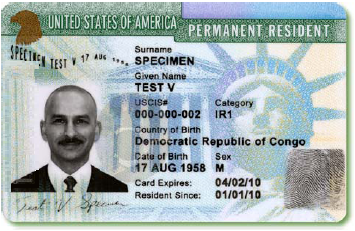
GreenCardImageBeginning May 1, 2017, the United States Citizenship and Immigration Services (USCIS) will begin issuing newly redesigned green cards and employment authorization documents with enhanced features and fraud-resistant technology to prevent tampering and fraud. The new technology has been introduced as part of the government’s ongoing effort to enhance the security of these documents and to facilitate detection of counterfeit documents.

The new green cards and employment authorization cards will

  • Display the individual’s photos on both sides;
  • Show a unique graphic image and color palette:
    • Green Cards will have an image of the Statue of Liberty and a predominately green palette;
    • EAD cards will have an image of a bald eagle and a predominately red palette;
  • Have embedded holographic images; and
  • No longer display the individual’s signature.
  • Green Cards will no longer have an optical stripe on the back.

USCIS may continue to issue some green cards and employment authorization cards with the previous design format, after May 1, 2017, until supplies for that design have run out.

EADCard

Document Validity

Existing and new green cards and employment authorization cards will remain valid until the printed expiration date indicated on the card. Older generation green cards that were issued without an expiration date will continue to remain valid and acceptable for purposes of filing Form I-9, Employment Eligibility Verification, EVerify, and Systematic Alien Verification for Entitlements (SAVE).

USCIS recommends that individuals who have an older green card that does not have an expiration date apply for a replacement card with an expiration date. Receiving a new replacement card will give individuals the benefit of having a highly secure card with fraud-resistant technology in the case the card is lost or stolen.

Continue reading

30994123601_945ea5da00_z

On December 6, 2016 Congress passed a continuing resolution to fund government programs through April 28, 2017. Among the programs that qualified to receive additional government funding was the EB-5 Regional Center Investor Program, a program made possible by a Congressional statute. The Continuing Resolution effectively extended the EB-5 Regional Center program through April 28, 2017 with no changes to the program’s policy. With time running out, Congress must either extend the statutory deadline once again to September 30, 2017, or pass reforms to the program. The government is currently holding Congressional hearings to make changes to the EB-5 Regional Center Program. It appears that legislators are contemplating overhauling the EB-5 program altogether, instead of extending the validity period of the program. At this stage, however, it is not likely that a major overhaul of the EB-5 program will take place by April 28th.

Proposed Rule EB-5 Immigrant Investor Regional Center Program

For their part, the U.S. Department of Homeland Security has already introduced a series of proposals in the Federal Register to modernize the EB-5 Immigrant Investor Program. The comment period for the proposed rule closed on April 11, 2017.

Among its major provisions the Department’s proposed rule would authorize:

  • Priority date retention for EB–5 petitioners;
  • Increases the minimum investment amount for targeted employment areas (TEAs) and nonTEAs to $1.8 million;
  • For investors seeking to invest in a new commercial enterprise that will be principally doing business in a targeted employment area (TEA), DHS proposes to increase the minimum investment amount from $500,000 to $1.35 million;
  • DHS is proposing to make regular CPI–U-based adjustments in the standard minimum investment amount, and conforming adjustments to the TEA minimum investment amount, every 5 years, beginning 5 years from the effective date of these regulations;
  • Revisions to the TEA designation process, including the elimination of state designation of high unemployment areas as a method of TEA designation;
  • DHS proposes to allow any city or town with high unemployment 4 and a population of 20,000 or more to qualify as a TEA;
  • DHS proposes to eliminate the ability of a state to designate certain geographic and political subdivisions as highunemployment areas; instead, DHS would make such designations directly;
  • Revisions to the filing and interview process for removal of conditions on lawful permanent residence.

Continue reading