Articles Posted in I-765

identification-card-gee67e2a74_1280

We are happy to start this week with interesting new developments in the world of immigration law.

As some of our readers may be aware, all green card applicants filing Form I-485 Application to Register Permanent Residence or Adjust Status, are given the opportunity to file the Form I-765 Application for Employment Authorization, and Form I-131 Application for Travel Document, along with their green card application (or separately at a later time), in order to receive what has been commonly referred to as an employment authorization document (EAD) and advance parole (AP) “combo” card.

With this “combo” card, green card applicants have engaged in lawful employment inside of the United States, and cards with the notation ‘Serves as I-512 Advance Parole’ have been used to re-enter the U.S. after temporary foreign travel.

That is all about to change. USCIS has announced that in an effort to drastically reduce the processing times associated with EAD and AP documents, the agency will now be discontinuing its policy of issuing the “combo” card.

Going forward, U.S. Citizenship and Immigration Services will be separating the issuance of the employment authorization document (EAD card) and advance parole (AP) document. This means that green card applicants that file the Forms I-765 and I-131 together with their green card (or at a later time) can expect to receive two separate documents in the mail, instead of one single combo card.

EADs that do not have the notation ‘Serves as I-512 Advance Parole,’ can only be used for employment purposes. Green card applicants wishing to return to the U.S. after temporary foreign travel must have a valid Advance Parole document. Applicants should not engage in international travel without such document.


Substantial Backlogs


USCIS has made this change to help alleviate the substantial processing times of EAD and AP documents during the Coronavirus pandemic. Unfortunately, these delays have caused employment interruptions for thousands of applicants who have had to wait many months for these applications to be approved.

Presently, the Nebraska Service Center is currently reporting processing times of between 11.5 to 13.5 months for an EAD to be issued based on a pending adjustment of status application. While the California Service Center is currently reporting a wait period of between 20 months to 21.5 months.

This lengthy waiting period has prompted USCIS to take action to separate issuance of the EAD and AP, in what will hopefully result in faster processing times.

Continue reading

animal-gdb1232b6c_1280

Happy Valentine’s Day! Welcome back to Visalawyerblog. In this blog post, we share with you some important updates in the world of immigration. But first, we hope you are having a wonderful holiday spent with friends and loved ones.


What’s New?


USCIS Updates its Guidelines to Increase Validity Period of Employment Authorization Documents for Certain Applicants


Last week, the U.S. Citizenship and Immigration Services announced new updates to its policy changing the maximum validity period granted to certain individuals applying for Employment Authorization Documents (EADs), also known as work permits.

Effective February 7, 2021, USCIS has announced that it will generally grant new and renewed EADs valid for a 2-year validity period to applicants in the following categories:

  • Admitted as a refugee (a)(3);
  • Granted asylum (a)(5);
  • Granted withholding of deportation or removal (a)(10); and
  • VAWA self-petitioner (c)(31).

USCIS will also be granting new and renewed EADs up to the end of the parole or deferred action period to applicants in the following categories:

  • Paroled into the United States for urgent humanitarian reasons or significant public benefit (c)(11); and
  • Granted deferred action (non-DACA) (c)(14).

This benefit will apply to those in the impacted categories seeking new and renewed EADs issued on or after February 7, 2022. EADs issued on or after this period will reflect the updated 2-year validity period. EADs issued prior to February 7, 2022, will not benefit from the change.


Why the change?


USCIS has said that this validity period extension will help ease processing backlogs because these applicants will no longer need to apply to renew their EADs every year. It will also help prevent interrupts in employment authorization.

Continue reading

travel-g9748ded53_1920

In this blog post, we share great news for E and L dependent spouses!

As we previously reported on our blog, pursuant to a new USCIS policy, E and L nonimmigrant dependent spouses are now considered employment authorized “incident to their status.”

This means that upon admission and issuance of a valid I-94 arrival/departure document showing E or L-2 spousal status, E and L nonimmigrant spouses will automatically be authorized to work without the need to apply for an Employment Authorization Document (EAD). Previously, E or L dependent spouses were required to apply for an EAD by filing Form I-765 Application for Employment Authorization with USCIS.


How does this system work?


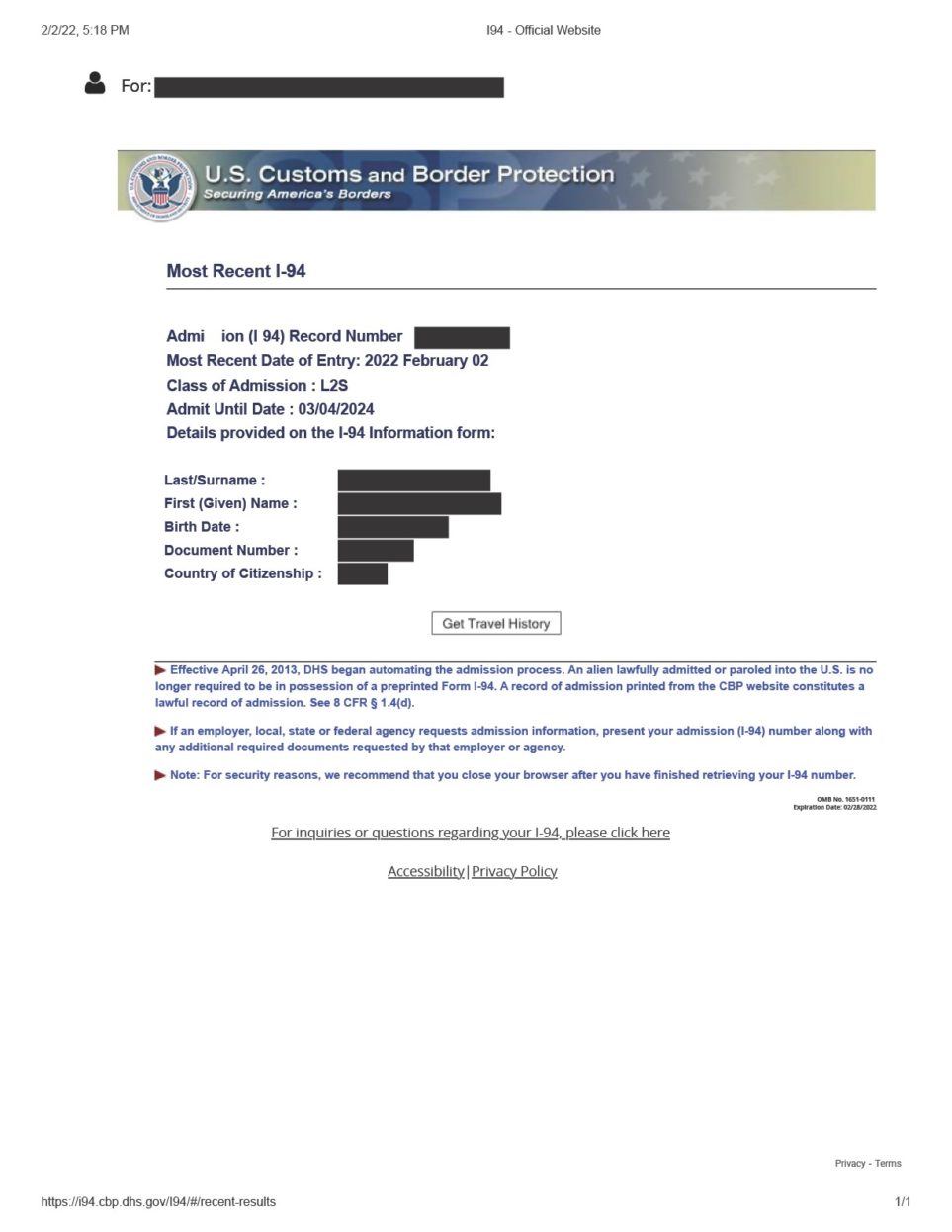
Effective January 31, 2022, CBP Office of Field Operations (OFO), in coordination with both USCIS and Department of State, began issuing new classes of admission on the I-94 arrival/departure record for E and L dependent spouses entering the U.S. at a Port of Entry. The new I-94 admission records indicate an “S” designation after the E or L class of admission to indicate that the spouse is authorized to work in the United States. The “S” designation is meant to indicate that the E or L nonimmigrant is a dependent “spouse” of a principal E or L visa holder. Please note that the new designation will not explicitly state that the spouse is “work authorized,” however the “S” designation signals to U.S. employers that the spouse is authorized to work for I-9 employment verification purposes.

Spouses who applied for an extension of their E or L visa status with USCIS, will receive I-94s that carry the new “S” designation at the bottom of their approval notices.


How can I prove that I am authorized to work as an E or L dependent spouse?


If you are an L or E dependent spouse who wishes to work in the United States without having to obtain an Employment Authorization Document (EAD), you must present an I-94 admission document with the “S” spousal annotation.

CBP has confirmed that the agency has been issuing new I-94’s with the “S” spousal annotation to E and L spouses who gained admission to the United States on or after January 31, 2022.


How does the annotation look?


sample-I94-963x1246-1

E/L Spousal Annotation

The I-94 will be annotated with an “S” next to the E or L-2 status designation, signaling to prospective employers that the individual is authorized to work during the validity period of the I-94. Spouses admitted in E or L-2 status should review their I-94 document immediately upon admission to ensure that it contains the appropriate annotation.


What if I gained admission to the United States prior to January 31, 2022 and I do not have the spousal designation on my I-94?


If you are an E or L dependent spouse who gained admission to the U.S. prior to January 31, 2022, and you do not have the “S” spousal annotation on your I-94, you must contact your closest CBP Deferred Inspection Office to determine whether they may, in their discretion, amend your I-94 arrival/departure record to include the “S” spousal annotation without requiring international travel. CBP may or may not agree to amend your I-94.

In cases where CBP will not amend your I-94 to include the spousal annotation, you may consider discussing with your immigration attorney whether you should depart the United States and re-enter at a U.S. port of entry to secure the new spousal annotated I-94. You must exercise caution before making any international travel plans. An immigration attorney will need to evaluate whether you have the proper documentation to gain re-admission after temporary foreign travel and determine whether your planned travel would result in the issuance of a new annotated I-94. Certain brief international trips may not result in a new I-94 issued by CBP.

Please note that if you are an E or L spouse admitted prior to January 31, 2022, and you have filed an application to extend your L or E status while in the U.S., USCIS is expected to issue the “S” spousal annotation on I-94’s printed at the bottom of USCIS-issued approval notices.

Continue reading

hiring-g89bff9159_1920

This week brings positive immigration news indeed. We are happy to report that the United States Citizenship and Immigration Service (USCIS) has updated its policy guidelines regarding validity periods for Employment Authorization Documents (EADs) for asylees and refugees, noncitizens with withholding of deportation or removal, noncitizens with deferred action, parolees, and Violence Against Women Act (VAWA) self-petitioners.


What is the new policy all about?


In the new policy alert, USCIS points out that under current guidelines the agency has been issuing initial and renewal Employment Authorization Documents (EADs) with a 1-year validity period, to asylees and refugees, noncitizens with withholding of deportation or removal, and VAWA self-petitioners.

Furthermore, in at least some cases involving deferred action or parolees, initial and renewal EADs are being issued for an even shorter duration, than that of the underlying deferred action or parole period, forcing applicants to file multiple applications for Employment Authorization to prevent employment gaps to cover their entire period of deferred action or parole.

The government is now recognizing its incredible inefficiency and is changing its policy to align with the Biden administration’s agenda. The USCIS policy manual has now been revised to state that initial and renewal EADs may be issued with a maximum validity period of up to 2 years for asylees and refugees, noncitizens with withholding of deportation or removal, and VAWA self-petitioners. For deferred action and parolee applicants, USCIS will now issue EADs up to the end of the authorized deferred action or parole period for individuals seeking an EAD in these filing categories.

Please note that replacement EADs will not be affected by this policy change.  USCIS will continue to issue replacement EADs with the same validity date as the original EAD.


When is this new policy effective?


The updated policy guidance, contained in Volume 10, Part A of the USCIS Policy Manual, is effective as of today Monday, February 7, 2022.

Accordingly, USCIS will immediately apply the updated validity period guidelines to EADs issued for impacted categories on or after February 7, 2022.

Continue reading

announcement-g9fd61cadf_1280

We are happy to share some great news for Temporary Protected Status (TPS) applicants! On November 29, 2021, the United States Citizenship, and Immigration Services (USCIS) announced that TPS applicants may now file Form I-821 Application for Temporary Protected Status and I-765 Application for Employment Authorization entirely online for certain country designations.


Who is eligible to apply online?


First-time TPS applicants and TPS beneficiaries who are re-registering are eligible to file Form I-821 and Form I-765 online, provided they are a national under one of the following current designations for TPS:

  • Burma (Myanmar)
  • El Salvador
  • Haiti
  • Honduras
  • Nepal
  • Nicaragua
  • Somalia
  • South Sudan
  • Sudan
  • Syria
  • Venezuela
  • Yemen

Applicants can request an Employment Authorization Document (EAD) by submitting a completed Form I-765 with their Form I-821 online, or they may choose to submit their Form I-765 separately later. TPS applicants are recommended to file both forms together to help receive their Employment Authorization Document more quickly.


Where can I file?


To file Form I-821 online, eligible TPS applicants should visit the myUSCIS page to log into or create a USCIS online account. Through their myUSCIS account, applicants will be able to track the status of their application, review requests for more evidence, download a copy of their receipt notice, and have the ability to communicate with USCIS about their application through a secure inbox.


Why the change?


The new online filing capability is part of USCIS’ efforts to streamline the application process and reduce workloads by easily and conveniently retrieving applications and supporting documentation electronically. Previously, TPS online filing was only available to individuals from certain countries. The expansion of the online filing capability will now give USCIS the ability to process applications and EADs on a more timely basis through its secure and convenient platform.

Continue reading

megaphone-ge64a5e7b4_1920

We are happy to deliver some amazing news for H-4, E, and L dependent spouses! On November 12, 2021, following a settlement agreement known as Shergill v. Mayorkas, the United States Citizenship, and Immigration Services (USCIS) issued a new Policy Memorandum (Policy Alert PA-2021-25) outlining that the agency will automatically allow for employment authorization for dependent E, L, and certain H-4 spouses of principal visa holders, without requiring spouses to file I-765 application for employment authorization to be eligible to work in the United States.

The new Policy Memorandum also rescinds the agency’s previous 2002 Memorandum which did not allow dependent spouses in E, L and certain H-4 visa holders to automatically qualify for work authorization in the United States.

Following this new settlement, E, L, and certain H-4 spouses will be able to work just by having their valid visas, and they will not need to file any separate applications nor need an employment authorization card (work permit) to lawfully work in the United States.

While some doubt initially arose regarding whether E dependent spouses would qualify for automatic employment authorization, USCIS has now explicitly confirmed that it will indeed consider E and L dependent spouses to be employment authorized incident to their valid E or L nonimmigrant status.

The new November 12, 2021, Policy Memorandum outlines the following:

  • Certain H-4, E, or L dependent spouses to qualify for an automatic extension of their existing employment authorization and accompanying employment authorization document (EAD) if they properly filed an application to renew their H-4, E or L-based EAD before the document expires and they have an unexpired Form I-94 evidencing their status as an H-4, E, or L nonimmigrant;
  • The automatic extension of the EAD will continue until the earlier of: end date on Form I-94 evidencing valid status the approval or denial of the EAD renewal application, or 180 days from the date of expiration of the prior EAD document; Form I-94, evidencing unexpired nonimmigrant status (H-4, E or L), Form I797C receipt for a timely – filed EAD renewal application stating “Class requested as “(a)(17),” “(a)(18) or ((c)(26)”, and the facially expired EAD issued under the same category);

Continue reading

tingey-injury-law-firm-L4YGuSg0fxs-unsplash-1-scaled

Welcome back to Visalawyerblog! In this blog post we share with you some recent news regarding a new class action lawsuit that has been filed by 49 plaintiffs against the Department of Homeland Security (DHS) and United States Citizenship and Immigration Services (USCIS), seeking relief from the extreme processing delays currently taking place for I-765 applications for employment authorization (EADs) filed by individuals seeking adjustment of status (AOS) in the United States, and for I-765 applications filed by E-2 dependent spouses with USCIS.

Currently, USCIS reports that I-765 work permit applications based on a pending I-485 adjustment of status application are taking between 20 to 21.5 months to process at the California Service Center; while it is taking 9 to 9.5 months to process work permit applications at the National Benefits Center; and 9.5 to 10.5 months to process such applications at the Nebraska Service Center.

The new legal challenge against the government has been mounted by the American Immigration Lawyers Association (AILA), Wolfsdorf Rosenthal LLP, Joseph and Hall PC, Kuck Baxter Immigration LLC, and Siskind Susser PC.

The lawsuit seeks to hold the government accountable once and for all for the exorbitant processing times taking place for work permit applications to be adjudicated, especially those at the California Service Center. Under the law, applicants for adjustment of status are afforded the option of applying for temporary employment authorization while their green card applications are pending with USCIS, through what is supposed to be an easy procedure that involves filing a simple I-765 application for employment authorization. In normal circumstances, such employment authorization applications took on average 7 to 9 months to be adjudicated. Since the onset of the pandemic however USCIS has not been able to adjudicate these applications within reasonable timeframes.

Processing times have gotten worse and worse to the point that applicants are receiving their green card interview appointments before even coming close to receiving an approved employment authorization document. This has resulted in applicants being unable to seek employment while waiting for their green card applications to process. This has caused great cause for concern for individuals who have a job offer lined up or who need to work to maintain their households. Further, the American economy is experiencing more and more labor shortages as they struggle to get individuals back to work. The situation at the USCIS level is making it even more difficult for American businesses to find qualified workers.

Continue reading

angry-3233158_1920

Welcome back to Visalawyerblog! We hope that you are having a wonderful week and are looking forward to your Labor Day weekend.

In this blog post, we share with you some recent immigration updates relating to automatic renewals for certain categories of applicants filing Employment Authorization Document renewal applications. In this post we also discuss Form I-9 Employment Eligibility Verification flexibilities recently extended due to the COVID-19 health crisis.


DHS Extends Form I-9 Requirement Flexibility (Effective September 1, 2021)


In order to remain in compliance with federal regulations, U.S. employers must complete Form I-9 Employment Eligibility Verification, to verify the identity and employment authorization documents of their employees.

On September 1, 2021, the Department of Homeland Security and U.S. Immigration and Customs Enforcement, announced that they will be extending previously issued flexibility guidelines for employers and noncitizen employees to comply with Form I-9 requirements due to the ongoing COVID-19 pandemic. DHS has extended these flexibility requirements until December 31, 2021.


What do the flexibility guidelines say?


DHS first introduced the I-9 flexibility guidelines on April 1, 2021, abandoning the requirement that employers inspect employees’ Form I-9 identity and employment eligibility documentation in-person for most employees. Employees who physically report to work at a company location on any “regular, consistent, or predictable basis” are not exempt from the in-person inspection requirement.

The physical inspection requirement would not apply to employees hired on or after April 1, 2021, who are working in a remote setting due to COVID-19-related precautions, under Section 274A of the INA, until they undertake non-remote employment on a “regular, consistent, or predictable basis,” or where the extension of the flexibilities related to such requirements is terminated, whichever is earlier.

Continue reading

career-3449422_1920

In this blog post we share with you some happy news for first time Temporary Protected Status (TPS) applicants from Venezuela, Syria, and Burma.

The Department of Homeland Security (DHS) has announced that it is extending the initial registration periods for applications under the Temporary Protected Status (TPS) designations for Venezuela, Syria, and Burma (Myanmar), from 180 days to 18 months.

Foreign nationals eligible to file initial (new) applications under the Temporary Protected Status (TPS) designations for Venezuela, Syria and Burma (Myanmar), will now have up to 18 months to submit their requests, up from 180 days, according to a recent Federal Register notice that has been published in the Federal Register by USCIS. The registration periods, which were to expire this fall, are being extended by the Department of Homeland Security (DHS) in an effort to ensure that eligible applicants have an opportunity to obtain TPS and to reduce operational burdens on U.S. Citizenship and Immigration Services (USCIS) by spreading out applications over a period of time.

The new 18-month filing periods align with the TPS designation for each country and are in keeping with the filing periods recently allotted in for Yemen, Haiti, and Somalia TPS designations.


What does the new filing extension allow me to do?


This new filing extension will allow eligible individuals to submit an initial Form I-821, Application for Temporary Protected Status, application for an Employment Authorization Document (Form I-765 work permit), and application for Travel Permission (Form I-131) (if desired) at any time during the 18-month designation or redesignation periods for these three countries.

Continue reading

jonathan-daniels-aqXcd12XrYY-unsplash-scaled

Welcome back to Visalawyerblog! It’s a brand-new week and we are excited to share with you a recent update that will benefit F-1 students applying for employment authorization under the Optional Practical Training program (OPT).

Today, April 12, 2021, the United States Citizenship and Immigration Services (USCIS) announced that F-1 students requesting OPT may now file their Form I-765, Application for Employment Authorization, online by creating an online account at myaccount.uscis.gov, instead of having to submit a paper application by mail to USCIS, if they fall under one of the following categories:

  • (c)(3)(A) – Pre-Completion OPT;
  • (c)(3)(B) – Post-Completion OPT; and
  • (c)(3)(C) – 24-Month Extension of OPT for science, technology, engineering and mathematics (STEM) students.

What is Optional Practical Training (OPT)?


Optional Practical Training (OPT) refers to a temporary period of employment that is directly related to an F-1 student’s major area of study.

Eligible F-1 students can apply to receive up to 12 months of OPT employment authorization before completing their academic studies (pre-completion) and/or after completing their academic studies (post-completion).

Eligible F-1 students who receive STEM degrees may apply for a 24-month extension of their post-completion OPT.


How Can You Qualify for OPT?


All OPT must be directly related to your major area of study. If you are an F-1 student, you may be eligible to participate in OPT in two different ways:

  • Pre-completion OPT:  You may apply to participate in pre-completion OPT after you have been lawfully enrolled on a full-time basis for one full academic year at a college, university, conservatory, or seminary that has been certified by the U.S. Immigration and Customs Enforcement (ICE) Student and Exchange Visitor Program (SEVP) to enroll F-1 students. You do not need to have had F-1 status for the one full academic year; you can satisfy the “one full academic year” requirement even if you had another nonimmigrant status during that time.

If you are authorized to participate in pre-completion OPT, you may work part time (20 hours or less per week) while school is in session. You may work full time when school is not in session.

Continue reading