Articles Posted in Deportations

36774192170_fde8cf078d_b

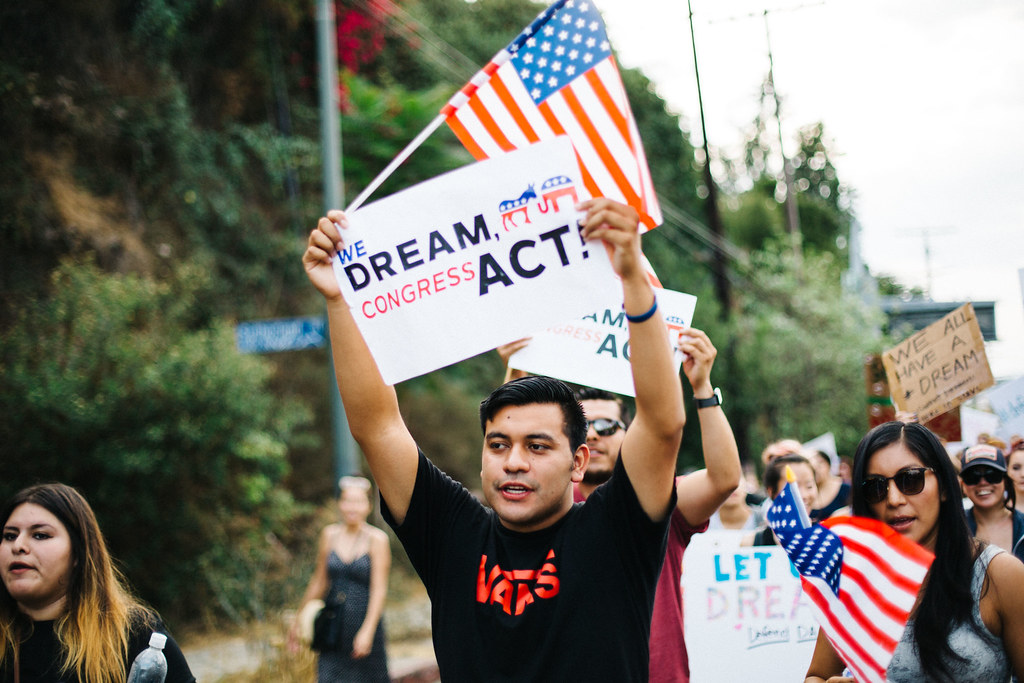
Source: Flickr: Molly Adams, LA March for Immigrant Rights 

In a stunning turn of events, a federal judge on Wednesday declared the Deferred Action of Childhood Arrivals (DACA) program illegal in a new court ruling.

The decision comes after a five-year long court battle which has left the future of Dreamers hanging in the balance.

Judge Andrew S. Hanen of the District Court of Houston rejected the Biden administration’s efforts to save the DACA program, arguing that former President Barack Obama did not have the authority to create the program in 2012 by executive authority.

In his ruling, Judge Hanen stopped short of terminating the program which will mean that current DACA recipients can retain their DACA benefits and apply for renewals with the U.S. Citizenship and Immigration Services (USCIS). However, initial first-time applications for DACA will remain prohibited.

In 2021, the Biden administration sought to defend the legality of DACA by issuing a Proposed Rule in the Federal Register to preserve and fortify the program. This came after Judge Hanen issued a prior ruling arguing that the government failed to abide by the public notice and comment procedure required by the Administrative Procedures Act before. This prompted Texas along with eight other states (Alabama, Arkansas, Louisiana, Nebraska, South Carolina, West Virginia, Kansas, Mississippi) to sue the federal government bringing the case before Judge Hanen yet again.

Unfortunately, the Biden administration’s efforts to appease the Judge did not work. Ultimately the Judge indicated that only Congress could enact legislation to protect Dreamers, and passing such a program was not under the authority of the President.

Continue reading

boy-gb1e2285a2_1280

This past week, the U.S. Department of Homeland Security announced the implementation of a new Family Reunification Parole (FRP) program for foreign nationals of Colombia, El Salvador, Guatemala, and Honduras, that falls in line with previous governmental policies aimed at reducing unlawful migration.

The program will benefit nationals of such countries whose family members are U.S. citizens or lawful permanent residents and have received approval to join their family in the United States.

Nationals of these countries can be considered for parole on a case-by-case basis for a period of up to three years while they wait to apply to become a lawful permanent resident. This means that those who are eligible for parole will have the opportunity to lawfully reside inside of the United States while applying for lawful permanent residence for a period of up to three years.

The Secretary of the Department of Homeland Security Alejandro N. Mayorkas, said that “These new processes promote family unity and provide lawful pathways consistent with our laws and our values,” and will allow for the expansion of safe, orderly, and lawful pathways to reduce “dangerous, irregular migration to the United States.”

Continue reading

hand-truck-564242_1280

We are happy to inform our readers that U.S. Immigration and Customs Enforcement (ICE) has launched a new online change of address form for noncitizens.


What is the online change of address form?


This new form gives noncitizens the option to update their information online instead of having to do so by phone or in-person.

To process an online change-of-address, the system requires a full name, A-number, and validated non-commercial address. It takes approximately one minute to complete the form.

This tool will make it easier for noncitizens to comply with their immigration obligations and improve the accuracy of address information reported to Immigration and Customs Enforcement (ICE) by utilizing address autofill to ensure U.S. Postal Service standardization.


Reporting a Change of Address with USCIS


As a reminder, all noncitizens in the United States, except A and G visa holders and visa waiver visitors, must also report a change of address to USCIS within 10 days of relocating.

You may change your address with USCIS online here.


Reporting a Change of Address with Immigration Court


Once a noncitizen has entered a valid mailing address, if they are currently in removal proceedings pursuant to Section 240 of the Immigration and Nationality Act (INA), the interactive online system will provide the noncitizen with information on how to also change their address with the immigration court as required, using the Executive Office for Immigration Review’s (EOIR) Form EOIR-33, Change of Address/Contact Information. Form EOIR-33 can be submitted by mail, in-person at the immigration court, or online through EOIR’s Respondent Access.

Continue reading

update-gcfbe3363f_1920

In this blog post, we share with you some recent updates in the world of immigration.


Suspension of Visa Services in Sudan


Today, April 24, 2023, the Department of State announced suspension of non-immigrant and immigrant visa services in Sudan, due to armed conflict in the country. The U.S. Embassy in Khartoum suspended all operations on April 22, 2023, and all personnel have been evacuated under orders of the Department of State.

All Immigrant and Diversity Visa interviews have been cancelled until further notice.  Those with an inquiry about a pending post-interview Immigrant Visa case, are advised to send only one email to KhartoumIV@state.gov.  The inbox will remain unmonitored for a certain period of time, until officials can begin to resume normal or alternative operations.

The mission is unable to conduct passport or document passback for the time being.

Applicants for U.S. nonimmigrant visas are encouraged to apply in any country in which they are physically present and where there are appointments available. As each U.S. Embassy and Consulate has specific application procedures, applicants should contact the U.S. Embassy where they wish to apply directly. Contact information for U.S. Embassies is available at usembassy.gov.


ICE launches online CeBONDS capability to automate bond payments


Last week, U.S. Immigration and Customs Enforcement (ICE) announced its implementation of a new web-based system called, Cash Electronic Bonds Online (CeBONDS), which provides a fully automated, online capability to request verification of bond eligibility, make cash immigration bond payments, and send electronic notifications to cash bond obligors. The web-system will benefit detained noncitizens determined by the Immigration Judge or ERO to be suitable for release on bond and enables ICE to send electronic notifications to cash bond obligors.

Individuals will still have the option of making in-person bond payments until the online system fully takes over on June 1st.


CeBONDS Frequently Asked Questions


Who can utilize CeBONDS?


U.S. citizens, lawful permanent residents, law firms, and non-profit organizations can use CeBONDS to post a delivery bond, voluntary departure bond, or order of supervision bond. Noncitizens can also post a voluntary departure bond or order of supervision bond on their own behalf.

Continue reading

border-g740e70764_1280

USCIS Updates Policy Manual Clarifying Physical Presence Requirement for Asylees and Refugees


The U.S. Citizenship and Immigration Services (USCIS) recently updated its Policy Manual to clarify that BOTH asylees and refugees must have been physically present in the United States for one year at the time the Immigration Officer adjudicates their Form I-485, Application to Register Permanent Residence or Adjust Status, rather than at the time the individual files their adjustment of status application.

This policy is effective immediately and applies to all Form I-485 Applications to Register Permanent Residence or Adjust Status and Form N-400, Applications for Naturalization, that are pending on February 2, 2023, and applications filed on or after that date.


What does this mean?


This means that in order to be eligible for adjustment of status (a green card), an asylee or refugee must have been physically present in the United States for at least 1 year after either being granted asylum status or admitted as a refugee.

Additionally, the policy manual:

  • Provides that asylees and refugees are required to accrue 1 year of physical presence by the time of adjudication of the adjustment of status application, rather than by the time they file the application (and that USCIS may request additional information to determine such physical presence in the United States).
  • Clarifies that asylee and refugee adjustment applicants who have held the immigration status of exchange visitor (J-1 or J-2 nonimmigrants) and who are subject to the 2-year foreign residence requirement under INA 212(e) are not required to comply with or obtain a waiver of such requirement in order to adjust status under INA 209.
  • Makes technical updates, including clarifying processing steps for refugees seeking waivers of inadmissibility and removing references to the obsolete Decision on Application for Status as Permanent Resident (Form I-291).
  • Provides that USCIS considers a refugee or asylee who adjusted status to a permanent resident despite filing for adjustment before accruing 1 year of physical presence to have been lawfully admitted for permanent residence for purposes of naturalization if the applicant satisfied the physical presence requirement at the time of approval of the adjustment of status application.

Continue reading

nathan-dumlao-vxHX2qLltdw-unsplash-1-scaled

DACA recipients can now breathe a sigh of relief. We are happy to report that the Department of Homeland Security recently published a final rule in the Federal Register, taking a major step to safeguard the Deferred Action for Childhood Arrivals (DACA) program, while the fight to uphold DACA is in litigation.


What does this mean?


The final rule officially took effect on October 31, 2022, to codify existing policy, preserve, and fortify DACA.

This means that effective October 31, 2022, pursuant to the final rule, the U.S. Citizenship, and Immigration Services (USCIS) will accept and process renewal DACA requests and accompanying requests for employment authorization (EAD), consistent with court orders and an ongoing partial stay. Currently, valid grants of DACA, related employment authorization, and advance parole will continue to be recognized as valid under the final rule. Those with pending DACA renewal applications, do not need to reapply.

USCIS will also continue to accept and process applications for advance parole for current DACA recipients and will continue to accept but will not process initial (new) DACA requests.

Pursuant to an injunction and partial stay, handed down by the U.S. District Court for the Southern District of Texas, DHS is prohibited from granting initial (new) DACA requests and related employment authorization under the final rule.

While this is a temporary measure to protect existing DACA benefits, Secretary of Homeland Security, Alejandro Mayorkas stated, “Ultimately, we need Congress to urgently pass legislation that provides Dreamers with the permanent protection they need and deserve.”

Continue reading

ethiopia-g9818de42f_1920

Happy Halloween! In this blog post, we bring you a brand-new immigration update.

On October 21, 2022, the Department of Homeland Security (DHS) announced the designation of Ethiopia for Temporary Protected Status (TPS) for a period of 18 months. This decision marks Ethiopia’s first designation for TPS.

This designation was made based on ongoing armed conflict and extraordinary and temporary conditions in Ethiopia that prevent its nationals from safely returning to their country. Concerns relating to conflict-related violence including killings, rape, and gender-based violence prompted the Secretary of Homeland Security to make this decision. Other temporary conditions further complicate the return of Ethiopian nationals including flooding, drought, and disease outbreaks.

In response to the DHS announcement, Secretary of Homeland Security Alejandro N. Mayorkas explained, “Ethiopian nationals currently residing in the U.S. who cannot safely return due to conflict-related violence and a humanitarian crisis involving severe food shortages, flooding, drought, and displacement, will be able to remain and work in the United States until conditions in their home country improve.”

Continue reading

venezuela-g25f459dd7_1920

In this blog post, we follow up on our previous reporting relating to a brand-new program launched by the Biden administration that will allow for the admission of up to 24,000 Venezuelans, closely following in the footsteps of the Uniting for Ukraine program.

Today, October 18, 2022, the U.S. Citizenship and Immigration Services updated its “Venezuela” webpage including all the details regarding this new program. Applications are currently being accepted by USCIS.

We break down the details for you down below.


What is this program all about?


USCIS has launched a new process that allows Venezuelan nationals and their immediate family members to come to the United States in a safe and orderly manner.

Like the Uniting for Ukraine program, nationals of Venezuela who are outside the United States and who lack U.S. entry documents will be considered for admission to the United States on a case-by-case basis.

Those who are found eligible, will receive advance authorization to travel to the United States and a temporary period of parole for up to 2 years for urgent humanitarian reasons and significant public benefit.

After being paroled into the United States, beneficiaries are eligible to apply for discretionary employment authorization from USCIS. To apply for an Employment Authorization Document (EAD), applicants must submit Form I-765, Application for Employment Authorization, using the (c)(11) category code with the required fee or apply for a fee waiver.

Using the same Form I-765 form, applicants can also apply for a Social Security number (SSN) by following the form instructions.

If you request an SSN in Part 2 (Items 13a-17.b) of your Form I-765, and your application is approved, USCIS will electronically transmit that data to the Social Security Administration (SSA), and SSA will assign you an SSN and issue you a Social Security card. SSA will mail your Social Security card directly to the address you provide on Form I-765.

Continue reading

borders-ga8db894a2_1280

The Biden administration is ramping up efforts to secure the Southwest border to curb illegal immigration stemming from the humanitarian and economic crisis in Venezuela.

In a press release issued October 12, 2022, the Biden administration announced that effective immediately, Venezuelans who enter the United States between ports of entry, without authorization, will be returned to Mexico, pursuant to its agreement with the Mexican government.

The U.S. government also announced a new process to efficiently grant admission of up to 24,000 Venezuelans into the country, that mirrors the Uniting for Ukraine program. This effort is designed to encourage lawful and orderly admission to the United States for Venezuelans.

To be eligible for this new program, Venezuelans must:

  • have a supporter in the United States who will provide financial and other support;
  • pass rigorous biometric and biographic national security and public safety screening and vetting; and
  • complete vaccinations and other public health requirements.

Continue reading

eric-gonzalez-Z3CHkelnvHA-unsplash-scaled

In the latest legal saga concerning the Deferred Action for Childhood Arrivals (DACA) program, a federal appeals court has declared the DACA program illegal, causing uncertainty for the future of the program.

Yesterday, the three-judge panel for the 5th Circuit Court of Appeals handed down a ruling in which it found that the Obama administration did not have the legal authority to create the DACA program in 2012. The Circuit Court ruling affirms a previous ruling handed down by U.S. District Court Judge Andrew Hanen of the Southern District of Texas which halted the Biden administration’s plans to revive the program last year.

While the panel declared the DACA program illegal, it stopped short of ordering the Biden administration to completely invalidate the program for those with existing DACA benefits, or those seeking to renew those benefits. For the time being, DACA policy remains intact for current beneficiaries, allowing U.S. Citizenship and Immigration Services (USCIS) to continue to accept and adjudicate renewal requests. However, USCIS is prohibited from approving initial applications for DACA, and accompanying requests for employment authorization.


What happens next?


The appeals court has sent the lawsuit back to U.S. District Judge Andrew Hanen, the same judge that previously ordered a nationwide injunction preventing the approval of new DACA applications. Judge Hanen will review the legality of the program under the Biden administration’s policy memorandum which includes revisions to the program.

Sadly, it is unlikely that Judge Hanen will rule in favor of the Biden administration which will likely result in a formal appeal sent to the United States Supreme Court, where chances of its survival hinge on a conservative leaning court. Judge Hanen previously found the program illegal because the government failed to follow the notice and comment periods required by the federal Administrative Procedures Act. In 2016, the Supreme Court deadlocked in a 4-4 decision over expanding DACA to parents of DACA recipients, keeping in place a lower court decision preventing its expansion.

The appellate court’s decision will have long-lasting repercussions, as it forces members of Congress to safeguard the future of the program by passing legislation to settle the matter once and for all. While the topic has been argued for the past decade on Capitol Hill, no meaningful steps have been taken to preserve the program and create a path to residency for Dreamers.

Continue reading