- Starting March 1, 2026, the premium processing fee for I-140 immigrant worker petitions and most Form I-129 nonimmigrant worker petitions will increase to $2,965, from $2,805. Fees for premium processing of certain I-129 petitions for nonimmigrant workers, I-539 petitions to extend/change nonimmigrant status, and I-765 EADs for OPT and STEM classifications will also increase.
- The new fees apply to filings postmarked on or after March 1, 2026.
Articles Posted in E-2 Business
New SBA Rule Bars Green Card Holders From Government‑Backed Small Business Loans Starting March 1st
Beginning March 1, 2026, the U.S. Small Business Administration (SBA) will restrict its flagship loan programs—like the 7(a) and 504 loans—to businesses that are 100 % owned by U.S. citizens or U.S. nationals whose primary residence is in the United States.
Under the revised policy, lawful permanent residents (green card holders) are no longer permitted to hold any ownership stake (direct or indirect) in businesses seeking SBA‑backed loans.
A notice published by the agency earlier this month explains, “SBA is requiring that 100% of all direct and/or indirect owners of a small business applicant be U.S. Citizens or U.S. Nationals who have their Principal Residence in the United States, its territories or possessions.”
This rule removes a long-standing exception that previously allowed limited minority ownership of up to 5% by non‑citizens (such as E-2 investors) or green card holders under certain conditions.
Officials say the new rules implement President Trump’s January 2025 executive order, “Protecting the American People Against Invasion,” described as an effort to enforce U.S. immigration laws and safeguard public safety.
E-2 Visa News: U.S. Embassy Lisbon and São Paulo Accepting Treaty Investor Applications for Portuguese Citizens as of April 2024
As of April 23, 2024, Portugal has joined the coveted list of countries eligible to participate in the E-2 Treaty Investor program via the passage of the Advancing Mutual Interests and Growing Our Success (AMIGOS) Act.
E-2 nonimmigrant visas are reserved for investors who are nationals of a treaty country. To qualify, an investment must be made into a U.S. company, the investor must hold at least 50% of the ownership interests, and the company must meet the E-2 visa requirements.
The E-2 visa is a very popular visa because there is no limit to the number of times the visa can be renewed, and it allows the company to sponsor other nationals of the treaty country as employees.
The addition of Portugal to the E-2 visa program presents a unique opportunity for Portuguese entrepreneurs to establish and grow their own businesses in the United States, while giving spousal dependents the opportunity to work for any employer in the United States.
It also presents an exciting opportunity for Brazilians who hold dual nationality with Portugal to participate in the program, as well as those who can obtain Portuguese citizenship through ancestry, legal residence, or by other lawful means.
Key Benefits of the E-2 visa program for Portuguese nationals
- By law, the E-2 visa does not require any minimum investment amount and instead focuses on whether the investment is proportional based on the nature of the business. In most cases, entrepreneurs invest anywhere from $50,000 to $100,000 in their businesses.
- E-2 treaty investor visas for Portuguese nationals are valid for five years and can be renewed indefinitely so long as the E-2 eligibility criteria are met.
- Spouses and unmarried children under the age of 21 can apply for E-2 dependent visas to accompany the E-2 principal investor in the United States. Spouses are eligible for work authorization and can work for any employer in the United States.
- Processing times for an E-2 visa interview at the U.S. Embassy in Lisbon can vary, but applicants can generally expect to be called for an interview approximately three months after submitting their application. Upon approval, visas are typically issued within three to five business days.
- Brazilians who hold dual nationality with Portugal can apply for the E-2 visa at the U.S. Consulate in Sao Paulo, the designated adjudicating post in Brazil for E-2 Treaty Country nationals.
New Changes are Coming to the International Entrepreneur Rule Starting October 1st
Recently the U.S. Citizenship and Immigration Services (USCIS) announced new changes to the International Entrepreneur Rule effective October 1, 2024.
What is the International Entrepreneur Rule
The International Entrepreneur Rule (IER), was first established by the Department of Homeland Security (DHS) in 2017.
The program allows noncitizen entrepreneurs to live and work in the United States temporarily, if they can demonstrate that their businesses will provide a significant public benefit to the United States via economic benefits and job creation.
Those granted parole under the program are eligible to work for their startup companies for an initial period of 2 ½ years, and their dependents can accompany them to the United States.
The current requirements of the International Entrepreneur parole program are as follows:
- Entrepreneurs already in the United States and those residing overseas are eligible to apply
- Start-up entities must have been formed in the United States within the past five years
- Start-up entities must demonstrate substantial potential for rapid growth and job creation by showing at least $264,147 in qualified investments from qualifying investors, at least $105,659 in qualified government awards or grants, or alternative evidence
- The spouse of the entrepreneur may apply for employment authorization after being paroled into the United States
- The entrepreneur may be granted an initial parole period of up to 2½ years. If approved for re-parole, based on additional benchmarks in funding, job creation, or revenue described below, the entrepreneur may receive up to another 2½ years, for a maximum of 5 years under the program
New Increases to Qualifying Investment Amounts
- Initial Applications: Starting October 1st to demonstrate the businesses’ potential for growth and job creation, initial applicants will need to show at least $311,071 in qualified investments from qualifying investors, at least $124,429 in qualified government awards or grants, or, if only partially meeting the threshold investment or award criteria, alternative evidence of the start-up entity’s substantial potential for rapid growth and job creation.
- Re-parole Applications: For those applying for a second period of authorized stay, the entrepreneur must demonstrate that the start-up entity has either:
- Received a qualified investment, qualified government grants or awards, or a combination of such funding, of at least $622,142(currently $528,293);
- Created at least five qualified jobs; or
- Reached annual revenue in the United States of at least $622,142 (currently $528,293) and averaged at least 20% in annual revenue growth.
USCIS Announces Increase in Premium Processing Filing Fees Starting February 26, 2024
As the new year approaches, we have some unfortunate news to report for certain employment-based applicants who may wish to file their petitions with premium processing service in 2024, including those filing:
- Form I-129 Petition for a Nonimmigrant Worker
- Form I-140 Immigrant Petition for Alien Worker, as well as
- Certain applicants filing Form I-765 Application for Employment Authorization and
- I-539 Application to Extend or Change Nonimmigrant Status with USCIS.
On December 28, 2023, USCIS published a final rule in the Federal Register that will increase the filing fee for Form I-907, Request for Premium Processing Service, to adjust for inflation.
The final rule states that starting February 26, 2024, the Department of Homeland Security (DHS) will increase the premium processing fees USCIS charges for all eligible forms and categories to reflect the amount of inflation from June 2021 through June 2023 according to the Consumer Price Index for All Urban Consumers.
Please note that not all petitions are eligible to request premium processing service. Applicants may only request premium processing if USCIS has specifically designated your classification as one that is eligible for premium processing service. To determine whether premium processing is available for your benefit request please review the USCIS webpage.
U.S. Embassy Israel Suspends Immigrant and Nonimmigrant Visa Services Amid Conflict
In this blog post, we share with you an important update from the U.S. Embassy in Israel.
If you have a pending nonimmigrant or immigrant visa application awaiting an interview at the U.S. Embassy in Jerusalem or U.S. Embassy Branch Office in Tel Aviv, you should be aware that visa services have been temporarily suspended at these missions due to the ongoing conflict in the region.
The U.S. Embassy in Israel will be focusing its resources to plan the evacuation and departure of U.S. Citizens from the region.
Starting October 13th, the government arranged charter flights to assist U.S. Citizens and their immediate family members to depart Israel.
U.S. citizens in need of assistance must complete the crisis intake form here.
Applying for a Nonimmigrant Visa at a Neighboring U.S. Consulate or Embassy
If you have an urgent need to travel to the United States and do not currently have a nonimmigrant visa, you may apply for your visa at another U.S. Embassy or Consulate other than Jerusalem or Tel Aviv.
You must contact the nonimmigrant visa unit at the neighboring Embassy or Consulate to determine whether they will accept your application as a third-country national.
The U.S. Consulates in Canada allow third-country nationals to apply for visas including Israelis. Alternatively, please check with the specific Consulate regarding their instructions for requesting expedited interview appointments for emergency travel. In most cases, once you have submitted your DS-160 online nonimmigrant visa application and paid the necessary visa fees on the U.S. Department of State Visa Appointment Services webpage, you may request an expedited appointment. More information about expedites can be found on the ‘Frequently Asked Questions’ portion of each country webpage by navigating to the bottom of the DOS Visa Appointment Service and selecting “Answers to Common Questions.”
Nonimmigrant Visa Fee Increases Effective June 17, 2023
Certain types of nonimmigrants will be expected to shell out more money for the nonimmigrant visa process.
The State Department has announced that starting June 17, 2023, nonimmigrant visa (NIV) application processing fees for visitor visas for business or tourism (B1/B2s and BCCs), and other non-petition based nonimmigrant visas such as student and exchange visitor visas (F, M, and J visas), will increase from $160 to $185.
Additionally, processing fees for certain petition-based nonimmigrant visas for temporary workers (H, L, O, P, Q, and R categories) will increase from $190 to $205.
Fees for a treaty trader, treaty investor, and treaty applicants in a specialty occupation (nonimmigrant E category) visa will also increase from $205 to $315.
What if I pay my nonimmigrant visa fee prior to June 17, 2023?
In this case you are in luck. Nonimmigrant visa fees paid prior to June 17, 2023, will remain valid through the expiration date on your nonimmigrant visa fee payment receipt.
Why the increase?
The Department of State has said that nonimmigrant visa fees are set based on the actual cost of providing nonimmigrant visa services and are determined after conducting a study of the cost of these services.
The agency uses Activity-Based Costing (ABC) methodology to calculate, annually, the cost of providing consular services, including visa services.
State Department Announces the End of COVID-19 Vaccination Requirement for Nonimmigrant International Air Travelers and Land Travelers, Starting May 12th
Welcome back to Visalawyerblog! In this blog post we share with you some breaking news regarding the COVID-19 vaccination requirement for non-immigrant international travelers.
On May 4, 2023, the State Department announced that the Biden administration will end the COVID-19 vaccine requirements for international air travelers at the end of the day on May 11, 2023, which marks the end of the federal COVID-19 public health emergency.
After this date, beginning May 12, noncitizen nonimmigrant air passengers will no longer need to show proof of being fully vaccinated with an accepted COVID-19 vaccine to board a flight to the United States.
Additionally, the Department of Homeland Security has released its own statement announcing that the COVID-19 vaccine requirement will also end for non-U.S. citizen travelers seeking entry through land parts of entry and ferries as indicated below:
Beginning May 12, 2023, DHS will no longer require non-U.S. travelers entering the United States via land ports of entry and ferry terminals to be fully vaccinated against COVID-19 and provide related proof of vaccination upon request. DHS intends to rescind these Title 19 travel restrictions in alignment with the end of the Public Health Emergency and the termination of the Presidential Proclamation on air travel.
What’s New in Immigration: USCIS Extends Temporary Suspension of Biometrics Submission for Form I-539 Applicants seeking H-4, L-2, or E Status
We have good news for applicants filing Form I-539, Application to Extend/Change Nonimmigrant Status, requesting an extension of stay in or change of status to H-4, L-2, or E nonimmigrant status.
The United States Citizenship and Immigration Services (USCIS) recently announced that it has extended the temporary suspension of the biometrics submission requirement for this group of applicants.
Previously, USCIS had suspended the biometrics requirement until May 17, 2023. With today’s announcement, the suspension of biometrics will continue through September 30, 2023, for H-4, L-2, and E nonimmigrants.
USCIS will allow adjudications for these specific categories to proceed based on biographic information and related background checks, without the normal requirement of capturing fingerprints and a photograph. However, the agency will retain its discretion to require biometrics for any applicant on a case-by-case basis. Therefore, certain applicants may still be scheduled to attend a biometrics appointment at a local application support center (ASC).
USCIS reminds Form I-539 applicants meeting the biometrics suspension criteria, that they do not need to submit the $85 biometric services fee for Form I-539 during the suspension period.
CBP Issuing Work-Authorized I-94s for E and L Spouses Effective January 31, 2022
In this blog post, we share great news for E and L dependent spouses!
As we previously reported on our blog, pursuant to a new USCIS policy, E and L nonimmigrant dependent spouses are now considered employment authorized “incident to their status.”
This means that upon admission and issuance of a valid I-94 arrival/departure document showing E or L-2 spousal status, E and L nonimmigrant spouses will automatically be authorized to work without the need to apply for an Employment Authorization Document (EAD). Previously, E or L dependent spouses were required to apply for an EAD by filing Form I-765 Application for Employment Authorization with USCIS.
How does this system work?
Effective January 31, 2022, CBP Office of Field Operations (OFO), in coordination with both USCIS and Department of State, began issuing new classes of admission on the I-94 arrival/departure record for E and L dependent spouses entering the U.S. at a Port of Entry. The new I-94 admission records indicate an “S” designation after the E or L class of admission to indicate that the spouse is authorized to work in the United States. The “S” designation is meant to indicate that the E or L nonimmigrant is a dependent “spouse” of a principal E or L visa holder. Please note that the new designation will not explicitly state that the spouse is “work authorized,” however the “S” designation signals to U.S. employers that the spouse is authorized to work for I-9 employment verification purposes.
Spouses who applied for an extension of their E or L visa status with USCIS, will receive I-94s that carry the new “S” designation at the bottom of their approval notices.
How can I prove that I am authorized to work as an E or L dependent spouse?
If you are an L or E dependent spouse who wishes to work in the United States without having to obtain an Employment Authorization Document (EAD), you must present an I-94 admission document with the “S” spousal annotation.
CBP has confirmed that the agency has been issuing new I-94’s with the “S” spousal annotation to E and L spouses who gained admission to the United States on or after January 31, 2022.
How does the annotation look?
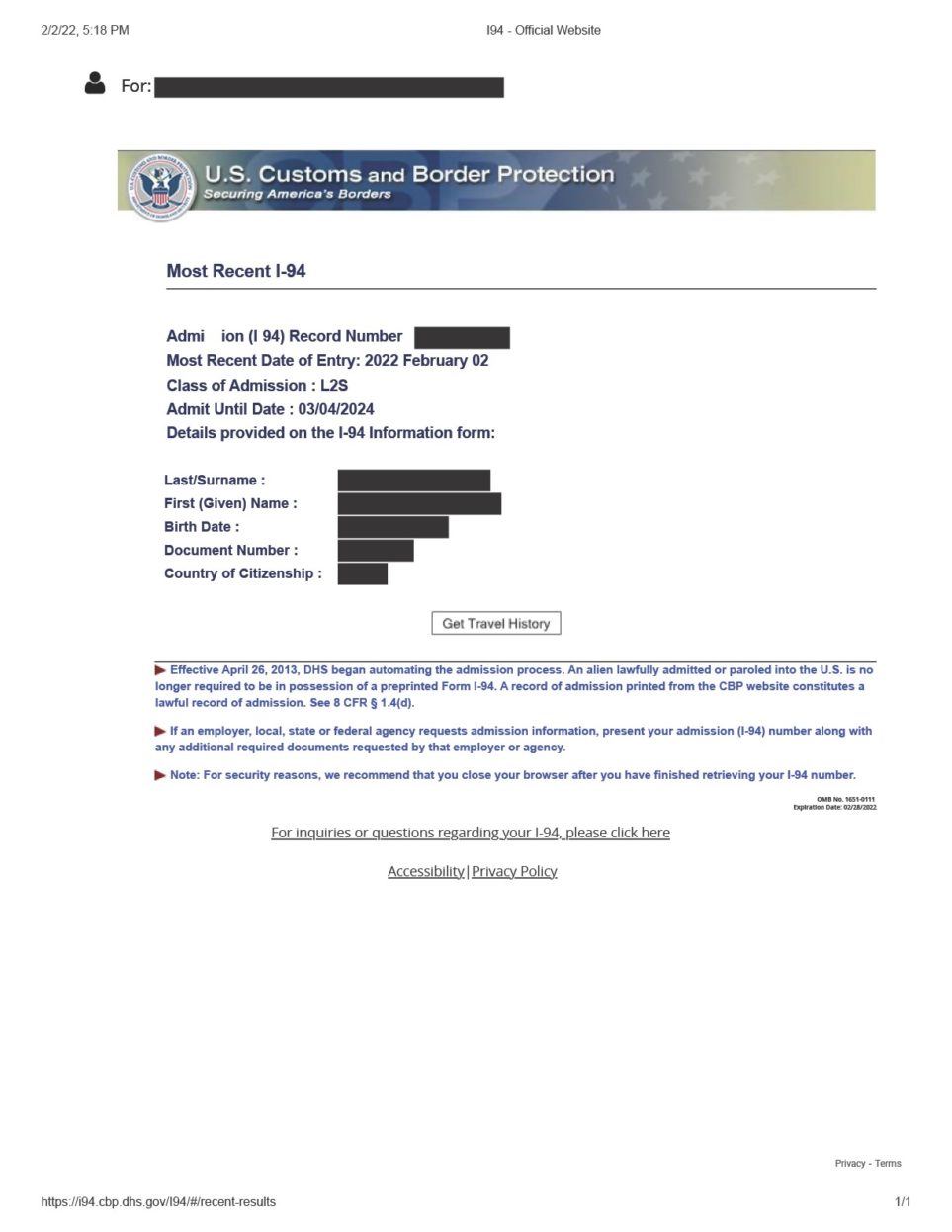
The I-94 will be annotated with an “S” next to the E or L-2 status designation, signaling to prospective employers that the individual is authorized to work during the validity period of the I-94. Spouses admitted in E or L-2 status should review their I-94 document immediately upon admission to ensure that it contains the appropriate annotation.
What if I gained admission to the United States prior to January 31, 2022 and I do not have the spousal designation on my I-94?
If you are an E or L dependent spouse who gained admission to the U.S. prior to January 31, 2022, and you do not have the “S” spousal annotation on your I-94, you must contact your closest CBP Deferred Inspection Office to determine whether they may, in their discretion, amend your I-94 arrival/departure record to include the “S” spousal annotation without requiring international travel. CBP may or may not agree to amend your I-94.
In cases where CBP will not amend your I-94 to include the spousal annotation, you may consider discussing with your immigration attorney whether you should depart the United States and re-enter at a U.S. port of entry to secure the new spousal annotated I-94. You must exercise caution before making any international travel plans. An immigration attorney will need to evaluate whether you have the proper documentation to gain re-admission after temporary foreign travel and determine whether your planned travel would result in the issuance of a new annotated I-94. Certain brief international trips may not result in a new I-94 issued by CBP.
Please note that if you are an E or L spouse admitted prior to January 31, 2022, and you have filed an application to extend your L or E status while in the U.S., USCIS is expected to issue the “S” spousal annotation on I-94’s printed at the bottom of USCIS-issued approval notices.
Visa Lawyer Blog