Articles Posted in Injunctions

ai-generated-8775233_1280On October 3, 2025, a coalition of labor unions, healthcare providers, academic institutions, and religious groups, filed a lawsuit urging a federal court to strike down the $100,000 fee imposed on new H-1B petitions by the Trump administration for workers outside the United States.

What the Lawsuit Says


The lawsuit, filed in the U.S. District Court for the Northern District of California, argues that the fee which took effect September 21, violates both the Immigration and Nationality Act and the Administrative Procedure Act. Plaintiffs claim the President lacks authority to unilaterally impose a fee of this kind, especially one designed to raise revenue or direct government spending.

The Trump administration’s sudden rollout of the H-1B fee caused immediate disruptions:

  • Workers abroad scrambled to return to the United States, paying steep travel costs.
  • Others inside the U.S. canceled planned international travel.
  • Some even asked to deplane midflight upon hearing the news.

The fee is seen by critics as a threat to institutions that rely heavily on skilled foreign workers—such as universities, health systems, and religious groups—particularly in fields already facing staffing shortages.

Continue reading

36952236081_5179c7d2d3_z

Source: Flickr Creative Commons Attribution mollyktadams

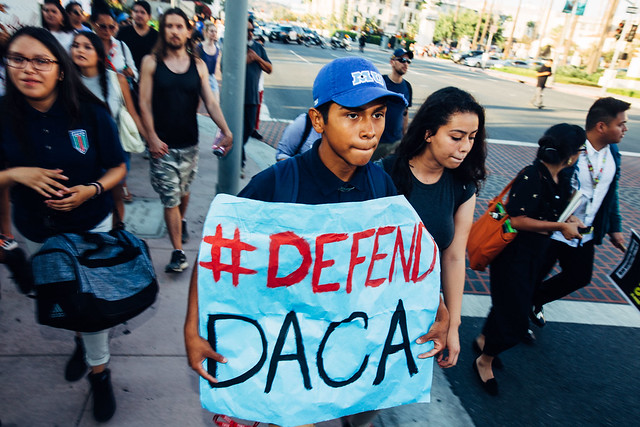
Recent court documents submitted by the government in the case, State of Texas v. United States of America (1:18-cv-00068), reveal that the U.S. Citizenship and Immigration Services (USCIS) may soon resume processing initial DACA applications for individuals living outside of Texas.

Since 2021, new DACA requests had been halted due to a court order which was later applied only to the state of Texas.

Under the proposed plan, USCIS would process initial applications for applicants residing outside of Texas. For those living in Texas, the government would only grant deferred action, without employment authorization or recognition of lawful presence. Moving to Texas could jeopardize a DACA recipient’s work authorization.

The government’s plan still requires court approval, and USCIS has not yet shared any timeline or implementation details if it moves forward.

DACA Refresher


Deferred Action for Childhood Arrivals (DACA) is a program that allows individuals who were brought to the United States as children to remain in the United States temporarily and apply for work permits. While it does not grant legal status, it offers protection from deportation.

Those eligible for DACA include individuals who entered the country as children before their 16th birthday, were under 31 years old as of June 15, 2012, and have not been convicted of a felony, a significant misdemeanor, or three misdemeanors.

Continue reading

people-4009327_1280On September 24, 2025, the Department of Homeland Security (DHS) issued a proposed rule that would change the current selection process for selecting H-1B visa petitions subject to the annual numerical limits established by the Immigration and Nationality Act.

Under the proposed rule, the current random lottery system would be replaced with a wage-based selection process that prioritizes the selection of H-1B workers offered higher salaries by sponsoring employers.

The goal is to better align the H-1B program with U.S. labor market needs by increasing the chances of selection for higher-paid, and presumably higher-skilled, foreign workers. This change aims to reduce the potential for abuse in the system, discourage mass low-wage registrations, and ensure that the most economically valuable positions are filled through the H-1B program.

What may change


Currently, the U.S. government selects H-1B visa petitions through a randomized lottery system due to the annual numerical cap on available visas. Employers first submit electronic registrations for each prospective H-1B worker during a designated registration period, typically held in March. Because the demand for H-1B visas consistently exceeds the supply, the U.S. Citizenship and Immigration Services (USCIS) conducts a lottery to determine which petitions can proceed with applying for H-1B visas.

There are two separate caps under the H-1B program: the regular cap of 65,000 visas and an additional 20,000 visas reserved for individuals who hold advanced degrees from U.S. institutions (commonly referred to as the master’s cap). All registered beneficiaries, including those with U.S. advanced degrees, are first entered into the regular cap lottery. After 65,000 are selected, those with U.S. master’s degrees who were not chosen in the initial round are entered into a second lottery for one of the 20,000 advanced degree slots.

This current system does not prioritize applicants based on wage levels, qualifications, or skills. Selection is purely random as long as the minimum eligibility requirements are met.

However, the Department of Homeland Security (DHS) is proposing changes that would shift the selection process to favor higher-paid workers.

Continue reading

imageOn Friday evening, President Donald J. Trump signed an executive order establishing a new pathway to permanent residency called “The Gold Card. This program creates a fast-track green card option for wealthy individuals who make significant “gifts” to the U.S. government through the Department of Commerce.

Highlights


Although clear guidance on the application process has not yet been provided, the executive order outlines several key features:

  • Unrestricted Gift requirement:

To qualify for an immigrant visa through the Gold Card program, applicants must provide an unrestricted gift (without conditions or limitations) to the Department of Commerce in the following amounts.

  • $1 million for individuals donating on their own behalf.
  • $2 million if the gift comes from a corporation or entity on behalf of an individual
  • Visa benefits: The gift can be used as evidence of eligibility under two employment-based categories:
    • Exceptional business ability and national benefit (8 U.S.C. §1153(b)(2)(A) and
    • National Interest Waiver (8 U.S.C. §1153(b)(2)(B))
      • Could be expanded to the EB-5 immigrant investor program under 8 U.S.C. 1153(b)(5).
  • Oversight and agencies involved: The Departments of Commerce, State, and Homeland Security are tasked with implementing the program, including setting up application, processing, status adjustment, and screening for public safety / national security.
  • Use of the funds: The money raised will go into a separate Department of Commerce fund, held with the Treasury, intended to promote commerce and American industry.
  • Timeline: The order gives the relevant secretaries 90 days to lay out implementation plans (application process, when gifts may start being submitted, fees, etc.)

Potential Legal Challenges


The Gold Card Executive Order, aimed at streamlining the visa process for wealthy donors may face several legal challenges. Plaintiffs could argue that it oversteps executive authority by altering immigration policy without congressional approval, potentially violating the Immigration and Nationality Act. Additionally, if the order is seen as favoring certain nationalities or industries, it may prompt lawsuits alleging discrimination or unequal treatment under the law. Legal battles may also arise from states or interest groups concerned about labor market impacts or federal overreach, leading to judicial review that could delay or block its implementation.

Continue reading

motherhood-7114294_1280Last month, the Supreme Court ruled that lower courts cannot issue nationwide injunctions blocking the Trump administration’s executive order limiting birthright citizenship, except in class action lawsuits.

Prior to the Supreme Court’s ruling, at least three different lawsuits had secured nationwide injunctions protecting all individuals potentially affected by Trump’s executive order restricting birthright citizenship. However, the Court’s ruling scaled back those protections, potentially leaving some children unprotected.

To safeguard all families across the country and address any gaps left by prior legal actions, the American Civil Liberties Union (ACLU) filed a class-action lawsuit, Barbara v. Donald J. Trump to stop the government’s enforcement of the order against all current or future babies born or after February 20, 2025, where:

(1) that child’s mother was unlawfully present in the United States and the child’s father was not a United States citizen or lawful permanent resident at the time of said child’s birth, or

(2) that child’s mother’s presence in the United States was lawful but temporary, and the child’s father was not a United States citizen or lawful permanent resident at the time of said child’s birth.

The U.S. District Judge Joseph Laplante agreed with the plaintiffs and issued a class-wide preliminary injunction blocking Trump’s executive order from being enforced against any affected baby born in the United States after February 20th.

Continue reading

prison-370112_1280A new lawsuit filed by a man detained in San Diego, California, is challenging the controversial practice of courthouse arrests by U.S. Immigration and Customs Enforcement (ICE) taking place in recent months. The case could offer critical insight into the government’s approach in making these arrests. (A.M. v. Larose (3:25-cv-01412))

The man identified in court filings as A.M. is seeking asylum in the United States after being subjected to torture in his home country from his human rights advocacy. On June 3, he arrived for what he believed would be a routine immigration court hearing but was shocked to find that the judge had dismissed his case and ICE agents were waiting outside, ready to arrest him and take him to Otay Mesa’s Detention Facility to eventually be deported.

Unfortunately, A.M.’s case is not unique. In recent months, the Trump administration has enforced a controversial policy in immigration courts to expedite deportations by instructing judges to swiftly dismiss cases, subjecting individuals to expedited removal without giving them a meaningful opportunity to contest the government’s claims or consult attorneys.

This approach, detailed in a May 30 directive from the Executive Office for Immigration Review, encourages judges to grant oral motions to dismiss without the standard 10-day response period, effectively eliminating opportunities for individuals to contest their cases. Once dismissed, individuals are immediately eligible for expedited removal, making it possible for ICE officers to arrest them.

Continue reading

gavel-7499921_1280In a stunning turn of events, on Tuesday a federal judge in New York blocked the Trump administration from ending Temporary Protected Status (TPS) benefits for Haitians ahead of schedule, ruling that DHS violated the law in attempting to strip deportations and work permits from over half a million Haitians.

The ruling comes in response to the Department of Homeland Security’s abrupt announcement that it would be terminating Haiti’s TPS designation effective September 2, 2025.

In a decision issued Tuesday, District Court Judge Brian M. Cogan found that accelerating the program’s expiration by at least five months was unlawful and that the government failed to follow required procedures mandated by Congress, such as conducting a review of current conditions in Haiti before ending its TPS designation—a requirement that was not followed in this case.

passport-8621284_1280

Harvard Travel Ban Blocked by Federal Judge

Earlier this month President Trump had signed an Executive Order suspending the entry of all nonimmigrants and exchange visitors attending Harvard University, for a period of 6 months starting June 4th (the effective date of the proclamation).

Those affected by the executive order were F, J, and M visa holders outside of the United States as of the date of the proclamation. The suspension did not apply to nonimmigrants entering the United States to attend other universities.

Shortly after the executive order was issued, a federal judge granted a preliminary injunction, temporarily halting its enforcement until the court can rule on the merits of the case.

Following the court’s actions, the State Department ordered embassies and consulates around the world to resume visa processing for Harvard University students and exchange visitors.

As a result, Harvard students can breathe easier. While the preliminary injunction remains in effect, consulates are barred from denying visas to Harvard students and exchange visitors, and visa holders attending Harvard cannot be refused entry to the United States.

For more information, please click here.

Continue reading

beverly-kimberly-tfiGOGEmJVI-unsplash-scaledOn June 4, 2025, President Trump continued his ongoing assault on Harvard University with a new Executive Order entitled, “Enhancing National Security by Addressing Risks at Harvard University.”

Effective June 4th, the order suspends the entry of all nonimmigrants and exchange visitors bound for Harvard University for a period of 6 months, citing national security concerns over Harvard’s failure to police foreign students and ensure that foreign nationals admitted on student and exchange visitor visas remain in compliance with Federal law.

The executive order also accuses Harvard of having extensive entanglements with foreign adversaries including China.

Who is affected?


All nonimmigrants who enter or attempt to enter the United States to begin attending Harvard University through the Student and Exchange Visitor Program (SEVP) after the effective date of the proclamation (June 4, 2025).

The executive order further empowers the Secretary of State Marco Rubio to consider in his discretion whether foreign nationals who currently attend Harvard University and are in the United States pursuant to F, M, or J visas, should have their visas revoked pursuant to the proclamation.

Who is not affected?


The suspension does not impact Harvard students who are already inside the United States with a valid student visa as of the effective date of the proclamation.

The suspension also does not apply to any alien who enters the United States to attend other universities through the Student and Exchange Visitor Program (SEVP).

It also does not apply to any alien whose entry would be in the national interest, as determined by the Secretary of State, the Secretary of Homeland Security, or their designated representatives.

Impact on Harvard Students Currently in the United States


The executive order does not:

  • Restrict change or extension of status applications filed with U.S. Citizenship and Immigration Services (USCIS)
  • Revoke existing visas, I-94, or STEM OPT work authorization status for students currently in the United States

Continue reading

united-states-8911597_1280After months of speculation and buildup, President Trump’s long-anticipated travel ban has finally arrived.

Issued by executive order on June 4th President Trump’s travel ban entitled “Restricting the Entry of Foreign Nationals to Protect the United States from Foreign Terrorists and Other National Security and Public Safety Threats,” closely mirrors the leaked draft that first surfaced in early March through the New York Times.

That draft hinted at sweeping restrictions targeting so-called “red,” “orange,” and “yellow” countries—coded designations that formed the backbone of President Trump’s proposed directive.

While there are notable differences, as predicted, the administration has framed the ban as a national security measure, but critics argue it remains susceptible to being challenged or overturned through lawsuits that may soon be filed in federal court.

Here’s what you need to know.

President Trump’s travel ban goes into effect today Monday June 9, 2025, at 12:01 am Eastern Daylight time.


Who it Affects


Full Suspension on Nationals from Countries of Concern

The travel ban temporarily suspends the entry of both immigrants and non-immigrants from 12 designated countries who are outside the United States and do not have a valid visa on the effective date of the proclamation, including Afghanistan, Burma, Chad, the Republic of the Congo, Equatorial Guinea, Eritrea, Haiti, Iran, Libya, Somalia, Sudan, and Yemen.

However, several key exceptions apply for lawful permanent residents (LPRs), immediate family members of U.S. citizens, dual nationals, athletes and teams competing in major international sporting events such as the World Cup and the Olympics, and others (a full list of exceptions is provided below).

Continue reading