Articles Posted in H1B Visas

ai-generated-9069946_1280The legal immigration landscape was shaken once again late Friday evening when the President issued a new proclamation barring new H-1B workers from entering the United States—unless their employers pay a $100,000 fee for each sponsored employee.

The proclamation took effect at 12:01 a.m. EDT on Sunday, September 21, and will remain in effect until a court order halts its implementation.

Emergency Litigation


A surge of emergency lawsuits is expected to be filed by impacted H-1B workers and their sponsoring employers, seeking a nationwide injunction to stop the implementation of the executive order. A court could issue an injunction as early as Monday. We will provide litigation updates as they develop in the coming days.

Highlights of the Executive Order


  • Effective today September 21, 2025, certain H-1B workers will be denied entry into the United States unless their employer pays a $100,000 fee on their behalf, according to the proclamation signed by President Trump late Friday.
  • Application: The ban on entry and the associated fee requirement applies only to any new H-1B visa petitions submitted after 12:01 a.m. eastern daylight time on September 21, 2025. This includes the 2026 lottery, and any other H-1B petitions submitted after 12:01 a.m. eastern daylight time on September 21, 2025.
  • The proclamation does not apply to:
    • any previously issued H-1B visas, or any petitions submitted prior to 12:01 a.m. eastern daylight time on Sept. 21, 2025.
    • does not change any payments or fees required to be submitted in connection with any H-1B renewals. The fee is a one-time fee on submission of a new H-1B petition.
    • does not prevent any holder of a current H-1B visa from traveling in and out of the United States.
  • Misuse of B Visas: The proclamation warns that individuals with approved H-1B petitions should not misuse B visas to enter the U.S. for jobs that start before October 1, 2026.
  • National Interest Exemptions: The proclamation grants the Department of Homeland Security authority to issue exemptions for individuals, specific employers, or workers in designated industries—if the agency determines that the H-1B employment serves the national interest and poses no threat to U.S. security or public welfare.
  • Termination: Absent a court order, this restriction will remain in effect for 12 months but may be extended based on recommendations from federal immigration agencies. An extension would continue the ban for individuals approved under the FY 2027 H-1B cap.
  • Changes to the Prevailing Wage: Besides restricting H-1B entry, the proclamation directs the Department of Labor to revise prevailing wage levels and prioritize H-1B approvals to high-skilled, high-paid H-1B workers.

In the hours after the proclamation was issued, chaos unfolded as H-1B visa holders, advised by their employers and legal counsel, abandoned flights and canceled international travel due to uncertainty about how the proclamation would be enforced at the U.S. border.

Adding to the uncertainty was the absence of clear guidance from immigration authorities, including the Department of Homeland Security (DHS) and Customs and Border Protection (CBP), about how the proclamation is to be enforced against current H-1B visa holders and approved beneficiaries.

Continue reading

26493199526_8a6efa5192_z

Flickr Creative Commons Attribution Jeroen Akkermans

In the last months, the U.S. Department of State released two significant policy updates that impact both immigrant and nonimmigrant visa applicants. These updates focus on a core change: applicants will now be required to have their visa interviews in their place of residence or country of nationality.

This change has significant consequences for third-country nationals who have traditionally applied for U.S. visas outside their country of nationality, particularly those renewing H-1B, E, O, and L visas, as well as immigrant visa applicants outside the United States.

Immigrant Visa Applicants Must Apply in their Country of Residence


On August 28, 2025, the State Department announced that, starting November 1, 2025, immigrant visa applicants must attend their interviews at a U.S. consulate or embassy located in their country of residence, or in their country of nationality, with limited exceptions. The update applies across all immigrant visa categories, including Diversity Visas.

There are exceptions to this rule, though they are limited. Exceptions may be granted in rare cases involving humanitarian or medical emergencies, or in circumstances involving specific foreign policy considerations. Applicants residing in countries where routine U.S. visa services have been suspended or paused will need to process their case at a designated consular post, which is typically assigned by the State Department to handle cases from those particular regions.

Existing appointments for immigrant visa interviews scheduled prior to November 1st will not be cancelled or rescheduled.

Same Policy Applies to Nonimmigrant Visa Applicants


A similar change was later announced on September 6, 2025, for nonimmigrant visa applicants. Effective immediately, nonimmigrant visa applicants must also apply for their visa in their country of residence or nationality. This means that individuals cannot simply choose a different country’s embassy based on convenience or shorter wait times unless they reside there or are citizens of that country. This applies to all third country nationals who previously traveled to embassies or consulates in Mexico or Canada to renew their nonimmigrant visas.

Continue reading

hand-634653_1280In a recent interview with the New York Times, published on July 25th the new director of the U.S. Citizenship and Immigration Services (USCIS) Joseph Edlow told reporters that the agency is planning sweeping changes to the way the agency awards visas for H-1B high-skilled workers in specialty occupations.

Under current provisions, USCIS conducts a random lottery to select enough applicants to fill the government’s annual H-1B visa quota of 85,000 visas. But that may all soon change.

As we reported last week, the government has been quietly advancing efforts to reform the H-1B visa selection process. On Thursday last week, the Department of Homeland Security submitted a proposed rule—RIN 1615-AD01, titled “Weighted Selection Process for Registrants and Petitioners Seeking to File Cap-Subject H-1B Petitions” aimed at significantly restructuring the selection system for cap-subject H-1B specialty occupation visas. The proposal is now under review by the White House Office of Information and Regulatory Affairs.

It has not yet been made public, but once approved, the government is required to publish the proposed rule in the Federal Register for public comment as part of the formal rulemaking process.

Continue reading

programming-8450423_1280A new Department of Homeland Security (DHS) proposed rule known as RIN 1615-AD01 “Weighted Selection Process for Registrants and Petitioners Seeking to File Cap-Subject H-1B Petitions,” seeks to make radical changes to the selection process for new H-1B specialty occupation cap-subject visas.

On Thursday last week, the proposed rule was quietly sent to the White House Office of Information and Regulatory Affairs for review.

If approved, USCIS will publish the proposed rule in the Federal Register for public comment. Once the comment period has closed, USCIS will review the public comments and submit a final rule in the Federal Register with a future effective date.


What is the H-1B Visa Program


The H-1B visa program allows U.S. employers to temporarily hire foreign workers in specialty occupations that require specialized knowledge and at least a bachelor’s degree.

Each fiscal year, U.S. Citizenship and Immigration Services (USCIS) conducts a random lottery to select enough applicants to fill the government’s annual H-1B visa quota of 85,000 visas—65,000 for regular applicants and 20,000 allocated for workers with advanced degrees from U.S. institutions.

Due to high demand, a lottery system is used to randomly select from the pool of eligible registrations submitted by employers each spring. Selected applicants can then file full H-1B petitions for USCIS adjudication.

Continue reading

engineer-4690505_1280The United States Citizenship and Immigration Services (USCIS) recently released detailed statistics and data regarding the number of beneficiaries selected during the fiscal year 2026 H-1B cap season, highlighting the highly competitive nature of the visa process.

Each year, the H-1B visa program allows U.S. employers to temporarily employ foreign workers in specialty occupations, and demand for these visas has consistently gotten tougher throughout the years.

The FY 2026 data shows a significant drop in H-1B registrants, with 126,361 fewer applicants compared to the previous year.

Overview


During the fiscal year 2026 H-1B cap season:

  • USCIS received eligible registrations for 336,153 unique beneficiaries and selected just 118,660 – or approximately 35.3% – of these beneficiaries.
  • The overall number of registrations submitted in FY 2026 decreased dramatically from 470,342 eligible registrations filed last year to just 343,981 eligible registrations filed this year.
  • On average, each beneficiary only had approximately one registration submitted on their behalf.
  • USCIS is not expected to announce a second cap lottery until at least July 2025, after the current H-1B filing period closes.

Continue reading

winner-4443135_1280In this blog post, we bring you an important announcement regarding the H-1B visa fiscal year (FY) 2026 cap season.

Today, March 31st the U.S. Citizenship and Immigration Services (USCIS) announced that it received sufficient electronic registrations during the initial registration period to meet the annual numerical limitations for fiscal year 2026, including for the advanced degree exemption (also known as the master’s cap).

Due to this, the agency has completed the H-1B visa lottery and selected unique beneficiaries at random from the properly submitted electronic registrations to reach the H-1B cap.

As of today, March 31st USCIS has notified all prospective petitioners of their selection via their myUSCIS organizational accounts. Please be aware that only selected beneficiaries are eligible to file an H-1B cap-subject petition with USCIS.

Congratulations to all those who were selected!


How will I know if I was selected in the lottery?


Petitioners with selected registrations will have their myUSCIS online organizational accounts updated to include a selection notice, which includes details of when and where to file. If you submitted your electronic registration with the assistance of an attorney, you should contact your legal representative to determine whether you were selected in the randomized lottery and your next steps.

Please note that a registrant’s USCIS online account will show one of the following statuses for each beneficiary registered:

  • Submitted: The registration has been submitted and is eligible for selection. If the initial selection process has been completed, this registration remains eligible, unless subsequently invalidated, for selection in any subsequent selections for the fiscal year for which it was submitted.
  • Selected: Selected to file an H-1B cap petition.
  • Not Selected: Not eligible to file an H-1B cap petition based on this registration.
  • Denied – duplicate registration: Multiple registrations were submitted by or on behalf of the same registrant for the same beneficiary. If denied as a duplicate registration, all registrations submitted by or on behalf of the same registrant for this beneficiary for the fiscal year are invalid.
  • Invalidated –failed payment: A registration was submitted but the payment method was declined, not reconciled, or otherwise invalid.
  • Deleted: The submitted registration has been deleted and is no longer eligible for selection.

Continue reading

interview-4783433_1280On February 18, 2025, the U.S. Department of State (DOS) announced new changes to the Visa Interview Waiver program, further adding to the unpredictability of the Trump administration.

Among these changes, the State Department has limited the categories of non-immigrants who are eligible to receive waivers of the in-person interview requirement.

Moving forward only the following individuals may qualify:

  • Applicants classifiable under the visa symbols A-1, A-2, C-3 (except attendants, servants, or personal employees of accredited officials), G-1, G-2, G-3, G-4, NATO-1 through NATO-6, or TECRO E-1;
  • Applicants for diplomatic- or official-type visas; and
  • Applicants who previously held a visa in the same category that expired less than 12 months prior to the new application

Additionally, those seeking interview waivers must also meet the following requirements:

  • apply in their country of nationality or residence
  • have never been refused a visa (unless such refusal was overcome or waived); and
  • have no apparent or potential ineligibility.

Previously, non-immigrant visa applicants applying for visa renewals in the same visa category could seek an interview waiver if their visa was expiring within 48 months. The Trump administration has now cut this time to just 12 months.

This means that renewal applicants with visas that expired past the 12-month window will be required to attend in-person interviews at a U.S. Consulate or Embassy.

These visa restrictions along with Trump’s recent executive order requesting Consulates to fire visa officers and local employees, means that wait times for visa appointments will drastically increase, especially in countries already facing severe backlogs.

The State Department has said that visa renewal applicants who qualify for an interview waiver based on the previously stated guidelines may still be required to attend an in-person interview by the Consulate. This is because the interview waiver process is discretionary. It is never guaranteed.

Continue reading

36774192170_fde8cf078d_c

Source: Flickr
Attribution mollyktadams

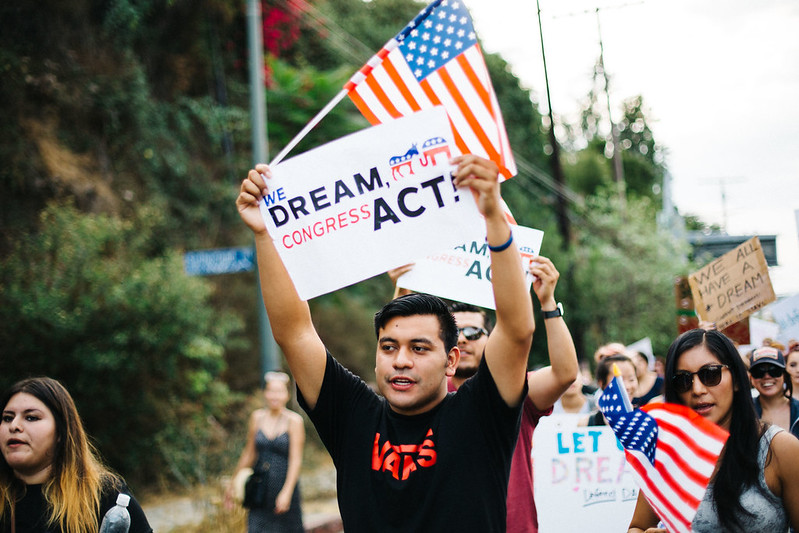
U.S. Congresswoman Sylvia Garcia of the state of Texas is leading a renewed push to create a pathway to citizenship for Deferred Action for Childhood Arrivals (DACA) recipients. Currently, DACA recipients are allowed to renew their DACA benefits but the future of the program remains uncertain.

Following a meeting with the Congressional Hispanic Caucus, Garcia urged President Trump to work with lawmakers on passing the American Dream and Promise Act. This piece of legislation was originally introduced in 2021 and was refiled in 2023, but the bill failed to gain approval from lawmakers.

The bill would give 10-year conditional permanent resident status to qualifying individuals who entered the United States as minors. Eligible candidates must pass background checks, prove that they have continuously lived in the U.S. since 2021, and be enrolled in school or have graduated. Among those who would benefit are those who are deportable or inadmissible, have deferred enforced departure, temporary protected status, or are children of “certain classes of nonimmigrants.”

As of September 2024, there were roughly 538,000 DACA beneficiaries in the United States. Another 3.6 million arrived in the U.S. as children but do not have protections. The Trump administration has remained largely silent on how it will approach the DACA program.

As we watch closely for more concrete developments, we encourage DACA recipients to meet with their attorneys to discuss potential legal avenues. These include employment-based non-immigrant visas, 245(i) eligibility for adjustment of status for those who qualify, and other screening.

Continue reading

ai-generated-8894578_1280The H-1B FY 2026 cap season is now in full swing!

Yesterday, the U.S. Citizenship and Immigration Services (USCIS) formally announced that the initial registration period for the FY 2026 cap season will open on March 7th at noon Eastern time and run through March 24th at noon eastern time.

Those who participated in the FY 2025 H-1B cap season may recall that there was a decrease in the number of registrations submitted (479,953) when compared to FY 2024 (780,884). Of the 479,953 total registrations submitted in FY 2025, only 470,342 were eligible to participate in the lottery.

Additionally, a total of 135,137 registrations were selected in FY 2025, compared to 188,400 in FY 2024.

H-1B FY 2026 Cap Registration Important Dates


  • February: Petitioners and registrants can begin creating H-1B registrant accounts at noon Eastern.
  • March 7: H-1B registration period opens at noon Eastern.
  • March 24: H-1B registration period closes at noon Eastern.
  • March 31: Date by which USCIS intends to notify selected registrants.
  • April 1: The earliest date that FY 2026 H-1B cap-subject petitions based on the registrations selected during the initial FY 2026 selection period may be filed.

FY 2026 Cap Season Highlights


  • FY 2026 H-1B cap petitioners or their representatives must register using their USCIS online accounts by the deadline of March 24th at noon ET to participate in the computer-generated lottery
  • The H-1B registration fee for each electronic registration is $215 U.S. dollars (per beneficiary)
  • H-1B cap selections will not take place until the initial registration period closes, so there is no requirement to register on the day the initial registration period opens
  • Legal representatives and registrations will need to wait until March 7 to enter beneficiary information and submit the registration with the associated fee

For more information about how to create a USCIS online account, please click here.

Continue reading

54160491284_b32055f6df_oAfter years of criticizing the H-1B work visa program, benefitting highly skilled foreign talent, on Saturday the President-elect shocked the world when he pledged his support for the program.

In an interview with the New York Post, Trump said, “I’ve always liked the visas, I have always been in favor of the visas. That’s why we have them,” referring to the H-1B program, which allows U.S. companies to hire foreign workers in specialty occupations.

The President elect went on to say, “I have many H-1B visas on my properties. I’ve been a believer in H-1B. I have used it many times. It’s a great program.”

These comments are a sudden change from Trump’s usual hardline stance on H-1B visas. During his first term in office, Trump passed an executive action known as “Buy American and Hire American,” which restricted access to H-1B visas.

His administration was also responsible for a dramatic increase in the issuance of Requests for Evidence, as well as denials of H-1B worker petitions—a record high when compared to previous administrations.

Since speaking with the media, Trump allies Elon Musk and Vivek Ramaswamy, both made posts on social media vehemently pledging their support for the H-1B visa program.

Continue reading