Articles Posted in CBP

judge-3008038_1280This week, the Justice Department announced that it has hired 36 new immigration judges — 11 permanent and 25 temporary — for the Executive Office for Immigration Review (EOIR), a key agency that handles immigration court proceedings in deportation cases.

What’s happening?


The hiring comes after several months of layoffs among immigration judges occurring earlier this year. In the past 10 months, EOIR fired more than 125 judges, causing delays in immigration court proceedings across the country.

The courts in Massachusetts and Illinois were among the most affected by these departures. The good news is these newly hired judges will begin serving across 16 states nationwide.

Who are the new judges?


  • The permanent hires largely come from federal‑government backgrounds: some from EOIR itself, some from the Department of Homeland Security (DHS), and others who previously trained agents or worked as asylum officers.
  • The temporary hires include military attorneys drawn from the Marines, Navy, Air Force, and Army.
  • These changes accompany a modification in DOJ policy that lowers the qualification requirements for temporary judges—prior immigration law experience is no longer mandatory.

Continue reading

ai-generated-9069946_1280The legal immigration landscape was shaken once again late Friday evening when the President issued a new proclamation barring new H-1B workers from entering the United States—unless their employers pay a $100,000 fee for each sponsored employee.

The proclamation took effect at 12:01 a.m. EDT on Sunday, September 21, and will remain in effect until a court order halts its implementation.

Emergency Litigation


A surge of emergency lawsuits is expected to be filed by impacted H-1B workers and their sponsoring employers, seeking a nationwide injunction to stop the implementation of the executive order. A court could issue an injunction as early as Monday. We will provide litigation updates as they develop in the coming days.

Highlights of the Executive Order


  • Effective today September 21, 2025, certain H-1B workers will be denied entry into the United States unless their employer pays a $100,000 fee on their behalf, according to the proclamation signed by President Trump late Friday.
  • Application: The ban on entry and the associated fee requirement applies only to any new H-1B visa petitions submitted after 12:01 a.m. eastern daylight time on September 21, 2025. This includes the 2026 lottery, and any other H-1B petitions submitted after 12:01 a.m. eastern daylight time on September 21, 2025.
  • The proclamation does not apply to:
    • any previously issued H-1B visas, or any petitions submitted prior to 12:01 a.m. eastern daylight time on Sept. 21, 2025.
    • does not change any payments or fees required to be submitted in connection with any H-1B renewals. The fee is a one-time fee on submission of a new H-1B petition.
    • does not prevent any holder of a current H-1B visa from traveling in and out of the United States.
  • Misuse of B Visas: The proclamation warns that individuals with approved H-1B petitions should not misuse B visas to enter the U.S. for jobs that start before October 1, 2026.
  • National Interest Exemptions: The proclamation grants the Department of Homeland Security authority to issue exemptions for individuals, specific employers, or workers in designated industries—if the agency determines that the H-1B employment serves the national interest and poses no threat to U.S. security or public welfare.
  • Termination: Absent a court order, this restriction will remain in effect for 12 months but may be extended based on recommendations from federal immigration agencies. An extension would continue the ban for individuals approved under the FY 2027 H-1B cap.
  • Changes to the Prevailing Wage: Besides restricting H-1B entry, the proclamation directs the Department of Labor to revise prevailing wage levels and prioritize H-1B approvals to high-skilled, high-paid H-1B workers.

In the hours after the proclamation was issued, chaos unfolded as H-1B visa holders, advised by their employers and legal counsel, abandoned flights and canceled international travel due to uncertainty about how the proclamation would be enforced at the U.S. border.

Adding to the uncertainty was the absence of clear guidance from immigration authorities, including the Department of Homeland Security (DHS) and Customs and Border Protection (CBP), about how the proclamation is to be enforced against current H-1B visa holders and approved beneficiaries.

Continue reading

prison-370112_1280Introducing sweeping changes, U.S. Citizenship and Immigration Services (USCIS) has expanded its role by gaining law enforcement powers previously limited to agencies like Immigration and Customs Enforcement (ICE) and Customs and Border Protection (CBP).

Under a new final rule published today, USCIS will now recruit 1,811-classified special agents—fully empowered officers with authority—to investigate, arrest, and prosecute individuals violating U.S. immigration laws.

What’s Changed?


  • Law Enforcement Authority: The newly designated USCIS special agents are authorized to carry firearms, execute search and arrest warrants, make arrests, and use force—including in pursuit and potentially lethal situations—under standard federal law enforcement protocols.
  • Operational Autonomy: Previously, USCIS investigations—especially those involving criminal violations—were referred to Immigration and Customs Enforcement (ICE).
  • Enforcement Agency: Now, USCIS itself can manage law enforcement investigations from start to finish, including investigating civil and criminal violations within the jurisdiction of USCIS and ordering expedited removal when warranted.

Continue reading

investigation-9604083_1280On June 4, 2025, the Department of Homeland Security (DHS) announced that the agency will expand its efforts to crackdown on visa overstays, due to a recent terrorist attack in Boulder Colorado. The attack was perpetrated by an Egyptian national who had been in the United States unlawfully since overstaying his visa in 2022.

What this Means

  • Swift policy action: Under Secretary of Homeland Security Kristi Noem’s directive, federal partners are now reviewing immigration files more aggressively, identifying visa overstays, and initiating enforcement actions

united-states-8911597_1280After months of speculation and buildup, President Trump’s long-anticipated travel ban has finally arrived.

Issued by executive order on June 4th President Trump’s travel ban entitled “Restricting the Entry of Foreign Nationals to Protect the United States from Foreign Terrorists and Other National Security and Public Safety Threats,” closely mirrors the leaked draft that first surfaced in early March through the New York Times.

That draft hinted at sweeping restrictions targeting so-called “red,” “orange,” and “yellow” countries—coded designations that formed the backbone of President Trump’s proposed directive.

While there are notable differences, as predicted, the administration has framed the ban as a national security measure, but critics argue it remains susceptible to being challenged or overturned through lawsuits that may soon be filed in federal court.

Here’s what you need to know.

President Trump’s travel ban goes into effect today Monday June 9, 2025, at 12:01 am Eastern Daylight time.


Who it Affects


Full Suspension on Nationals from Countries of Concern

The travel ban temporarily suspends the entry of both immigrants and non-immigrants from 12 designated countries who are outside the United States and do not have a valid visa on the effective date of the proclamation, including Afghanistan, Burma, Chad, the Republic of the Congo, Equatorial Guinea, Eritrea, Haiti, Iran, Libya, Somalia, Sudan, and Yemen.

However, several key exceptions apply for lawful permanent residents (LPRs), immediate family members of U.S. citizens, dual nationals, athletes and teams competing in major international sporting events such as the World Cup and the Olympics, and others (a full list of exceptions is provided below).

Continue reading

patty-zavala-TKwGZ9a6YHU-unsplash-scaledThe Department of Homeland Security has announced the implementation of its REAL ID enforcement measures at Transportation Security Administration (TSA) checkpoints nationwide as of May 7th.

Anyone 18 years and older traveling domestically within the United States must have a REAL ID-compliant state-issued driver’s license or another accepted form of identification to board a commercial flight.

According to the agency, 81 percent of travelers are already REAL ID compliant.

airport-8081875_1280On Friday May 9, 2025, President Trump signed executive order “Establishing Project Homecoming,”a new White House initiative aimed at encouraging the voluntary departure of undocumented immigrants from the United States.

This new policy offers financial incentives and logistical support to those who facilitate self-deportation, with the stated goal of reducing the fiscal and social burdens associated with deportation to prioritize funding for Americans in need.

Key Provisions of Project Homecoming:

  • Free Government-Funded Flights:Undocumented immigrants are offered complimentary flights to any country willing to accept them, excluding the United States.This service is accessible through the government’s new “CBP Home” mobile application and at participating airport
  • $1,000 Exit Bonus: Individuals who voluntarily and permanently depart the U.S. under this program are allegedly eligible to receive a $1,000 “exit bonus” upon successful relocation.
  • Concierge Travel Assistance: A government-provided concierge service is available at airports to assist individuals, even those lacking valid travel documents from their home countries, in booking flights and navigating the voluntary departure process.

Continue reading

boeing-159589_1280A new article published in the New York Times reveals the 43 countries that are reportedly included in President Trump’s new travel ban, expected to be released by executive order on Friday March 21st.

According to anonymous government sources, the White House is considering a draft proposal establishing partial or full suspensions on entry to the United States for countries falling into three different tiers: red, orange, and yellow.

The “red” list of countries includes nationals whose entry to the United States would be barred for a temporary period that is yet to be determined by the U.S. government including:

  • Afghanistan
  • Bhutan
  • Cuba
  • Iran
  • Libya
  • North Korea
  • Somalia
  • Sudan
  • Syria
  • Venezuela and
  • Yemen

The draft proposal also includes an “orange” list of countries whose nationals would not be barred from the United States, but who must be properly vetted and screened at mandatory in-person visa interviews before gaining admission to the United States.

Continue reading

36774192170_fde8cf078d_c

Source: Flickr
Attribution mollyktadams

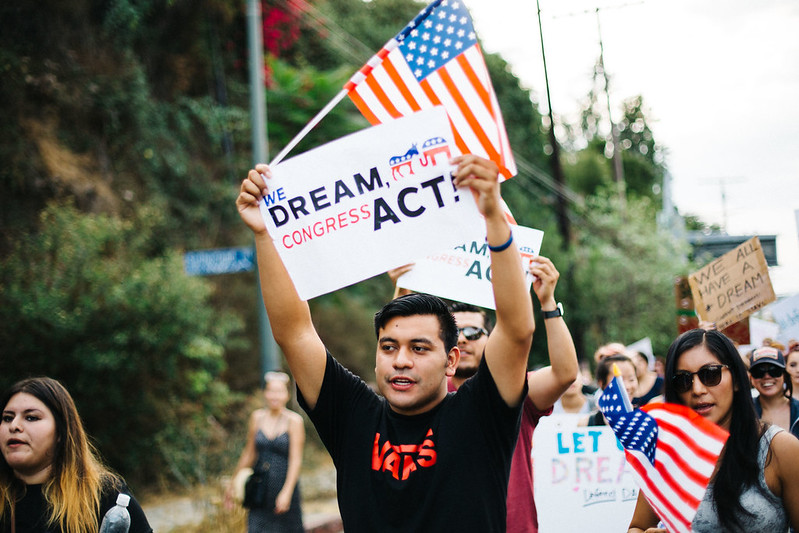
U.S. Congresswoman Sylvia Garcia of the state of Texas is leading a renewed push to create a pathway to citizenship for Deferred Action for Childhood Arrivals (DACA) recipients. Currently, DACA recipients are allowed to renew their DACA benefits but the future of the program remains uncertain.

Following a meeting with the Congressional Hispanic Caucus, Garcia urged President Trump to work with lawmakers on passing the American Dream and Promise Act. This piece of legislation was originally introduced in 2021 and was refiled in 2023, but the bill failed to gain approval from lawmakers.

The bill would give 10-year conditional permanent resident status to qualifying individuals who entered the United States as minors. Eligible candidates must pass background checks, prove that they have continuously lived in the U.S. since 2021, and be enrolled in school or have graduated. Among those who would benefit are those who are deportable or inadmissible, have deferred enforced departure, temporary protected status, or are children of “certain classes of nonimmigrants.”

As of September 2024, there were roughly 538,000 DACA beneficiaries in the United States. Another 3.6 million arrived in the U.S. as children but do not have protections. The Trump administration has remained largely silent on how it will approach the DACA program.

As we watch closely for more concrete developments, we encourage DACA recipients to meet with their attorneys to discuss potential legal avenues. These include employment-based non-immigrant visas, 245(i) eligibility for adjustment of status for those who qualify, and other screening.

Continue reading

donald-2911302_1280La administración Trump planea revocar la libertad condicional CHNV dejando a miles sin estatus legal


En un sorprendente giro, CBS News ha publicado nueva información sobre planes inminentes de la administración Trump para revocar el estatus legal de aquellos a quienes se les concedió un permiso de permanencia temporal en el país a base de los programas para los cubanos, haitianos, nicaragüensens, y venezolanos (conocidos como CHNV).

Se estima que más de 530,000 cubanos, haitianos, nicaragüenses y venezolanos se encuentran actualmente en los EE. UU. bajo estos programas.

¿Qué es la permanencia temporal CHNV?


El programa de permanencia temporal CHNV fue promulgado por primera vez en 2023 por la administración Biden. Al igual que el programa de permanencia temporal de “Unidos por Ucrania,” los ciudadanos de los países que calificaban (Cuba, Haití, Nicaragua y Venezuela) debían tener un patrocinador en los EE. UU., pasar verificaciónes de seguridad, y cumplir con otros criterios para obtener la admisión a los EE. UU.

A los admitidos se les concedió la entrada a los EE. UU. por un período temporal de hasta dos años, incluyendo la capacidad de solicitar autorización de empleo temporal con el Servicio de Ciudadanía e Inmigración de los EE. UU. (USCIS).

Después de la orden ejecutiva firmada por el Presidente Trump titulada “Asegurando Nuestras Fronteras,” el dia 28 de enero USCIS dejó de aceptar el Formulario I-134A, solicitud para ser patrocinador para estos programas de permanencia temporal a la espera de revisiones adicionales.

Esta fue la primera señal de problemas para el programa CHNV. También vale la pena destacar que la página web de permanencia temporal CHNV ya no está disponible en el sitio web de USCIS.

Aviso del DHS Para Revocar CHNV


Según documentos internos del gobierno revisados ​​por CBS News, el Departamento de Seguridad Nacional pronto publicará un aviso en el Registro Federal poniendo un fin a los programas de permanencia temporal de CHNV y revocando el estado de permanencia temporal de todos a quienes se les concedió la entrada a los Estados Unidos bajo los programas de permanencia temporal de CHNV.

Estas personas serán sometidas a un proceso de deportación si no tienen ningún otro fundamento legal para permanecer en el país.

Qué significa esto:

  • Aquellos cuya clasificación de permanencia temporal sea revocada y que no tengan otro estatus migratorio, serán inmediatamente inelegibles para permanecer en los Estados Unidos y ya no podrán trabajar de manera legal.
  • Deportaciones aceleradas: El Departamento de Seguridad Nacional ha ampliado los procedimientos de deportación acelerada, dirigidos a personas sin estatus legal
  • Vías legales alternativas: aquellos en los EE. UU. bajo permanencia temporal CHNV deben explorar vías legales alternativas para permanecer en los EE. UU. o prepararse para partir.

Continue reading