Articles Posted in Criminal Convictions

donald-2911302_1280Trump Administration Plans Revocation of CHNV Parole Leaving Thousands Without Legal Status


In a shocking turn of events, new information has been released by CBS News about the Trump administration’s imminent plans to revoke the legal status of those who were granted humanitarian parole under the Cuba, Haiti, Nicaragua, and Venezuela (CHNV) humanitarian parole programs.

It is estimated that more than 530,000 Cubans, Haitians, Nicaraguans and Venezuelans are currently in the U.S. under these programs.

What is CHNV Parole?


The CHNV parole program was first enacted in 2023 by the Biden administration. Much like the Uniting for Ukraine parole program, nationals from qualifying countries (Cuba, Haiti, Nicaragua, and Venezuela) were required to have a U.S.-based supporter, pass enhanced security vetting, and meet other criteria to gain admission to the U.S.

Those admitted were granted entry to the U.S. for a temporary period of up to two years, including the ability to apply for temporary employment authorization with the U.S. Citizenship and Immigration Services (USCIS).

Following President Trump’s day one executive order entitled, “Securing Our Borders,” on January 28th USCIS stopped the acceptance of Form I-134A, Online Request to be a Supporter and Declaration of Financial Support, for these parole programs pending further review. This was the first sign of trouble for the CHNV program. The CHNV parole webpage is no longer available on the USCIS website.

DHS Notice to Revoke CHNV


According to internal government documents reviewed by CBS News, the Department of Homeland Security will soon publish a notice in the Federal Register terminating the CHNV parole programs and revoking the parole status of all who were granted entry to the United States under the CHNV humanitarian parole programs.

Such individuals will be placed in removal proceedings if they do not have any other lawful basis to remain in the country.

What this means: 

  • Those whose parole classification is revoked, and who lack another immigration status, will be immediately ineligible to remain in the United States, and can no longer work on a lawful basis.
  • Accelerated Deportations: The Department of Homeland Security has expanded expedited removal procedures, targeting individuals without permanent legal status
  • Alternative Legal Pathways: those in the U.S. under CHNV parole must explore alternative legal avenues to remain in the U.S. or prepare to depart

Continue reading

american-flag-2054414_1280This week President Trump unleashed a fresh barrage of executive orders targeting illegal immigration and antisemitism in the United States.

Executive Order Expanding Migration Operations at Guantánamo Bay


Among these orders, on January 29th the President signed, “Expanding Migration Operations Center at Naval Station Guantánamo Bay,” unveiling his administration’s plans to use a migrant holding facility at the U.S. naval base in Guantánamo Bay, Cuba, to house more than 30,000 migrants deported from the United States.

The White House has said the naval station will soon be operating at its full capacity to detain “high priority” criminal aliens unlawfully present in the United States, and to “address attendant immigration enforcement needs,” identified by the Department of Defense and the Department of Homeland Security.

Immigration advocates have questioned the optics of this decision due to Guantánamo Bay’s sordid history. Once a processing center for asylum seekers and HIV-positive refugees, it has been well known for its detainment of notorious terrorists and unlawful enemy combatants such as the 9/11 mastermind Khalid Sheikh Mohammed. This decision has raised alarm due to Guantanamo’s unfit conditions and frequent human rights violations reported to international human rights organizations.

Despite these criticisms, the White House has said that deported migrants held in Guantánamo will not be detained in the same U.S. military prison where foreign terrorists are being held. Instead, migrants will be placed in a separate holding facility previously used to detain migrants intercepted at sea.

Continue reading

library-of-congress-jPN_oglAjOU-unsplash-scaledIt has been less than 24 hours since President Donald Trump has taken office, and he has already signed into law a flurry of executive orders directly impacting immigration.

More than a dozen of these executive orders dismantle Biden era immigration policies, and usher in restrictive policies for visa seekers, asylum applicants, and undocumented immigrants.

The swift issuance of these executive orders signals a tough political climate ahead for immigration, and what is sure to be a continuance of the Trump administration’s hardline stance on immigration.

While some of these executive orders may face legal challenges, here is a summary of all the executive orders affecting immigration issued on day one of Trump’s presidency.


Executive Order: President Trump’s America First Priorities


President Trump’s first executive order entitled “President Trump’s America First Priorities,” states the following as top priorities of his administration, which touch upon immigration.

  • President Trump promises to take “bold action” to secure the U.S. border and protect communities by calling on the U.S. Armed Forces and National Guard to assist with border security
  • At the President’s direction, the State Department will have an “America-First” foreign policy
  • Ends Biden’s Catch-and-Release Policies

What it is: Catch-and-release authorized the release of individuals without legal status from detention while awaiting immigration court hearings.

  • Reinstates Remain in Mexico Policy

What it is: Known formerly as the Migrant Protection Protocol, this policy will require certain asylum seekers at the southern border to wait in Mexico for their hearings in U.S. immigration court.

  • Continues the construction of his southern border wall with Mexico
  • Prohibits asylum for individuals who have crossed the border illegally

What it is: Aims to end asylum and close the border to those without legal, to facilitate a more immediate removal process

  • Cracks down on U.S. sanctuary cities
  • Enhanced vetting and screening of noncitizen aliens seeking admission to the U.S.

What it is: The President will direct agencies to report recommendations for the suspension of entry for nationals of any country of particular concerns.

  • Expands deportation operations for aliens with a criminal record
  • Suspends the refugee resettlement program
  • Designates cartels such as the “Tren de Aragua” as foreign terrorist organizations and calls for their removal by using the Alien Enemies Act
  • Calls on the Department of Justice to implement the death penalty for illegal immigrants “who maim and murder” Americans and commit “heinous crimes”

Continue reading

ai-generated-8775948_1280Last month, San Diego’s Board of Supervisors passed a resolution ending the use of county resources aiding federal immigration enforcement actions.

The measure was made ahead of President Trump’s inauguration and puts an end to the cooperation between law enforcement agencies and Immigration and Customs Enforcement (ICE). Previously, local law enforcement agencies cooperated with ICE officials by facilitating the transfer of detainees to ICE custody and notifying ICE of their release from custody to aid in their removal from the United States.

In response to San Diego’s actions, the America First Legal Foundation (founded by Trump advisor Stephen Miller) issued a letter to 249 elected officials including the Chair of San Diego’s Board of Supervisors, Nora Vargas. In the letter, the organization warned Vargas that she could be subject to criminal prosecution and civil liability for what the organization considered to be “obstruction” of federal immigration law.

48554137807_fa4094864c_e

Source: Flickr Creative Commons Attribution Gage Skidmore

A estas alturas ya habrás visto los titulares de las noticias. Ahora analicemos la nueva acción ejecutiva histórica del Presidente Biden sobre inmigración y vayamos al meollo de todo lo que necesitas saber sobre esta orden diseñada para mantener unidas a las familias y brindar más oportunidades a los Dreamers.


Proceso para Promover la Unidad y Estabilidad de las Familias– Legalización de cónyuges Indocumentados de Ciudadanos Estadounidenses


Hoy, 18 de junio de 2024, el Presidente Biden anunció un nuevo proceso que permitirá la protección y legalización de los cónyuges indocumentados de ciudadanos estadounidenses que hayan residido en los Estados Unidos durante al menos diez años a partir del 17 de junio de 2024.

En virtud de la autoridad ejecutiva del Presidente, el Departamento de Seguridad Nacional (DHS), en coordinación con los Servicios de Ciudadanía e Inmigración de los Estados Unidos (USCIS), crearán un nuevo programa discrecional de “permanencia temporal” para que los cónyuges indocumentados de ciudadanos estadounidenses legalicen su estatus mientras permaneciendo en los Estados Unidos.

Aquellos que sean aprobados después de la evaluación caso por caso de su solicitud por parte del DHS tendrán un período de tres años para solicitar la residencia permanente. A los elegibles se les permitirá permanecer con sus familias en los Estados Unidos y ser elegibles para una autorización de trabajo por hasta tres años.

Las personas deben cumplir ciertos requisitos de elegibilidad para convertirse en residentes permanentes legales (titulares de tarjeta verde) bajo este nuevo proceso,

A continuación se encuentran respuestas a preguntas frecuentes sobre esta orden ejecutiva.


Q: ¿Cuáles son los requisitos para que los cónyuges sean elegibles para solicitar el permiso de permanencia temporal y legalizar su estatus en los Estados Unidos?


Para ser considerado caso por caso para una concesión discrecional de permiso de permanencia temporal en virtud de este proceso, una persona debe:

  • Estar presente en Estados Unidos sin admisión ni permiso de permanencia temporal;
  • Haber estado presente continuamente en Estados Unidos durante al menos 10 años a partir del 17 de junio de 2024; y
  • Tener un matrimonio legalmente válido con un ciudadano estadounidense a partir del 17 de junio de 2024
  • No tener antecedentes penales que lo descalifiquen o de otra manera constituir una amenaza a la seguridad nacional o la seguridad pública y
  • Merecer un ejercicio favorable de discreción para recibir permiso de permanencia temporal

Continue reading

48554137807_fa4094864c_e

Source: Flickr Creative Commons Attribution Gage Skidmore

By now you’ve seen the headlines in the news. Now let us break down President Biden’s historic executive action on immigration and get to the nitty gritty of everything you need to know about this order designed to keep families together and provide further opportunities for Dreamers.


Process to Promote the Unity and Stability of Families – Legalization of Undocumented Spouses of U.S. Citizens


Today, June 18, 2024, President Biden announced a new process that will allow for the legalization of undocumented spouses of U.S. Citizens who have been residing in the United States for at least ten years as of June 17, 2024.

By virtue of the President’s executive authority, the Department of Homeland Security (DHS) in coordination with the U.S. Citizenship and Immigration Services (USCIS) will create a new discretionary “parole in place” program for undocumented spouses of U.S. Citizens to legalize their status while remaining in the United States.

Those who are approved after DHS’s case-by-case assessment of their application will be afforded a three-year period to apply for permanent residency. They will be allowed to remain with their families in the United States and be eligible for work authorization for up to three years.

Individuals must meet certain eligibility requirements to become lawful permanent residents (green card holders).

Below are answers to frequently asked questions regarding this executive order. 


Q: What are the requirements for spouses to be eligible to apply for parole and legalize their status in the United States?


To be considered for a discretionary grant of parole in place under this process, spouses of U.S. Citizens must:

  • Be present in the United States without admission or parole;
  • Have been continuously present in the United States for at least 10 years as of June 17, 2024; and
  • Have a legally valid marriage to a U.S. citizen as of June 17, 2024
  • Have no disqualifying criminal history or otherwise constitute a threat to national security or public safety and
  • Merit a favorable exercise of discretion to receive parole

Q: Are Noncitizen Children of Undocumented Spouses eligible for parole?


Yes. In addition to undocumented spouses of U.S. Citizens, their noncitizen children may also be considered for parole on a case-by-case basis under this process along with their parent, if they are:

  • Physically present in the United States without admission or parole and
  • Have a qualifying stepchild relationship with a U.S. citizen parent as defined by the Immigration and Nationality Act as of June 17, 2024

To qualify as a stepchild under the Immigration and Nationality Act, the noncitizen child must be unmarried, under the age of 21, and the marriage of their noncitizen parent and U.S. citizen stepparent must have taken place prior to the child’s 18th birthday.


Q: How is this new parole program different from the current laws in place?


This new “parole in place” program will eliminate the need for spouses of U.S. Citizens to travel outside of the United States to legalize their status through what is known as an extreme hardship “waiver” process.

The “waiver” process is an extremely cumbersome and lengthy process that requires the undocumented spouse to depart the United States and be interviewed and approved for an immigrant visa overseas. Only once the visa is issued can the applicant return to the United States.

This process has unnecessarily torn families apart and created much fear and uncertainty among applicants forced to remain away from their families for prolonged periods of time. Many applicants are the sole providers for their families and take care of children with disabilities, making this process extremely difficult to bear.

This executive action will instead open a pathway to permanent residence by allowing eligible undocumented spouses of U.S. Citizens to adjust their status to permanent residence while in the United States, without requiring them to depart the country.

Continue reading

florida-890553_1280A new week brings new immigration news. Recently, a federal judge issued a temporary injunction blocking part of a Florida law that imposes criminal penalties on those who transport undocumented immigrants into the state of Florida, classifying such actions as felonies.

The order was made in response to a lawsuit filed by the Farmworker Association of Florida and seven individuals who feared traveling in and out of the state of Florida with undocumented friends and family members due to Florida’s controversial law.

In his ruling, Judge Roy Altman indicated that the Florida law is likely unconstitutional because the supremacy clause places the regulation of immigrants under the purview of the federal government.

In his preliminary order, the judge stated that Florida’s law is preempted by the federal government, “By making it a felony to transport into Florida someone who ‘has not been inspected by the federal government since his or her unlawful entry,’ [the law] extends beyond the state’s authority to make arrests for violations of federal immigration law and, in so doing, intrudes into territory that’s preempted.”

The judge further stated that any harm created by the injunction is outweighed by the harm suffered by the plaintiffs and the federal government. As a result, the Florida law will be halted until the judge rules on the merits of the case.

Continue reading

courthouse-1223279_1280The federal government has sued the state of Oklahoma in a new lawsuit seeking to block HB 4156 from taking effect, a new anti-immigration law that regulates the entry of noncitizens by detaining and fining migrants who are unlawfully present in the state.

The U.S. government filed the lawsuit in the U.S. District Court for the Western District of Oklahoma on May 21st arguing that HB 4156 is unconstitutional because the federal government maintains exclusive jurisdiction over the subject of immigration and the status of noncitizens under the supremacy clause and foreign commerce clause of the U.S. Constitution.

Oklahoma’s HB 4156 which was slated to take effect July 1st considers the unlawful presence of a noncitizen in the state to be an “impermissible occupation” and directs law enforcement officials to arrest and jail undocumented immigrants.

The law aims to protect the state’s citizens against undocumented immigrants who could “potentially harm” its residents. Under the law, a first conviction would be a misdemeanor punishable by up to a year in county jail and a $500 fine. A second conviction would rise to a felony and carry a sentence of up to two years in county jail and a $1,000 fine.

Those convicted would be required to leave the state of Oklahoma within three days of being released from county jail.

In attempting to enforce this law, the Justice Department argues that the state is circumventing established law and constitutional authority by trying to take matters into its own hands.

Continue reading

36774192170_fde8cf078d_z

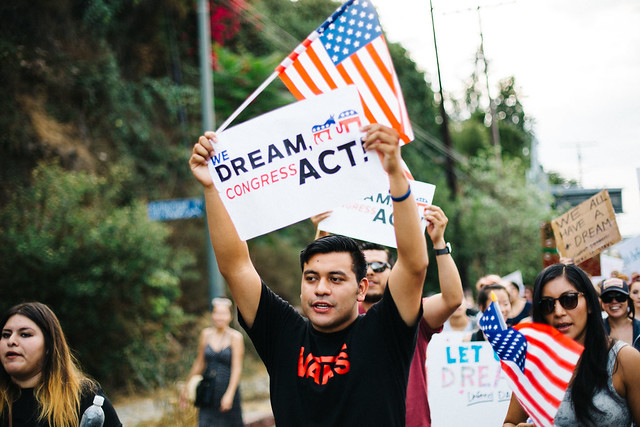
Welcome back to Visalawyerblog! In this post, we are breaking down Biden’s new immigration reform proposal which was recently introduced before Congress. The new proposal, also known as the U.S. Citizenship Act of 2021, is groundbreaking because it creates an earned path to citizenship for undocumented immigrants who arrived in the United States on or before January 1, 2021.

While this piece of legislation is still just a bill, it is opening the door for further dialogue from members of Congress and provides a unique window into what a final bill on immigration reform might look like.


How exactly does one “earn” their citizenship with this bill?


Undocumented immigrants who came to the United States on or before January 1, 2021, who can prove that they do not have a criminal record, and are not otherwise ineligible, would be eligible to secure something called “lawful prospective immigrant status” or “LPI” under this new bill.

Essentially, “LPI” would be a provisional temporary type of status that would allow undocumented immigrants to remain in the United States lawfully for a six-year period of time. This provisional status would act as a “gateway” to allow undocumented immigrants to apply for permanent residence and citizenship in the future.

Under the bill, eligible applicants would be granted “LPI” status for a 6-year period, and within that period of provisional status, immigrants would then be eligible to apply for permanent residence after 5 years. After 3 years of being in green card status, such immigrants would then be eligible to apply for U.S. Citizenship.

All applicants would be required to pass background checks and pay taxes under the law.


Would LPI immigrants be able to travel in and out of the country?


Yes. LPI immigrants would be eligible to receive employment authorization and advance parole that would allow them to work and travel in and out of the country.

Additionally, LPI immigrants would be protected from deportation while their applications for LPI would be pending with immigration.


Are there special provisions for DACA recipients, TPS eligible immigrants, and farm workers?


Yes. Under the bill, those with DACA, individuals eligible for TPS, and farm workers with a demonstrated work history would be exempted from the “LPI” provisional status and would be permitted to apply for permanent residence directly without having to wait 5 years to apply for permanent residence, through an expedited “fast track” type of processing.

All others, however, would need to first obtain LPI status and then after 5 years apply for a green card.

Continue reading

bill-oxford-udXD2NrbXS8-unsplash

Last week, the United States Citizenship and Immigration Services (USCIS) updated its policy manual to clarify acts that may prevent a naturalization applicant from meeting the good moral character requirement.

A successful naturalization applicant must show that they have been, and continue to be a person of good moral character during the statutory period prior to filing the application for naturalization and up until taking the Oath of Allegiance. The statutory period is generally give years for permanent residents of the United States, three years for applicants married to U.S. citizens, and one year for certain applicants applying on the basis of qualifying U.S. military service.

Two or more DUI Convictions

Firstly, the policy manual clarifies that two or more DUI convictions during the statutory period could affect an applicant’s good moral character determination (Matter of Castillo-Perez). However, applicants with two or more DUI convictions may be able to overcome this presumption by presenting evidence that they had good moral character even during the period within which they committed the DUI offenses.

DUI refers to all state and federal impaired-driving offenses, including driving while intoxicated, operating under the influence, and other offenses that make it unlawful for an individual to operate a motor vehicle while impaired.

Post-Sentencing Orders

Secondly, the policy manual clarifies the definition of “term of imprisonment or a sentence” to mean, an alien’s original criminal sentence, without regard to post-sentencing changes. Post-sentencing orders that change a criminal alien’s original sentence are only relevant for immigration purposes if they are based on a procedural or substantive defect in the underlying criminal proceeding.

Furthermore, the policy guidance provides the following as examples of unlawful acts recognized by case law as barring good mood character (this list is not exhaustive):

Continue reading