Articles Posted in Nonimmigrant Visas

woman-g16621ff47_1920

In this blog post we share very exciting news for H-1B and L visa holders working in the United States.

The State Department is planning to resume the process of domestic visa revalidation in certain categories, like H-1B and L-1 visas, through the launch of a new pilot program that will soon be implemented later this year, specifically benefitting H-1B specialty occupation workers and L-1 visa holders who are currently required to travel abroad for renewal of their visas.

This move will restore stateside visa renewals, a practice that was previously discontinued by the government in 2004. Previously, certain categories of non-immigrant visa holders, particularly H-1B workers, could renew their visas and be stamped domestically while inside the United States. However, the government stopped allowing domestic renewal of these visas, requiring foreign workers to go out of the country and make an appointment at a U.S. Embassy or Consulate in their home country to receive an H-1B extension stamped in their passport.

The pilot program when fully implemented will benefit H-1B and L-1 workers allowing them to receive their stamping inside the United States without having to leave the country. This will help reduce the visa backlogs at U.S. Embassies and Consulates worldwide.

Additionally, the pilot program will potentially benefit tens of thousands of foreign workers, especially technology workers from India, where Consular operations are some of the busiest in the world.

Continue reading

border-g740e70764_1280

USCIS Updates Policy Manual Clarifying Physical Presence Requirement for Asylees and Refugees


The U.S. Citizenship and Immigration Services (USCIS) recently updated its Policy Manual to clarify that BOTH asylees and refugees must have been physically present in the United States for one year at the time the Immigration Officer adjudicates their Form I-485, Application to Register Permanent Residence or Adjust Status, rather than at the time the individual files their adjustment of status application.

This policy is effective immediately and applies to all Form I-485 Applications to Register Permanent Residence or Adjust Status and Form N-400, Applications for Naturalization, that are pending on February 2, 2023, and applications filed on or after that date.


What does this mean?


This means that in order to be eligible for adjustment of status (a green card), an asylee or refugee must have been physically present in the United States for at least 1 year after either being granted asylum status or admitted as a refugee.

Additionally, the policy manual:

  • Provides that asylees and refugees are required to accrue 1 year of physical presence by the time of adjudication of the adjustment of status application, rather than by the time they file the application (and that USCIS may request additional information to determine such physical presence in the United States).
  • Clarifies that asylee and refugee adjustment applicants who have held the immigration status of exchange visitor (J-1 or J-2 nonimmigrants) and who are subject to the 2-year foreign residence requirement under INA 212(e) are not required to comply with or obtain a waiver of such requirement in order to adjust status under INA 209.
  • Makes technical updates, including clarifying processing steps for refugees seeking waivers of inadmissibility and removing references to the obsolete Decision on Application for Status as Permanent Resident (Form I-291).
  • Provides that USCIS considers a refugee or asylee who adjusted status to a permanent resident despite filing for adjustment before accruing 1 year of physical presence to have been lawfully admitted for permanent residence for purposes of naturalization if the applicant satisfied the physical presence requirement at the time of approval of the adjustment of status application.

Continue reading

spin-wheel-g87d245642_1280

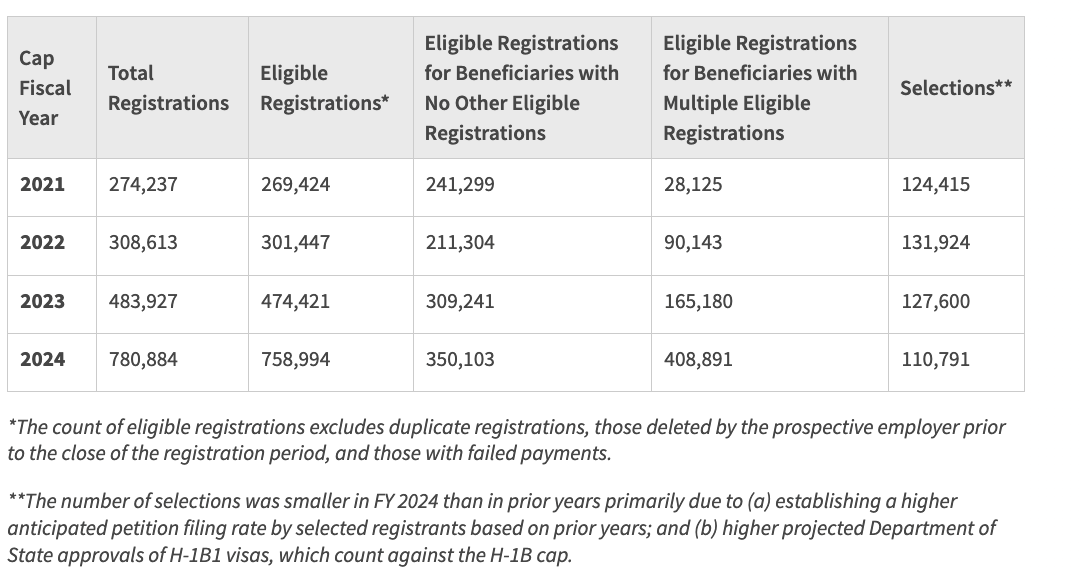
It’s that time of the year again. The H-1B cap season for FY 2024 will soon be in full swing.

USCIS has just announced that the H-1B initial registration period for the FY 2024 cap is scheduled to open at noon ET on March 1, 2023 and will remain open until noon ET on March 17, 2023.

Prospective petitioners (also known as registrants), and their authorized representatives, who are seeking authorization to employ H-1B workers subject to the cap, must complete an electronic registration process on their myUSCIS online account to receive a chance at selection. The registration process is simple and easy, requesting only basic information about the prospective petitioner and each requested worker.

The H-1B FY 2024 selection process will be based off properly submitted electronic registrations. Only those with selected registrations will be eligible to file H-1B cap-subject petitions.

That means that in order to have a chance of being selected, all prospective petitioners and their authorized representatives seeking to file H-1B cap-subject petitions for FY 2024, including for beneficiaries eligible for the advanced degree exemption, must first register during the registration period (March 1, 2023, to March 17, 2023) and pay the associated $10 registration fee for each beneficiary.

Continue reading

Welcpuzzle-g75f3e575f_1920ome back to Visalawyerblog! We hope you had a wonderful holiday break and wish you a prosperous new year ahead.

We kick off the new year with some important updates in the world of immigration.

Today, the United States Citizenship and Immigration Services (USCIS) officially announced a Notice of Proposed Rulemaking (NPRM) that will be posted in the Federal Register tomorrow Wednesday, January 4, 2023 that will increase filing fees for certain types of immigration benefits. An unpublished version is already available in the Federal Register.

A 60-day public comment period will follow the publication of the NPRM on January 4, 2023 and will close on March 5, 2023.

Fees will not change until the final rule goes into effect, and only after the public has had the opportunity to comment and USCIS finalizes the fee schedule in response to such public comments. USCIS will host a public engagement session on the proposed fee rule on January 11, 2023.

According to USCIS, the proposed fee increases are necessary to ensure that the agency will have enough resources to provide adequate services to applicants and petitioners moving forward. The agency has said that after having conducted a review of current fees, it has determined that it cannot cover the full cost of providing adjudication and naturalization services without a fee increase.

The agency cited the COVID-19 pandemic as one of the factors leading the agency to increase its fees. As you may recall, the pandemic caused a dramatic reduction in the filing of new applications, leaving USCIS with a substantial decrease in revenues of 40 percent. This unfortunate drop in applications led USCIS to reduce its workforce accordingly.

With current resources, the agency has said it is incapable of adjudicating applications in a timely manner, when considering that agency caseloads are now returning to pre-pandemic levels.

Among the new proposals included in the NPRM are measures that:

  • Incorporate biometrics costs into the main benefit fee and remove the separate biometric services fee
  • Require separate filing fees for Form I-485 and associated Form I-131 and Form I-765 filings
  • Establish separate fees for Form I-129, Petition for Nonimmigrant Worker, by nonimmigrant classification.
  • Revise the premium processing timeframe interpretation from 15 calendar days to 15 business days
  • Create lower fees for certain immigration forms filed online.

Continue reading

happy-birthday-gc71254c11_1920

Welcome back to Visalawyerblog! We hope you had a wonderful Christmas break with your families.

In this blog post, we share a new update from the State Department regarding the continuation of its interview waiver policy for certain nonimmigrant visa types.

In a new announcement, the Secretary of State has revealed that it is extending its interview waiver policy for certain nonimmigrant visa types until December 31, 2023, allowing Consular officers to continue to waive the in-person interview requirement for certain classes of immigrants.


What is the extension all about?


As you might recall back in December of last year, the State Department first announced its interview waiver policy for temporary workers applying for H-1, H-3, H-4, L, O, P, and Q visas in their country of nationality or residence, following USCIS approval of their petitions.

The State Department has now confirmed it will continue its interview waiver policy until at least the end of 2023.


Who qualifies?


Interview Waiver Policy for H, L, O, P, Q visas


Pursuant to the interview waiver policy, Consular officers have the discretion to waive the visa interview requirement for:

  • individual petition-based H-1, H-3, H-4, L, O, P, and Q applicants who were previously issued any type of visa, and that have not had any visa refusal or ineligibility issues in the past OR
  • first-time individual petition-based H-1, H-3, H-4, L, O, P, and Q who are citizens or nationals of a country that participates in the Visa Waiver Program (VWP), provided that they have no ineligibility issues and have previously traveled to the United States using an authorization obtained via the Electronic System for Travel Authorization (ESTA)

Continue reading

board-g893a3f402_1920

Welcome to the start of a brand-new week. In a recent announcement, the U.S. Customs and Border Protection (CBP) Carrier Liaison Program, revealed that United States visas issued at all U.S. embassies and consulates worldwide will now have a new look.

Foreign nationals seeking to visit, work, or remain temporarily in the United States must apply for U.S. visas at foreign consulates or embassies overseas. Once a U.S. visa has been approved following the in-person visa interview, consulates stamp and issue the U.S. visa in the applicant’s foreign passport.

Previously, U.S. visas were printed with the image of Abraham Lincoln, but now U.S. visas will debut a new design.

To ensure the security of documents and protect against counterfeiting, the government has said it will begin issuing new visa foils in the year 2023, replacing the prior image of Abraham Lincoln with the iconic San Francisco Golden Gate Bridge. These new visas are referred to as “Bridge” visa foils. Visas with the new “Bridge” foil are expected to be rolled out as early as 2023.

According to CBP’s announcement:

  • The U.S. has begun issuing a new Bridge visa foil
  • This is a redesigned visa foil that will replace the Lincoln visa.
  • As each consular posts depletes Lincoln visa stock, they will begin to issue Bridge visas.
  • All Lincoln visas will remain valid until the printed expiration date, unless revoked or canceled.
  • The Lincoln visas that will gradually be phased out were first issued in 2022.
  • Revisions to visa designs make altering and counterfeiting more difficult, officials state.

Continue reading

pumpkin-g0b3c427b5_1920

We kick off the Thanksgiving week with some exciting news.

Recently, the American Immigration Lawyers Association (AILA) met with representatives from the Department of State to address some issues of concern relating to several different immigration topics.

We provide a summary of the questions asked and responses from the Department of State down below that was part of a recent roundtable with representatives from Consular Affairs.


Nonimmigrant and Immigrant Visa Applications from Third Country Nationals


Representatives reminded nonimmigrant visa applicants, including students, that they can apply for their visas at any embassy or consulate where they are physically present and obtain a visa appointment.

Additionally, immigrant visa applicants can request to transfer their case to another embassy or consulate if they are unable to travel to the post where their case is assigned.

As to the possibility for virtual visa interviews, the State Department has said immigrant visa applicants are required to appear in person before a consular officer to provide fingerprints, therefore video interviews would be of limited utility.


Interview Waivers


AILA informed the State Department that it appears that some appointment scheduling systems incorrectly identify applicants that are clearly not eligible for interview waivers as eligible and invite them to send in their passports for visa issuance.

In these instances, once the passport is submitted to the post, it is determined that the applicant is not eligible for an interview waiver, the applicant has to be contacted, their passport has to be returned, and they have to then schedule an in-person interview appointment.

The State Department has said it is not aware of this issue happening at posts and recommended that those experiencing issues with applications submitted via interview waiver processes should contact the relevant post for information.


E-2 Treaty Investor Visas  


Question: 9 FAM 402.9-6(A)(a)(4) informs officers that one of the determinations in evaluating E-2 Treaty Investor applications is that the: “Enterprise is a real and operating commercial enterprise,” and is then referred to 9 FAM 402.9-6(C) for further discussion.

The first sentence of 9 FAM 402.9-6(C) states: “The enterprise must be a real and active commercial or entrepreneurial undertaking, producing some service or commodity.” The third sentence of 9 FAM 402.9-6(C) continues the description of the enterprise to state, “It cannot be a paper organization or an idle speculative investment…”Especially in the context of start-up businesses, defining these terms will provide greater clarity and guidance to E-2 visa applicants.

Please confirm: Are the words “operating” at 402.9-6(A)(a)(4) and “active” at 402.9-6(C) used interchangeably?

Answer: Almost. The term “active” at 402.9-6(C) was used to ensure that new enterprises that had not yet begun producing services or commodities, but which were actively taking steps to become operational, could also provide a basis for E visa issuance.

Continue reading

world-g6a890258f_1280

In this blog post, we share with you the list of countries whose nationals are eligible to participate in the H-2A and H-2B visa programs next year.

By law, DHS has the authority to update the eligible countries lists at any time by publishing a notice in the Federal Register, if the agency determines that a country fails to meet the requirements for continued designation.

The H-2A and H-2B visa programs enable U.S. employers to bring foreign nationals to the United States to fill temporary agricultural and nonagricultural jobs, respectively.

USCIS approves H-2A and H-2B petitions only for nationals of countries that the secretary of homeland security has designated as eligible to participate in the programs. However, USCIS may approve H-2A and H-2B petitions, including those that were pending as of the date of publication of the Federal Register Notice, for nationals of countries not on the lists on a case-by-case basis only if doing so is determined to be in the interest of the United States.

Continue reading

a-book-g7ca408570_1920

In this blog post, we bring you some unfortunate news. Recently, the U.S. Department of Education announced that it will no longer recognize the Accrediting Council for Independent Colleges and Schools (ACICS) as an accrediting agency.

Sadly, this means that certain F-1 student visa applicants will be impacted by this change, including those undertaking an English language study program. The U.S. Citizenship and Immigration Services has said that such programs are required to be accredited under the Accreditation of English Language Training Programs Act.

Additionally, this change will impact F-1 students applying for a 24-month science, technology, engineering and mathematics (STEM) optional practical training (OPT) extension, because government regulations now require use of a degree from an accredited, Student and Exchange Visitor Program (SEVP) certified school to receive a STEM OPT extension.

The regulations make clear that the school must be accredited at the time of the application (the date of the designated school official’s (DSO) recommendation on the Form I-20, Certificate of Eligibility for Nonimmigrant Student Status).


What happens next?


Students who have been impacted by this change will receive notification letters from SEVP informing them that their schools’ certification has been withdrawn.

USCIS has said that students who are enrolled at an ACICS-accredited school should contact their DSOs immediately to understand how this loss of accreditation will impact their status and/or immigration benefits.

To make matters worse, schools accredited by ACICS will not be able to issue program extensions, and students will only be allowed to finish their current session if the ACICS-accredited school chooses to voluntarily withdraw its certification or if is withdrawn by SEVP.

If a student’s ACICS-accredited school can provide evidence of a Department of Education recognized accrediting agency or evidence in lieu of accreditation within the allotted timeframe, the student may remain at the school to complete their program of study.


Requests for Evidence Imminent for I-539 Extend/Change of Status


The U.S. Citizenship and Immigration Services (USCIS) will be issuing requests for evidence (RFEs) to individuals who filed Form I-539, Application to Extend/Change Nonimmigrant Status, on or after August 19, 2022, requesting a change of status or reinstatement to attend an ACICS-accredited English language study program.

Once the individual receives the RFE, they will be given the opportunity to provide evidence in response, such as documentation showing that the English language study program they are seeking to enroll in meets the accreditation requirements.

If the student does not submit a new Form I-20 from a school accredited by an entity recognized by the Department of Education, USCIS will deny a change of status or reinstatement request.

Continue reading

together-gc428d3cbf_1920

Our readers will be happy to know that the Department of State has released a new update in the month of October on the status of worldwide consular visa operations.

The COVID-19 pandemic caused a period of uncertainty and created tremendous backlogs at the Consular level. As most of you will remember, Consular missions around the world suspended routine visa services in March of 2020 to combat the rapid spread of COVID-19. Later, the Department of State announced a phased resumption of routine visa services, however some Consulates and Embassies resumed services faster than others. Since then, things have slowly but surely started to turn around.

To help improve visa processing, the State Department has said that worldwide visa operations are now recovering faster than expected. More U.S. foreign service personnel have been hired to reduce visa interview wait times at Consular posts worldwide. It is expected that this year, the Department of State will reach pre-pandemic processing levels. This is amazing news for immigrants that have been waiting for visa interview appointments for months, or even years.


How did COVID-19 impact Worldwide Visa Operations?


The COVID-19 pandemic impacted the agency’s ability to process visa applications in two major ways.

First, restrictions on travel to the United States, social distancing, and local quarantine restrictions made it difficult to accommodate large groups of people inside Consular facilities, such as waiting rooms. This of course reduced the number of people that could be scheduled for in-person visa appointments dramatically, causing a reduction in the number of visa applications that could be processed.

Secondly, due to the suspension of visa services worldwide, the State Department experienced a substantial decrease in funding which led to a declining workforce in 2020 and 2021. This dramatically impacted the number of applications that could be processed.

Continue reading