Articles Posted in Immigration Fraud

prison-370112_1280Introducing sweeping changes, U.S. Citizenship and Immigration Services (USCIS) has expanded its role by gaining law enforcement powers previously limited to agencies like Immigration and Customs Enforcement (ICE) and Customs and Border Protection (CBP).

Under a new final rule published today, USCIS will now recruit 1,811-classified special agents—fully empowered officers with authority—to investigate, arrest, and prosecute individuals violating U.S. immigration laws.

What’s Changed?


  • Law Enforcement Authority: The newly designated USCIS special agents are authorized to carry firearms, execute search and arrest warrants, make arrests, and use force—including in pursuit and potentially lethal situations—under standard federal law enforcement protocols.
  • Operational Autonomy: Previously, USCIS investigations—especially those involving criminal violations—were referred to Immigration and Customs Enforcement (ICE).
  • Enforcement Agency: Now, USCIS itself can manage law enforcement investigations from start to finish, including investigating civil and criminal violations within the jurisdiction of USCIS and ordering expedited removal when warranted.


Continue reading

statue-9782657_1280On Tuesday, August 19th, U.S. Citizenship and Immigration Services (USCIS) issued updated policy guidance clarifying that immigration officers will assess a range of factors when determining whether to grant a favorable exercise of discretion in the green card process—signaling a tougher stance that may create additional hurdles for applicants seeking approval.

Even where a person has met all eligibility requirements for a green card, officers are required to conduct a discretionary analysis to determine whether an application should be approved. This exercise of discretion involves weighing positive factors against negative ones and considering the totality of the circumstances of each applicant’s case.

Among these factors, immigration officers will need to consider the “[legality of] past requests for parole,” “any involvement in anti-American or terrorist organizations,” and “evidence of antisemitic activity,” which are counted as negative factors weighing against a favorable exercise of discretion.

This guidance is also meant to provide clearer guidance to immigration officers on the “substantial negative discretionary weight” that should be given in cases where an individual has “endorsed, promoted, supported, or otherwise espoused the views of a terrorist organization or group.” This includes those supporting or promoting anti-American sentiments, antisemitic terrorism, terrorist groups with antisemitic agendas, or antisemitic beliefs.

Continue reading

the-now-time-KXUKLB-_Sb0-unsplash-scaledOn August 1st the U.S. Citizenship and Immigration Services (USCIS) announced new policies that could make immigrants applying for green cards through family-based petitions more vulnerable to deportation.

The changes appear in various updates to USCIS’ Policy Manual which states that immigration officials can begin removal proceedings for immigrants who lack legal status and apply to become permanent residents through family-based petitions.

According to the Policy Manual, “if USCIS determines the alien beneficiary is removeable and amenable to removal from the United States, USCIS may issue a Notice to Appear (NTA) [in immigration court] placing the beneficiary in removal proceedings. Petitioners and alien beneficiaries should be aware that a family-based petition accords no immigration status nor does it bar removal.”

The new policy went into effect immediately and applies to pending requests for a green card, and those filed on or after August 1st.

While the practical impact of this policy is yet to be seen, it provides immigration officials with more discretion to initiate removal proceedings even where a green card application is pending with USCIS, for those who entered the U.S. illegally, overstayed a U.S. visa, or otherwise failed to maintain their legal status.

These policy changes underscore the importance of maintaining underlying legal status throughout the green card process. Those who lack legal status or who lost their status during the green card process may be most at risk.

Continue reading

judge-7602999_1280Last week the United States Citizenship and Immigration Services (USCIS) released a new policy memorandum that requires the agency to initiate removal proceedings after it denies an application for an immigration benefit, if the foreign national is no longer lawfully present in the United States.

Importantly, the memo exempts certain individuals including beneficiaries of employment-based petitions, but it does not exempt dependent family members.

The memorandum also broadens USCIS’s authority to begin removal proceedings for certain foreign nationals with previous criminal charges, arrests, or convictions.

It is effective immediately.

How will USCIS implement this policy?


Under this policy, USCIS will initiate removal proceedings against a foreign national by issuing a Notice to Appear (NTA) after it has denied an application for an immigration benefit, if the foreign national no longer has a lawful basis to remain in the United States.

The issuance of a Notice to Appear (NTA) commences removal (deportation) proceedings in immigration court. Those who are issued an NTA must appear on the scheduled date before a judge who will decide whether the foreign national has a lawful basis to remain in the country or should be removed.

Traditionally, Notices to Appear (NTAs) have been issued by Immigration Customs and Enforcement (ICE) and Customs and Border Protection (CBP) officials.

However, USCIS also has the authority to issue NTAs in limited circumstances defined in policy memorandums issued by the agency.

Continue reading

library-of-congress-jPN_oglAjOU-unsplash-scaledIt has been less than 24 hours since President Donald Trump has taken office, and he has already signed into law a flurry of executive orders directly impacting immigration.

More than a dozen of these executive orders dismantle Biden era immigration policies, and usher in restrictive policies for visa seekers, asylum applicants, and undocumented immigrants.

The swift issuance of these executive orders signals a tough political climate ahead for immigration, and what is sure to be a continuance of the Trump administration’s hardline stance on immigration.

While some of these executive orders may face legal challenges, here is a summary of all the executive orders affecting immigration issued on day one of Trump’s presidency.


Executive Order: President Trump’s America First Priorities


President Trump’s first executive order entitled “President Trump’s America First Priorities,” states the following as top priorities of his administration, which touch upon immigration.

  • President Trump promises to take “bold action” to secure the U.S. border and protect communities by calling on the U.S. Armed Forces and National Guard to assist with border security
  • At the President’s direction, the State Department will have an “America-First” foreign policy
  • Ends Biden’s Catch-and-Release Policies

What it is: Catch-and-release authorized the release of individuals without legal status from detention while awaiting immigration court hearings.

  • Reinstates Remain in Mexico Policy

What it is: Known formerly as the Migrant Protection Protocol, this policy will require certain asylum seekers at the southern border to wait in Mexico for their hearings in U.S. immigration court.

  • Continues the construction of his southern border wall with Mexico
  • Prohibits asylum for individuals who have crossed the border illegally

What it is: Aims to end asylum and close the border to those without legal, to facilitate a more immediate removal process

  • Cracks down on U.S. sanctuary cities
  • Enhanced vetting and screening of noncitizen aliens seeking admission to the U.S.

What it is: The President will direct agencies to report recommendations for the suspension of entry for nationals of any country of particular concerns.

  • Expands deportation operations for aliens with a criminal record
  • Suspends the refugee resettlement program
  • Designates cartels such as the “Tren de Aragua” as foreign terrorist organizations and calls for their removal by using the Alien Enemies Act
  • Calls on the Department of Justice to implement the death penalty for illegal immigrants “who maim and murder” Americans and commit “heinous crimes”

Continue reading

recruitment-6838250_1280New changes are being implemented for certain self-petitioners filing immigration petitions under the Violence Against Women Act, also known as VAWA.

The U.S. Citizenship and Immigration Services (USCIS) has announced that beginning in December they will be conducting in-person interviews for select VAWA self-petitioners who have an I-360 and I-485 application pending.

Not all self-petitioners will be required to attend an interview. Self-petitioners who have filed a stand-alone I-360 will not be interviewed.

USCIS expects to continue to adjudicate the majority of VAWA cases without the need for an interview.


Why has this change been made?


An increase in the volume of immigration petitions filed under the VAWA program, along with a surge in VAWA-related fraud reported in the states of New York, Massachusetts, and Maryland has led to this policy change.

While no plans are currently being made to expand interviews to a broader pool of VAWA self-petitioners, the incoming Trump administration may consider this in the future.


How will I know if I am required to attend an in-person interview?


VAWA self-petitioners who are required to attend an interview, will receive an interview notice by mail at the safe address they have provided. Legal representatives will also be notified by mail.

Please note that a self-petitioner’s selection for an interview is not a negative indicator and does not suggest a case will receive an unfavorable outcome.

Continue reading

traffic-signs-464641_1280In this blog post we bring you some breaking news.

On Friday August 2, 2024, the Biden administration announced that it has paused the humanitarian parole program for nationals of Cuba, Haiti, Nicaragua, and Venezuela, effective immediately due to concerns regarding fraudulent filings and potential abuse of the program.

This means that the Department of Homeland Security (DHS) will temporarily pause the issuance of travel authorizations for new beneficiaries of the program seeking parole, while the agency implements additional security screenings and vets U.S. supporters who sponsor qualifying nationals to arrive in the United States.

While sponsors can still submit the Form I-134A Declaration of Support on the USCIS webpage, these applications will not be approved until further notice.

Only once new safeguards have been put in place, the agency will restart the processing of applications.

Please note that foreign nationals who have already been admitted through the program, will not be impacted by the pause.


Why was the Parole Program paused?


DHS officials have said that it stopped processing new parole applications in mid-July due to an internal report that highlighted potential abuse by U.S.-based sponsors, such as the filing of multiple applications from a single sponsor.

The Federation for American Immigration Reform (FAIR) obtained a copy of the report and released a statement of the findings which shows that thousands of I-134A declarations were filed containing fraudulent information, such as fake Social Security Numbers (SSNs), as well as SSNs belonging to deceased individuals, the use of false phone numbers, and filings using the same physical address.

According to the statement, “Some 100 addresses were listed on over 19,000 forms, and many parole applicants applied from a single property (including a mobile park home, warehouse, and storage unit). In addition, many applications were submitted by the same IP address…the same exact answers to Form I-134A questions were provided on hundreds of applications – in some instances, the same answer was used by over 10,000 applicants.”

These concerns have led the government to put in place further mechanisms to prevent such abuse.

Continue reading

audit-4576720_1280

If you are an EB-5 investor in a Regional Center project, you may be interested to learn of new information released by the U.S. Citizenship and Immigration Services (USCIS) regarding Regional Center audits.

In March 2022, with the passage of the EB-5 Reform and Integrity Act of 2022, Congress implemented new reforms designed to increase the oversight of Regional Centers to prevent fraud and abuse within the immigrant investor program.

Among these fraud prevention mechanisms, USCIS established the EB-5 Integrity Fund, funded by annual regional center fees and immigrant petition fees, to detect and investigate fraud and other crimes related to the program, ensure compliance, conduct regional center audits (every five years) and site visits (for each new NCE or JCE).

USCIS recently released information confirming that the agency must audit each designated regional center at least once every five years.


What is done during a Regional Center audit?


Audits are performed during a site visit which include a review of documentation required to be maintained by the regional center and a review of the flow of immigrant investor capital into any capital investment project.

Effective April 23rd audits will be utilizing the Generally Accepted Government Auditing Standards, also known as the Yellow Book. The Yellow Book provides standards and guidance for auditors and audit organizations.


What is the purpose of Regional Center audits?


Regional center audits are conducted to strengthen the integrity of the EB-5 program by verifying information in regional center applications, annual certifications, and associated investor petitions.

Continue reading

growth-g45a2536b3_1920

This Friday afternoon, we share with you some interesting new insights revealed by the U.S. Citizenship and Immigration Services regarding the recent H-1B electronic registration period for fiscal year 2024.

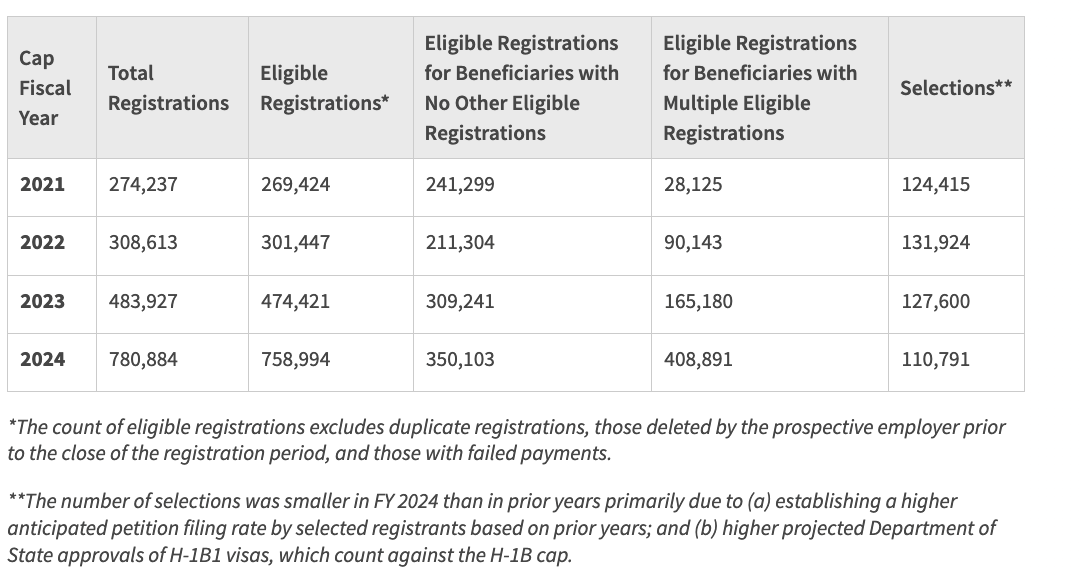
USCIS has disclosed that this H-1B season, it received 758,994 eligible registrations for FY 2024, breaking its previous record of 474,421 eligible registrations just the previous year.

This represents a 60% increase in eligible registrations, with 284,573 more registrants in comparison to last year’s H-1B season.

In terms of actual selections, USCIS selected a total of 110,791 registrations to meet the annual H-1B numerical cap of 85,000 visas this H-1B season. When crunching the numbers, registrants had about a 14.6% chance of being selected, when compared to last year when the chance of selection sat at 26.9%.

This H-1B season, USCIS saw a dramatic increase in the number of registrations submitted, in comparison to prior years. Across the board, there was also an increase in the number of registrations submitted on behalf of beneficiaries with multiple registrations, and the number of registrations submitted on behalf of unique beneficiaries with only one registration. USCIS saw upward trends in the FY 2022 and FY 2023 H-1B registration periods as well.

From looking at the chart below for H-1B fiscal years 2021-2014, one can see that the competition has become greater and greater for H-1B visas year by year, however FY 2024 stands out in particular as the most competitive H-1B season overall.


This chart shows registration and selection numbers for fiscal years 2021-2024 (as of April 24, 2023).

https://www.visalawyerblog.com/files/2023/04/Screen-Shot-2023-04-28-at-6.22.17-PM.png


Specifically, the selection rate this H-1B season was significantly lower than all previous H-1B seasons. According to USCIS, there were fewer registrations selected this season, because of higher demand for Chile/Singapore H-1B visa (cap-exempt), and projections showing a higher rate of filings from employers whose registrations were selected in the cap lottery.

Continue reading

joakim-honkasalo-DurC25GdOvk-unsplash-1-scaled

A brand-new bill called the H-1B and L-1 Visa Reform Act of 2020 (S. 3770) sponsored by Republican Senator Chuck Grassley has recently surfaced. As you might have already guessed, the bill seeks to make changes to the current H-1B and L visa programs to reduce fraud and abuse within the H-1B and L visa programs, provide protections for American workers, and enforce stricter requirements for the recruitment of foreign workers. The H-1B visa program is aggressively targeted in this new piece of legislation.


Proposed Changes to the H-1B visa program


First, as it relates to the H-1B visa worker program, the bill proposes changes to existing wage requirements.

The law would require employers to pay the highest wage from three categories:

1) the locally determined prevailing wage level for the occupational classification in the area of employment

2) the median average wage for all workers in the occupational classification in the area of employment; or

3) the median wage for skill level 2 in the occupational classification found in the most recent OES survey.

Second, the bill would make changes to current law and require U.S. employers seeking to hire H-1B workers to publish job postings on a website established by the Department of Labor. After filing the labor condition application, the employer would be required to post the job on the website for at least 30 calendar days. The job posting would have to include a detailed description of the position, including the wages and other terms and conditions of employment, minimum education, training, experience, and other requirements for the position, as well as the process for applying for the position.

Third, all H-1B employers would be required to prove that they have tried to recruit American workers for jobs offered to H-1B workers. Under current law, only H-1B dependent employers (those with more than 50 full time employees of which at least 15% are H-1B employees) are required to recruit American workers for H-1B positions. This would be a drastic change in the law creating additional burdens for U.S. employers seeking to hire foreign workers with specialized skills.

Continue reading