Articles Posted in Immigrant Visas

staff-6779620_1280We bring you this breaking news to inform our readers that the Trump administration has ordered U.S. Embassies and Consulates worldwide to begin the process of firing its staff members and has taken further actions to dramatically change the operations of the foreign service moving forward.

The U.S. foreign service is the diplomatic branch of the Department of State that is responsible for representing U.S. interests abroad. This includes the issuance of U.S. visas at U.S. Consulates and Embassies worldwide.

These changes have been made in response to President Trump’s executive order entitled, “One Voice for America’s Foreign Relations,” signed on February 12th.

The President’s executive order calls upon the Department of State headed by Marco Rubio to make dramatic changes to the way foreign U.S. Consulates and Embassies operate.

This includes making the following changes:

  • Consular officers and employees must faithfully implement the President’s foreign policies
  • Failure to implement the President’s agenda will be grounds for professional discipline, which may result in firing Consular personnel
  • The Secretary of State will change the foreign service to better align with the President’s foreign policy agenda
  • These reforms include making changes to the recruitment, performance, evaluation, and retention standards of foreign service employees including U.S. Consular officers
  • The Secretary of State will make revisions and replacements to the Foreign Affairs Manual (FAM). The Foreign Affairs Manual (FAM) is an authoritative source used by Consular officers when issuing U.S. visas at Consulates and Embassies worldwide
  • The Secretary of State will direct subordinate agencies to remove, amend, or replace any handbooks, procedures, or guidance which are used by Consular officials when issuing U.S. visas at posts worldwide

Continue reading

painting-1292226_1280-1We are pleased to report that today the U.S. Department of State’s Bureau of Consular Affairs published the March 2025 Visa Bulletin.

In this blog post, we breakdown the movement of the employment-based and family-sponsored categories in the coming month.


USCIS Adjustment of Status


For employment-based preference categories, the U.S. Citizenship and Immigration Services (USCIS) has confirmed it will continue to use the Final Action Dates chart to determine filing eligibility for adjustment of status to permanent residence in the month of March.

For family-sponsored preference categories, USCIS will also continue to use the Dates for Filing chart to determine filing eligibility for adjustment of status to permanent residence in the month of March.

Please click here for more information.


Highlights of the March 2025 Visa Bulletin


At a Glance

What can we expect to see in the month of March?

Employment-Based Categories

Dates for Filing


  • No change from previous month 

Final Action Advancements & Retrogressions


EB-2 Members of the Professions and Aliens of Exceptional Ability

  • EB-2 India will advance by more than six weeks to December 1, 2012
  • EB-2 China will advance by two weeks to May 8, 2020
  • EB-2 All other countries will advance by six weeks to May 15, 2023

EB-3 Professionals and Skilled Workers

  • EB-3 India will advance by almost seven weeks to February 1, 2013
  • EB-3 China will advance by one month to August 1, 2020

EB-3 Other Workers

  • EB-3 India will advance by almost seven weeks to February 1, 2013
  • EB-3 Philippines will advance by five weeks to January 15, 2021
  • EB-3 All other countries will advance by almost two months to February 1, 2021

EB-4 Religious Workers

  • EB-4 All countries retrogressed by seventeen months to August 1, 2019 

Continue reading

36774192170_fde8cf078d_c

Source: Flickr
Attribution mollyktadams

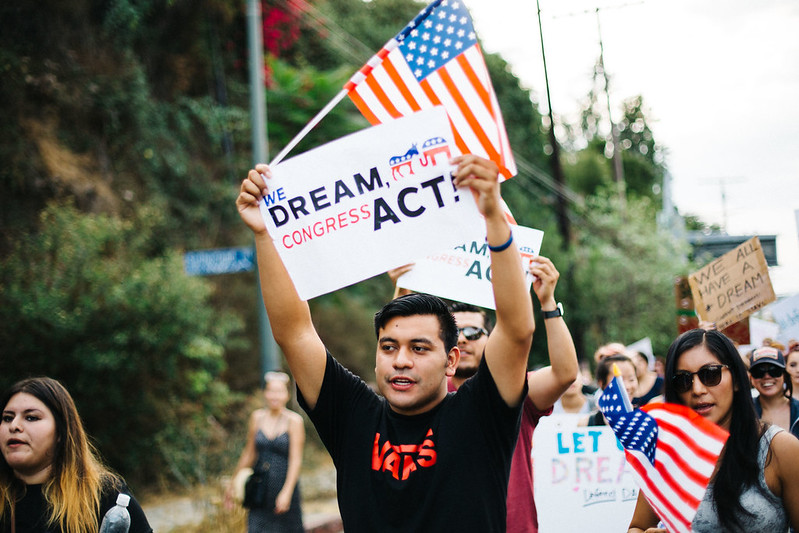
U.S. Congresswoman Sylvia Garcia of the state of Texas is leading a renewed push to create a pathway to citizenship for Deferred Action for Childhood Arrivals (DACA) recipients. Currently, DACA recipients are allowed to renew their DACA benefits but the future of the program remains uncertain.

Following a meeting with the Congressional Hispanic Caucus, Garcia urged President Trump to work with lawmakers on passing the American Dream and Promise Act. This piece of legislation was originally introduced in 2021 and was refiled in 2023, but the bill failed to gain approval from lawmakers.

The bill would give 10-year conditional permanent resident status to qualifying individuals who entered the United States as minors. Eligible candidates must pass background checks, prove that they have continuously lived in the U.S. since 2021, and be enrolled in school or have graduated. Among those who would benefit are those who are deportable or inadmissible, have deferred enforced departure, temporary protected status, or are children of “certain classes of nonimmigrants.”

As of September 2024, there were roughly 538,000 DACA beneficiaries in the United States. Another 3.6 million arrived in the U.S. as children but do not have protections. The Trump administration has remained largely silent on how it will approach the DACA program.

As we watch closely for more concrete developments, we encourage DACA recipients to meet with their attorneys to discuss potential legal avenues. These include employment-based non-immigrant visas, 245(i) eligibility for adjustment of status for those who qualify, and other screening.

Continue reading

donald-2911302_1280Trump Administration Plans Revocation of CHNV Parole Leaving Thousands Without Legal Status


In a shocking turn of events, new information has been released by CBS News about the Trump administration’s imminent plans to revoke the legal status of those who were granted humanitarian parole under the Cuba, Haiti, Nicaragua, and Venezuela (CHNV) humanitarian parole programs.

It is estimated that more than 530,000 Cubans, Haitians, Nicaraguans and Venezuelans are currently in the U.S. under these programs.

What is CHNV Parole?


The CHNV parole program was first enacted in 2023 by the Biden administration. Much like the Uniting for Ukraine parole program, nationals from qualifying countries (Cuba, Haiti, Nicaragua, and Venezuela) were required to have a U.S.-based supporter, pass enhanced security vetting, and meet other criteria to gain admission to the U.S.

Those admitted were granted entry to the U.S. for a temporary period of up to two years, including the ability to apply for temporary employment authorization with the U.S. Citizenship and Immigration Services (USCIS).

Following President Trump’s day one executive order entitled, “Securing Our Borders,” on January 28th USCIS stopped the acceptance of Form I-134A, Online Request to be a Supporter and Declaration of Financial Support, for these parole programs pending further review. This was the first sign of trouble for the CHNV program. The CHNV parole webpage is no longer available on the USCIS website.

DHS Notice to Revoke CHNV


According to internal government documents reviewed by CBS News, the Department of Homeland Security will soon publish a notice in the Federal Register terminating the CHNV parole programs and revoking the parole status of all who were granted entry to the United States under the CHNV humanitarian parole programs.

Such individuals will be placed in removal proceedings if they do not have any other lawful basis to remain in the country.

What this means: 

  • Those whose parole classification is revoked, and who lack another immigration status, will be immediately ineligible to remain in the United States, and can no longer work on a lawful basis.
  • Accelerated Deportations: The Department of Homeland Security has expanded expedited removal procedures, targeting individuals without permanent legal status
  • Alternative Legal Pathways: those in the U.S. under CHNV parole must explore alternative legal avenues to remain in the U.S. or prepare to depart

Continue reading

family-6719424_1280Are you applying for adjustment of status to lawful permanent residence (a green card)?

If so, you will be pleased to know that on January 22, 2025, the U.S. Citizenship and Immigration Services (USCIS) announced that it is waiving any and all requirements for the COVID-19 vaccination on the Form I-693, Report of Immigration Medical Examination and Vaccination Record.

As a result, adjustment of status (green card) applicants will no longer be required to present evidence that they have received the COVID-19 vaccination.

USCIS will also not deny any adjustment of status application based on an applicant’s failure to present documentation that they received the COVID-19 vaccination.

Due to this new policy, USCIS will no longer issue any Request for Evidence (RFE) or Notice of Intent to Deny (NOID) related to proving a COVID-19 vaccination.

Continue reading

library-of-congress-jPN_oglAjOU-unsplash-scaledIt has been less than 24 hours since President Donald Trump has taken office, and he has already signed into law a flurry of executive orders directly impacting immigration.

More than a dozen of these executive orders dismantle Biden era immigration policies, and usher in restrictive policies for visa seekers, asylum applicants, and undocumented immigrants.

The swift issuance of these executive orders signals a tough political climate ahead for immigration, and what is sure to be a continuance of the Trump administration’s hardline stance on immigration.

While some of these executive orders may face legal challenges, here is a summary of all the executive orders affecting immigration issued on day one of Trump’s presidency.


Executive Order: President Trump’s America First Priorities


President Trump’s first executive order entitled “President Trump’s America First Priorities,” states the following as top priorities of his administration, which touch upon immigration.

  • President Trump promises to take “bold action” to secure the U.S. border and protect communities by calling on the U.S. Armed Forces and National Guard to assist with border security
  • At the President’s direction, the State Department will have an “America-First” foreign policy
  • Ends Biden’s Catch-and-Release Policies

What it is: Catch-and-release authorized the release of individuals without legal status from detention while awaiting immigration court hearings.

  • Reinstates Remain in Mexico Policy

What it is: Known formerly as the Migrant Protection Protocol, this policy will require certain asylum seekers at the southern border to wait in Mexico for their hearings in U.S. immigration court.

  • Continues the construction of his southern border wall with Mexico
  • Prohibits asylum for individuals who have crossed the border illegally

What it is: Aims to end asylum and close the border to those without legal, to facilitate a more immediate removal process

  • Cracks down on U.S. sanctuary cities
  • Enhanced vetting and screening of noncitizen aliens seeking admission to the U.S.

What it is: The President will direct agencies to report recommendations for the suspension of entry for nationals of any country of particular concerns.

  • Expands deportation operations for aliens with a criminal record
  • Suspends the refugee resettlement program
  • Designates cartels such as the “Tren de Aragua” as foreign terrorist organizations and calls for their removal by using the Alien Enemies Act
  • Calls on the Department of Justice to implement the death penalty for illegal immigrants “who maim and murder” Americans and commit “heinous crimes”

Continue reading

martin-luther-king-180477_1280At the Law Offices of Jacob J. Sapochnick, we are proud to honor the life and legacy of Martin Luther King Jr. who once said, “injustice anywhere is a threat to justice everywhere.” His endless pursuit for justice, and the belief that we are all created equal continue to inspire the world.

As we reflect on his words and actions, let us remember that the fight for justice is ongoing. We are committed to representing our clients each and every day to help build a more diverse and inclusive America. Today, we reflect on the future of American society, and what it means to stand up for what is right.

In observance of this historic day, our office will be closed. We will reopen on Tuesday January 21, 2025. We look forward to serving you.

engineer-4922781_1280On January 15, 2025, the U.S. Citizenship and Immigration Services (USCIS) released updated police guidance for EB-2 National Interest Waiver petitions.

The updated policy guidance is effective immediately and applies to requests pending or filed on or after its publication date of January 15.

This guidance provides insights into how USCIS officials will determine eligibility for NIW petitions for employment-based immigrants, who are seeking a waiver of the job offer requirement, and thus labor certification.

Updated Policy Highlights


  • Clarifies that a petitioner seeking a national interest waiver must first demonstrate qualification for the underlying EB-2 classification, as either a member of the professions holding an advanced degree, or an individual of exceptional ability in the sciences, arts, or business.
  • Explains that USCIS considers on a case-by-case basis whether the occupation in which the person proposes to advance an endeavor is a profession and, if applicable, whether the 5 years of post-baccalaureate experience is in the specialty, noting that it is the petitioner’s burden to establish each element of eligibility.
  • Clarifies that USCIS determines the relationship between exceptional ability and the proposed endeavor on a case-by-case basis, considering any shared skillsets, knowledge, or expertise.
  • Provides additional guidance, with examples, about how USCIS evaluates whether a proposed endeavor has national importance.
  • Explains how USCIS evaluates evidence such as letters of support and business plans, when determining whether a person is well positioned to advance an endeavor.
  • Clarifies, with examples, that not every entrepreneur qualifies for a national interest waiver. While USCIS decides each case on its merits, broad assertions regarding general benefits to the economy and potential to create jobs will not establish an entrepreneur’s qualification for a national interest waiver.
  • Explains that, as with all adjudications, USCIS evaluates all of the evidence in the aggregate, and that the list of suggested evidence for entrepreneurs is not intended to suggest that any one piece, by itself, necessarily establishes eligibility. USCIS reviews all of the person’s education, experience, and skills and the benefit to the national interest when determining eligibility.

Continue reading

passport-159592_1280We are pleased to report that today the U.S. Department of State’s Bureau of Consular Affairs published the February 2025 Visa Bulletin.

In this blog post, we breakdown the movement of the employment-based and family-sponsored categories in the coming month.


USCIS Adjustment of Status


For employment-based preference categories, the U.S. Citizenship and Immigration Services (USCIS) has confirmed it will use the Final Action Dates chart to determine filing eligibility for adjustment of status to permanent residence in the month of February.

For family-sponsored preference categories, USCIS will use the Dates for Filing chart to determine filing eligibility for adjustment of status to permanent residence in the month of February.

Please click here for more information.


Highlights of the February 2025 Visa Bulletin


At a Glance

What can we expect to see in the month of February?

Employment-Based Categories

Dates for Filing


  • No change from previous month 

Final Action Advancements


EB-2 Members of the Professions and Aliens of Exceptional Ability

  • EB-2 India will advance by two weeks to October 15, 2012

EB-3 Professionals and Skilled Workers

  • EB-3 India will advance by two weeks to December 15, 2012
  • EB-3 China will advance by one month to July 1, 2020

EB-3 Other Workers

  • EB-3 India will advance by two weeks to December 15, 2012

Continue reading

donald-trump-2789735_1280We are just 14 days away from Donald Trump’s presidential inauguration, setting the stage for a new era in the world of immigration.

The President’s border czar Tom Homan is set to be one of the key players of the incoming Trump administration, in charge of securing our nation’s borders. Homan was the former acting director of Immigration and Customs Enforcement (ICE) during the first Trump administration, and was a key contributor of Project 2025, a conservative political agenda.

On Sunday night, Tom Homan appeared on CBS News’s, “Face the Nation” where he was asked about his plans to carry out the largest deportation operation in history, during a time when deportations have already been at a record high under President Biden.

Homan responded by criticizing the Biden administration’s deportation record, stating that 80 percent of the deportation numbers were from Border Patrol arrests, and not interior enforcement arrests carried out by Immigration and Customs Enforcement (ICE).

When asked whether Trump’s deportation numbers would come from arresting and deporting people within the interior of the United States versus securing the southern border, Homan deflected instead focusing on Biden’s dismal track record on border security.

He was further questioned about the Trump administration’s deportation plans on day one, including whether ICE plans to conduct workplace raids across the nation to remove undocumented immigrants from the country.

Continue reading